Proteinuria Reduction and Cardiovascular and Mortality Outcomes in Chronic Kidney Disease: Evidence Across the CKM Continuum
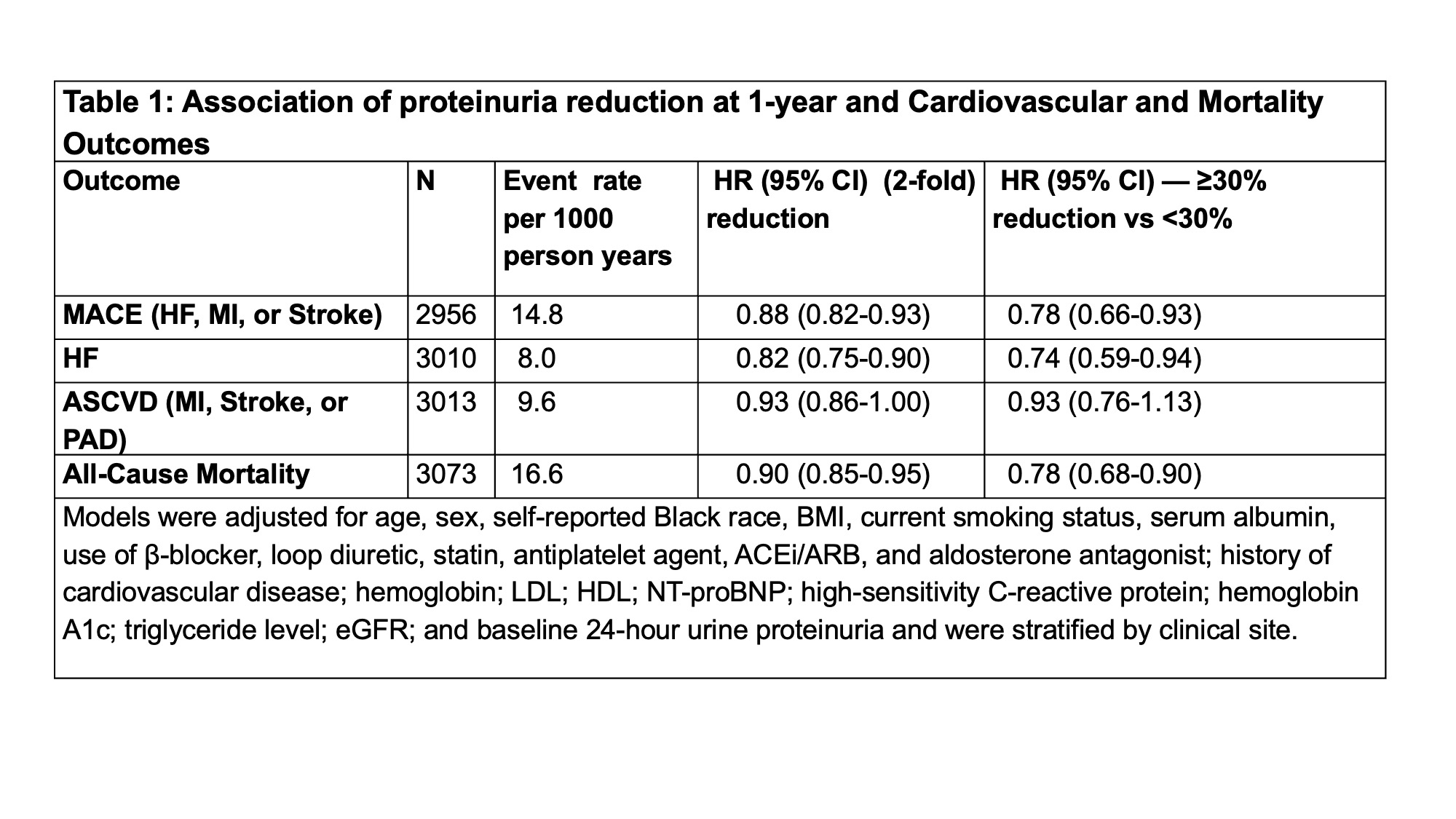

Abstract Body: Introduction: Proteinuria reduction has consistently been associated with improved kidney outcomes in chronic kidney disease (CKD). However, whether reduction in proteinuria also translates into lower risk of specific cardiovascular outcomes remains less well established. We aimed to evaluate the association between 1-year change in proteinuria and subsequent risks of cardiovascular and mortality outcomes in CKD. Hypothesis: We hypothesized that greater reduction in proteinuria over one year would be independently associated with cardiovascular outcomes, irrespective of diabetes status. Methods: We studied 3,073 participants with established CKD in the Chronic Renal Insufficiency Cohort (CRIC) who had repeated 24-hour urine protein measurements at baseline and 1 year. Percent change in proteinuria was modeled continuously (restricted cubic splines) and categorically (≥30% vs <30% reduction). Time-varying Cox models adjusted for demographics, BMI, smoking, serum albumin, medication use, prior CVD, hemoglobin, lipids, NT-proBNP, hsCRP, HbA1c, triglycerides, eGFR, and baseline proteinuria, with follow-up starting post 1 year. Outcomes included MACE (HF, MI, or stroke), ASCVD (MI, stroke, or PAD), HF, and all-cause mortality. Results: Among 3,073 participants (mean age 58.2 ± 10.5 years; 45.5% female; median baseline 24-hour urine protein 161 mg [IQR 70–775]; 68.9% on ACEi/ARB), median follow-up ranged from 10.7–13.7 years. Event rates per 1,000 person-years were 14.8 for MACE, 8.0 for HF, 9.6 for ASCVD, and 16.6 for mortality. A ≥30% reduction in proteinuria was associated with lower risk of MACE (HR 0.78 [0.66–0.93]), HF (0.74 [0.59–0.94]), and mortality (0.78 [0.68–0.90]), but not ASCVD (0.93 [0.76–1.13]). The MACE association was primarily driven by reduced HF events. Restricted cubic splines demonstrated a linear, graded association between greater proteinuria reduction and lower risk of MACE, HF, and mortality. Associations were consistent across diabetes strata (p-interaction > 0.05). Conclusions: Across the CKM spectrum, greater reduction in proteinuria over one year was linearly and independently associated with lower risk of HF, MACE, and mortality—regardless of diabetes or CVD status. The MACE association was largely driven by lower HF events, underscoring the cardiorenal coupling of proteinuric injury. Proteinuria change represents a dynamic, actionable biomarker of CKM health and a potential surrogate endpoint for cardiorenal protection in CKD.
Verma, Ashish
(
Boston Medical Center
, Boston , Massachusetts , United States )
Claudel, Sophie
(
Boston Medical Center
, Boston , Massachusetts , United States )
Zhao, Runqi
(
Boston University
, Boston , Massachusetts , United States )
Schmidt, Insa
(
Boston Medical Center
, Boston , Massachusetts , United States )
Lloyd-jones, Donald
(
Boston University Medical Center
, Boston , Massachusetts , United States )
Waikar, Sushrut
(
Boston Medical Center
, Boston , Massachusetts , United States )