Association of smoking status with incident heart failure among patients with chronic kidney disease: Insights from CRIC
Abstract Body (Do not enter title and authors here): Introduction Smoking is a well-known risk factor for atherosclerotic cardiovascular disease and kidney failure among patients with chronic kidney disease (CKD). However, the association of former and current smoking status (vs. never) with incident heart failure (HF) and N-terminal pro-B-type natriuretic peptide (NT-proBNP) among patients with CKD warrants further exploration.
Methods Using data from participants of the Chronic Renal Insufficiency Cohort, without a history of HF, we used Cox regression models to estimate the association of smoking status (never, former, current) with incident HF. We also fit linear regression models to explore the association of smoking status with log-transformed NT-proBNP. Models were adjusted for demographics, comorbid disease, medications, systolic blood pressure, and socioeconomic variables (including income, education, marital status, illicit drug use, and alcohol use).
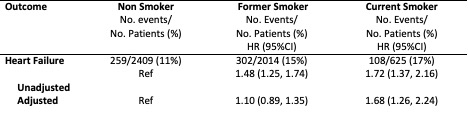
Results Of the 5,083 included participants, 2,423 (48%) were never smokers, 2,030 (40%) were former smokers, and 630 (12%) were current smokers. Over a median follow-up of 6.7 years, there were 664 HF events. In adjusted analyses, compared with never smokers, the risk for future HF events was non-significantly higher for former smokers (HR 1.10; 0.89, 1.35), but significantly higher for current smokers (HR 1.68; 95%CI 1.26, 2.24; Table 1). Similarly, compared with never smoking, former smoking was non-significantly associated with NT-proBNP (-3%; 95%CI -12, +6%), while current smoking was associated with higher NT-proBNP (+24%; 95%CI +9%, +42%).
Conclusion Current smoking status, but not former smoking, is associated with higher NT-proBNP and a higher risk of incident heart failure among patients with CKD. Enhanced public health efforts to promote smoking cessation among patients with CKD may be relevant to prevention of HF.
Castro, Valentina
(
Brigham and Women's Hospital
, Boston , Massachusetts , United States )
Waikar, Sushrut
(
Boston Medical Center
, Boston , Massachusetts , United States )
Mc Causland, Finnian
(
Brigham and Women's Hospital
, Boston , Massachusetts , United States )
Author Disclosures:
Valentina Castro:DO NOT have relevant financial relationships
| Sushrut Waikar:DO NOT have relevant financial relationships
| Finnian Mc Causland:DO have relevant financial relationships
;
Research Funding (PI or named investigator):Lexicon:Active (exists now)
; Other (please indicate in the box next to the company name):Rubin-Anders Scientific (expert witness):Active (exists now)
; Consultant:Zydus:Active (exists now)
; Consultant:GSK:Active (exists now)
; Research Funding (PI or named investigator):NIDDK:Active (exists now)
; Research Funding (PI or named investigator):Novartis:Active (exists now)