Life’s Essential 8-Based Models Predict Subclinical Cardiovascular Disease And Are Not Strengthened by the Inclusion of Social Determinants of Health
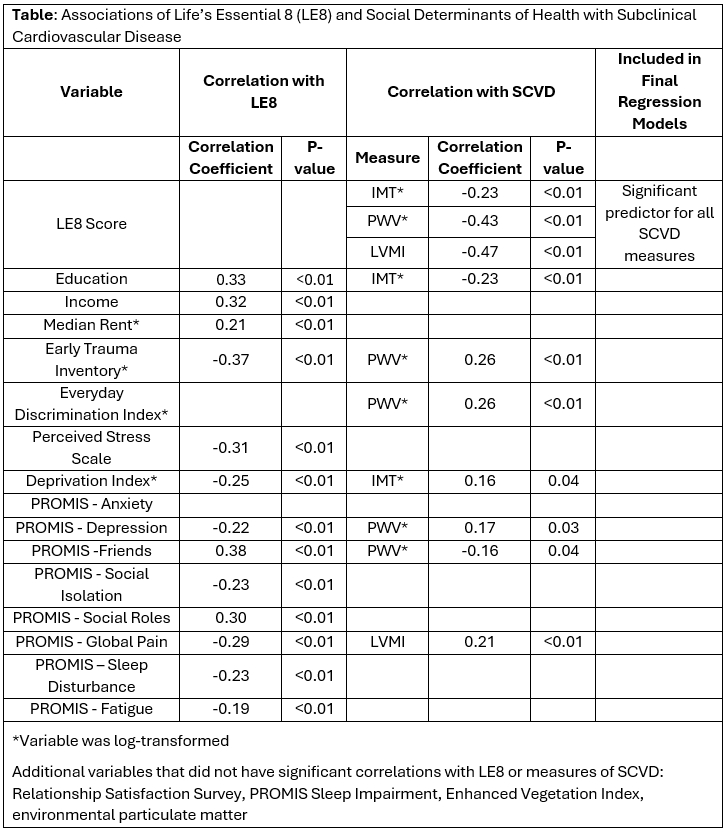
Abstract Body: Introduction: Life’s Essential 8 (LE8) is validated method of quantifying cardiovascular health (CVH). Although SDoH impact CVH, LE8 lacks direct SDoH measures. Hypothesis: We hypothesized that adding SDoH metrics would enhance subclinical CV disease (SCVD) prediction beyond LE8 alone in a cohort of Black and White women in mid-life. Methods: We analyzed 219 women (mean age 46±1 years; 54% Black) from the NHLBI Growth and Health Study. Anthropometrics and laboratory evaluation were performed. Participants completed validated questionnaires related to SDoH (education, income, Early Trauma Inventory (ETI), Everyday Discrimination Index (EDI), Relationship Satisfaction Survey, Perceived Stress Scale (PSS) and PROMIS Psychosocial Scales). Current addresses were geocoded for place-based measures of SDoH (Deprivation Index (DI), median neighborhood rent, Enhanced Vegetation Index for green spaces and environmental particulate matter). SCVD was assessed via carotid IMT, pulse wave velocity (PWV) and left ventricular mass indexed by height2.7 (LVMI). Variables were log transformed if indicated. Correlations (Pearson or Spearman) and regression models with backward selection were used to identify predictors of SCVD from LE8 and SDoH variables. Results: LE8 (mean overall LE8 score 60.3±17.8) was inversely correlated with adverse SDoH including logDI, neighborhood rent, logETI, PSS, and PROMIS scores - anxiety, depression, global pain, social isolation, and fatigue (p<0.01 for all). Positive correlations were observed with education, income, friendship quality, and social roles (p<0.01 for all). LE8 was inversely correlated with SCVD: logIMT, logPWV, LVMI (p<0.01 for all). SCVD measures also correlated with SDoH. Greater logIMT was correlated with lesser education, greater logDI and PROMIS sleep disturbance score (p<0.05 for all). Greater logPWV was correlated with greater logETI, EDI, PSS, and PROMIS scores for anxiety, depression, and friendship quality (p<0.05 for all). LVMI was correlated with lower PROMIS global pain (p<0.01). In regression analyses, lower LE8 was a significant predictor of all measures of SCVD. No SDoH remained significant in final models. Conclusions: LE8 was significantly associated with both SDoH and SCVD. While multiple SDoH measures correlated with SCVD, none improved the explanatory power of LE8-based models. Future work should explore alternative SDoH constructs or modeling approaches to better capture their contribution to CVH.
Sill, Jordan
(
Cincinnati Children's Hospital
, Cincinnati , Ohio , United States )
Urbina, Elaine
(
Cincinnati Children's Hospital
, Cincinnati , Ohio , United States )
Woo, Jessica
(
Cincinnati Children's Hospital
, Cincinnati , Ohio , United States )