
Challenges in Assessing Exercise Impairment in Adolescent Obesity: Insights From Cardiopulmonary Exercise Testing
Abstract Body: Introduction: Adolescent obesity is linked to significantly increased risk of cardiovascular and metabolic comorbidities. Exercise outcomes are often impaired in adolescents with obesity (AO), but it remains unclear whether this reflects compromised cardiovascular reserve or non-cardiovascular factors. This study aimed to characterize mechanisms of reduced exercise performance in AO using cardiopulmonary exercise testing (CPET). The secondary aim was to assess the contribution of excess weight burden by correcting for extra fat mass in AO through estimated standard body mass (eSBM).
Methods: We retrospectively analyzed CPET data from asymptomatic AO, defined as BMI ≥ 30 (n = 94), and age-matched, normal-weight controls without obesity (n = 139). In a subset of AO (n = 47), % body fat was measured by bioelectric impedance analysis, and eSBM was calculated as if they have comparable % body fat to controls using median values by sex and age in US adolescents. CPET was performed with a cycle ergometer following a ramp protocol.
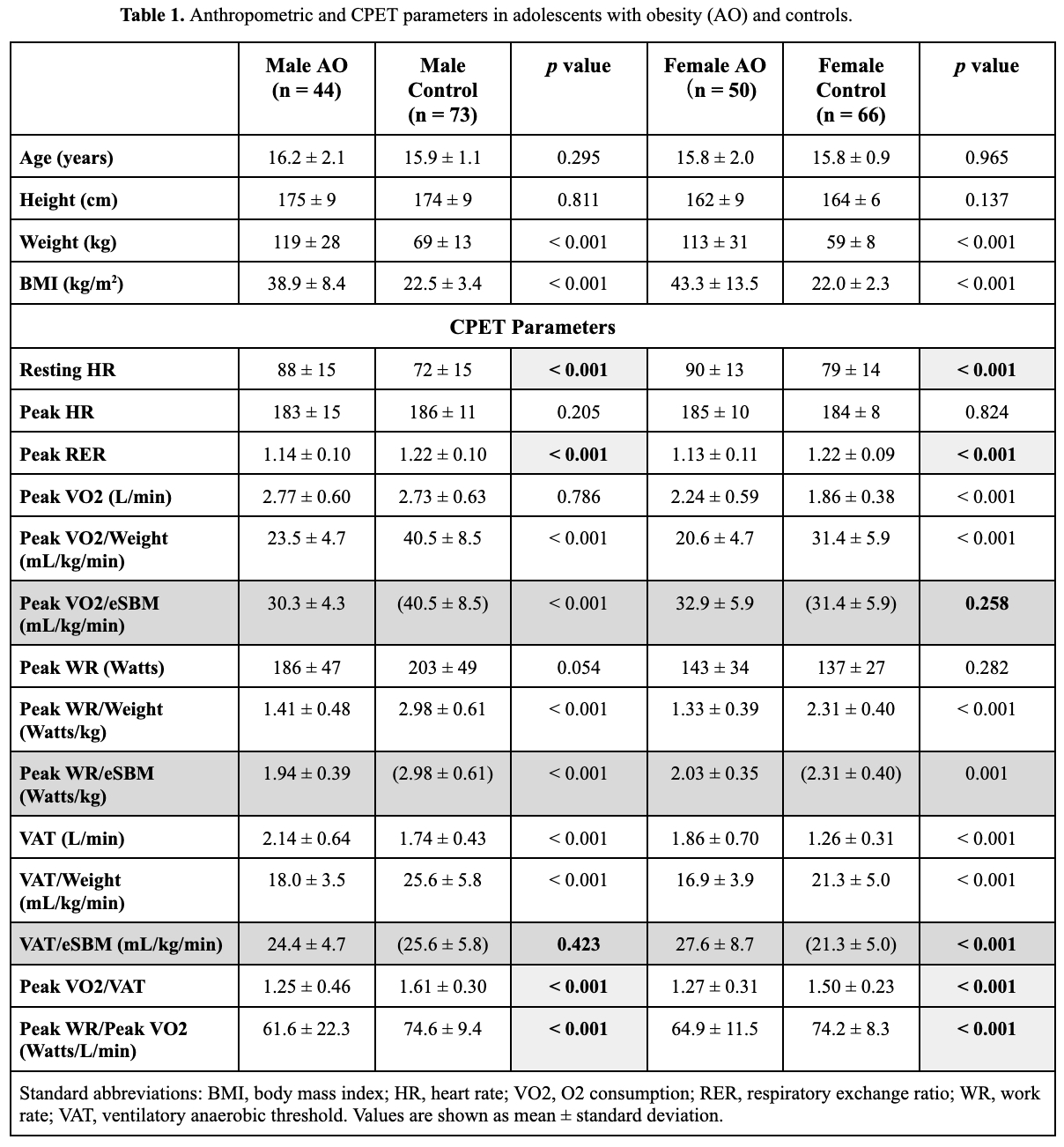
Results: Both male and female AO exhibited higher resting HR (p < 0.001) while peak HR remained comparable to controls. Absolute peak oxygen consumption (VO2) was higher in female AO (p < 0.001), while males showed no difference. Absolute ventilatory anaerobic threshold (VAT) was elevated in AO in both sexes (p < 0.001). When indexed by total body weight, peak VO2, peak work rate (WR), and VAT were lower in both male and female AO (p < 0.001). Peak respiratory exchange ratio (RER), peak VO2/VAT, and peak WR/peak VO2 were also significantly reduced in AO (p < 0.001). When indexed by eSBM, peak VO2 normalized only in female AO; peak WR remained lower, but VAT normalized in AO of both sexes with overcorrection in females, suggesting comparable submaximal exercise performance to controls.
Conclusion: Reduced exercise performance in AO appears characterized by elevated resting HR, early exhaustion near peak exercise (lower peak RER and peak VO2/VAT), and decreased work efficiency (lower peak WR/peak VO2). Indexing CPET parameters by eSBM revealed relatively normal cardiopulmonary performance in AO during submaximal exercise, suggesting that reduced performance primarily reflects premature, fatigue-driven termination of exercise due to excess weight burden rather than true cardiopulmonary compromise. Further study is needed to clarify factors contributing to the observed sex-specific differences in AO exercise performance.
Bao, Jasmine Yimeng
( Sidney Kimmel Medical College
, Philadelphia
, Pennsylvania
, United States
)
Falini, Lauren
( Nemours Childrens Hospital Delaware
, Wilmington
, Delaware
, United States
)
D Aloisio, Gina
( A.I. Dupont Hospital for Children
, Wilmington
, Delaware
, United States
)
Balagopal, Babu
( NEMOURS CHILDRENS-MAYO CLINIC
, Jacksonville
, Florida
, United States
)
Tsuda, Takeshi
( Nemours Childrens Hospital Delaware
, Wilmington
, Delaware
, United States
)