
EPI-Lifestyle Scientific Sessions 2026
/
Poster Session 1
/
Correlation between plasma atherosclerosis index (AIP) and in-hospital mortality in STEMI patients with and without LDL cholesterol control: findings from The Chinese Cardiovascular Association (CCA) Database-Chest Pain Center
American Heart Association
72
0
Final ID: TU119
Correlation between plasma atherosclerosis index (AIP) and in-hospital mortality in STEMI patients with and without LDL cholesterol control: findings from The Chinese Cardiovascular Association (CCA) Database-Chest Pain Center
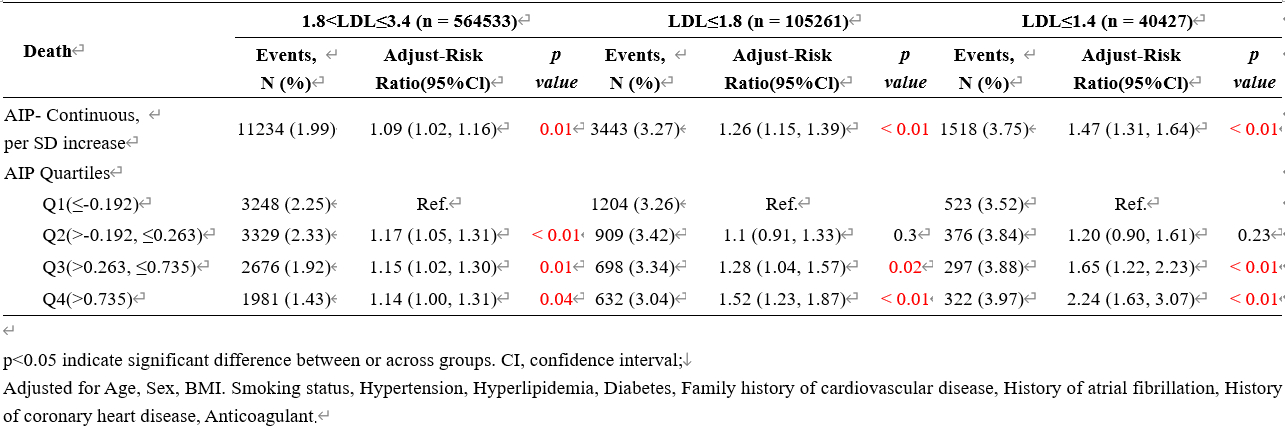
Abstract Body: Background In-hospital mortality after ST-segment elevation myocardial infarction (STEMI) remains high, even in patients with normal admission LDL-C levels. The atherogenic index of plasma (AIP) better reflects atherogenic dyslipidemia than conventional lipid markers, but its association with in-hospital mortality in STEMI patients is unclear. Aim To investigate the association between AIP and in-hospital mortality in patients with STEMI across different admission LDL-C levels. Methods We analyzed data from 918,620 adults with STEMI (mean age: 62.4 ± 13 years; 76.6% male) in the Chinese Cardiovascular Association (CCA) Database-Chest Pain Centre Registry study from 2015 through 2024. The primary outcome was in-hospital mortality. We examined the association between AIP and in-hospital mortality using log binomial regression models in the total population and across different admission LDL-C levels. The non-linear association between AIP and in-hospital mortality was assessed by using restricted cubic spline models. Results A total of 19,190 in-hospital deaths was recorded. Higher AIP was associated higher risk of in-hospital mortality across all LDL-C levels and showed the highest risk ratio (RR: 1.47 [95% CI, 1.31-1.64]; per standard deviation increase) among those with LDL-C levels < 1.4 mmol/L. Similarly, when analyzed as categorical variable, patients in the highest AIP quartile have the highest risk of in-hospital mortality. In the LDL-C < 1.4 mmol/L group, patients in the highest quartile had 124% higher risk of in-hospital mortality (RR: 2.24, 95% CI, 1.63-3.07) after adjustment. Conclusion Higher AIP levels are associated with higher in-hospital mortality in STEMI patients, even among patients with target LDL-C levels. This suggest that AIP captures residual risk beyond LDL-C and may contribute to risk assessment in this population.
Liang, Yuansicheng
(
Department of Cardiology, the Second Affiliated Hospital, Jiangxi Medical College, Nanchang University, Nanchang, China
, Nanchang , China )
Cheng, Zaihua
(
Department of Cardiology, the Second Affiliated Hospital, Jiangxi Medical College, Nanchang University, Nanchang, China
, Nanchang , China )
Qin, Guowei
(
Department of Cardiology, the Second Affiliated Hospital, Jiangxi Medical College, Nanchang University, Nanchang, China
, Nanchang , China )
Guan, Wanjin
(
Johns Hopkins University
, Philadelphia , Pennsylvania , United States )
Hu, Xudong
(
Department of Cardiology, the Second Affiliated Hospital, Jiangxi Medical College, Nanchang University, Nanchang, China
, Nanchang , China )
Ouyang, Jun
(
Department of Cardiology, the Second Affiliated Hospital, Jiangxi Medical College, Nanchang University, Nanchang, China
, Nanchang , China )
Ding, Congcong
(
The SecondAffiliated Hosp of NanchangUniv, Jiangxi, China
, Jiaxi , China )
Liu, Lishun
(
Graduate School at Shenzhen, Tsinghua University
, Shenzhen , China )
Huang, Xiao
(
Department of Cardiology, the Second Affiliated Hospital, Jiangxi Medical College, Nanchang University, Nanchang, China
, Nanchang , China )