Association Between Plasma Homocysteine and Stroke Risk in Hypertensive Patients with Metabolic Syndrome
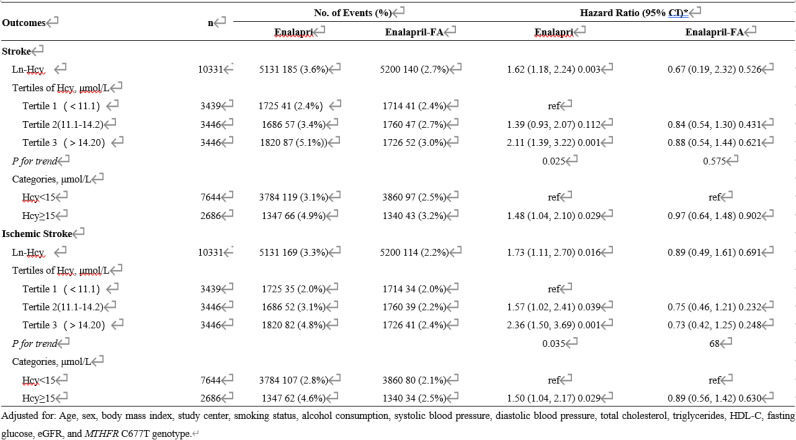
Abstract Body: Background: Folic acid therapy has been shown to reduce the risk of incident stroke in hypertensive adults with elevated plasma total homocysteine (tHcy). However, data are limited among people with metabolic syndrome (MetS), who have higher comorbidity burdens. Aim: To investigate the association between tHcy and the risk of incident stroke among adults with MetS and the therapeutic effect of daily small dose folic acid therapy. We will also consider the modifying effect of methylenetetrahydrofolate reductase (MTHFR) C677T genotype, a common genetic variant in Chinese people that has been linked to higher risk of stroke. Methods: We conducted a post hoc analysis of data from the China Stroke Primary Prevention Trial (CSPPT), a randomized, double-blind, multicenter clinical study conducted from May 2008 through August 2013. The analysis included 10,331 participants who met the NCEP ATP III criteria for MetS. Of these, 5,131 were taking enalapril only (control group), and 5,200 were taking enalapril and a daily 0.8 mg folic acid (treatment group). The primary outcome was incident stroke, and the secondary outcome was incident ischemic stroke. Results: During a median follow-up of 4.5 years, 185 cases of stroke were found in the enalapril group, compared with 140 in the enalapril-folic acid group. In the enalapril-only group, tHcy was significantly associated with the risk of incident stroke. For each unit increase in log-transformed Hcy (Ln-Hcy), stroke risk increased by 62% (HR: 1.62, 95% CI: 1.18, 2.24). Compared with participants in the lowest Hcy tertile, those in the highest Hcy tertile had a 111% increased risk of stroke (HR: 2.11, 95% CI: 1.39, 3.22). Compared with participants with Hcy <15 μmol/L, those with Hcy ≥15 μmol/L had a 48% increased risk of stroke (HR: 1.48, 95% CI: 1.04, 2.10). This association was not observed in the folate supplementation group. Furthermore, the MTHFR C677T genotype significantly modified treatment effects, with the greatest reduction in first-stroke risk observed in CC genotype patients (up to 37%), a 28% risk reduction in CT genotype patients, and no significant benefit in TT genotype patients. Similar results were observed for ischemic stroke. Conclusion: This study found that an increased tHcy levels was significantly associated with the risk of incident stroke among adults with MetS, even with daily enalapril treatment. More importantly, daily low-dose folic acid supplement appeared to mitigate this association.
Qin, Guowei
(
Department of Cardiology, the Second Affiliated Hospital, Jiangxi Medical College, Nanchang University, Nanchang, China
, Nanchang , China )
Cheng, Zaihua
(
Department of Cardiology, the Second Affiliated Hospital, Jiangxi Medical College, Nanchang University, Nanchang, China
, Nanchang , China )
Liang, Yuansicheng
(
Department of Cardiology, the Second Affiliated Hospital, Jiangxi Medical College, Nanchang University, Nanchang, China
, Nanchang , China )
Guan, Wanjin
(
Department of Epidemiology, Johns Hopkins Bloomberg School of Public Health, Baltimore, USA.
, Baltimore , Maryland , United States )
Ouyang, Jun
(
Department of Cardiology, the Second Affiliated Hospital, Jiangxi Medical College, Nanchang University, Nanchang, China
, Nanchang , China )
Hu, Xudong
(
Department of Cardiology, the Second Affiliated Hospital, Jiangxi Medical College, Nanchang University, Nanchang, China
, Nanchang , China )
Ding, Congcong
(
Department of Cardiology, the Second Affiliated Hospital, Jiangxi Medical College, Nanchang University, Nanchang, China
, Nanchang , China )
Liu, Lishun
(
Shenzhen Evergreen Medical Institute, Shenzhen
, Shenzhen , China )
Huang, Xiao
(
Department of Cardiology, the Second Affiliated Hospital, Jiangxi Medical College, Nanchang University, Nanchang, China
, Nanchang , China )