
Logo

American Heart Association

  11
  0


Final ID: WE578

Early Bystander Resuscitation in the Workplace: Insights and Implications

Abstract Body: Introduction: Out-of-hospital cardiac arrest (OCHA) remains a major burden, with an estimated incidence rate of around 50/100,000 person-year in Europe. Survival is still low and early bystander cardiopulmonary resuscitation (CPR) and defibrillation remain key determinants. Workplaces have historically implemented CPR and automated external defibrillators (AED) training programs earlier than in the general population. This study aimed to compare bystander resuscitation and survival across locations, focusing on workplace environments.
Methods: Data was extracted from the Paris sudden death expertise center registry, including all OHCA within Paris and its suburbs. Descriptive summary of characteristics, multi-adjusted models as well as time trends for bystander CPR initiation, AED use and survival by location were computed over a 10-year period.
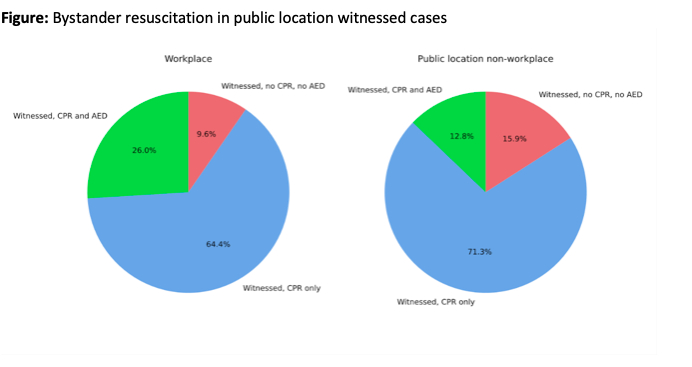
Results: OHCA incidence remained stable over the study period, with 4000 cases per year overall and 80 cases per year in workplaces. Workplace patients were younger (52.5 ± 12.5 years vs 59.3 ± 18.7 years) and had fewer cardiovascular comorbidities than in other public locations. In workplaces, bystanders were more likely to perform CPR (OR=1.38, p=0.005) and use AED (OR=2.24, p<0.001) independently of adjustment covariates. Compared to other locations, bystander CPR initiation rate remained stable and higher in workplaces (77% to 86%). AED use increased across all locations but remained higher at work (increasing from 16% to 32%). Survival was stable over 10 years and consistently twice as high in workplaces compared to other public locations (respectively 20%-27% vs 13%-16%).
Conclusion: Workplace cardiac arrests were characterized by a stable incidence over time, with early CPR and AED use significantly more frequent, leading to consistently higher survival rates. These findings identify workplace environments as a benchmark for community response, emphasizing the need for public health policies aiming to achieve similar outcomes across all public settings.
  • Lebled, Julien  ( INSERM UMR 970 , Paris , France )
  • Chocron, Richard  ( Paris Cardiac Arrest Center , Paris , France )
  • Laurenceau, Thomas  ( Paris Cardiac Arrest Center , Paris , France )
  • Cezard, Pierre  ( Paris Cardiac Arrest Center , Paris , France )
  • Meli, Ugo  ( INSERM UMR 970 , Paris , France )
  • Menant, Emma  ( INSERM UMR 970 , Paris , France )
  • Beganton, Frankie  ( INSERM UMR 970 , Paris , France )
  • Empana, Jean-philippe  ( INSERM UMR 970 , Paris , France )
  • Jouven, Xavier  ( Paris Cardiac Arrest Center , Paris , France )
  • Author Disclosures:
Meeting Info:

EPI-Lifestyle Scientific Sessions 2026

2026

Boston, Massachusetts

Session Info:

Poster Session 2

Wednesday, 03/18/2026 , 05:00PM - 07:00PM

Poster Session

More abstracts on this topic:
A Comparison of Synchronized Versus Unsynchronized Mechanical Chest Compressions in a Swine Model

Marill Keith, Menegazzi James, Gumucio Jorge, Salcido David

A 60-fold increase in SCA risk in the last kilometer of endurance races : Final sprint, fatal outcome.

Chocron Richard, Levy Bernard, Beganton Franckie, Bougouin Wulfran, Empana Jean-philippe, Jouven Xavier, Laurenceau Thomas, Chabrol Marion, Mignot Soline, Meli Ugo, Langlois Camille, Cezard Pierre, Schwartz Peter, Kaab Stefan

More abstracts from these authors:
A “numerical autopsy” of out-of-hospital cardiac arrest: reclassifying unknown etiologies from five years of nationwide health data

Cezard Pierre, Laurenceau Thomas, Meli Ugo, Lebled Julien, Menant Emma, Chocron Richard, Jouven Xavier

Beyond the heart: neuropsychiatric factors as leading risk markers for sudden cardiac arrest in the young

Laurenceau Thomas, Chocron Richard, Cezard Pierre, Meli Ugo, Empana Jean-philippe, Jouven Xavier

You have to be authorized to contact abstract author. Please, Login
Not Available