Mechanistic Components of Arterial Stiffness and Incident Dementia in Older Adults
Abstract Body: Background: Arterial stiffness measured by pulse wave velocity (PWV) predicts cardiovascular events and all-cause mortality. PWV reflects both intrinsic structural remodeling and pressure-dependent distension. PWV can be decomposed into structural PWV (S-PWV) and load-dependent PWV (LD-PWV), representing distinct mechanisms of arterial stiffening. LD-PWV, driven by blood pressure load, predicts cardiovascular events and decreases with intensive blood-pressure lowering, whereas S-PWV, reflecting age-related elastin fragmentation and collagen accumulation, is associated with cerebral small-vessel disease and cognitive decline.
Aim/Hypothesis: We have previously reported in the Cardiovascular Health Study Cognitive Study (CHS-CS) that higher carotid–femoral PWV (cfPWV) was significantly associated with incident dementia. We hypothesize that S-PWV, but not LD-PWV, would be significantly associated with incident dementia.
Methods: CHS-CS is a longitudinal cohort of 532 older adults (mean age 78 ± 4 years; 41% men; 22% APOE-e4 carriers) who were free of dementia at baseline and were followed annually for up to 15 years. cfPWV was measured between 1996–2000 using carotid and femoral Doppler recordings. S- and LD-PWVs were estimated using participant-specific exponential models: S-PWV was cfPWV standardized to 120/80 mmHg, and LD-PWV was the difference between observed cfPWV and S-PWV. Dementia was adjudicated by standardized criteria. Cox proportional hazards models estimated hazard ratios for dementia across tertiles of S- and LD-PWV, adjusting for age, race, education, diabetes, body mass index, APOE-e4 carrier status and hypertension medication.
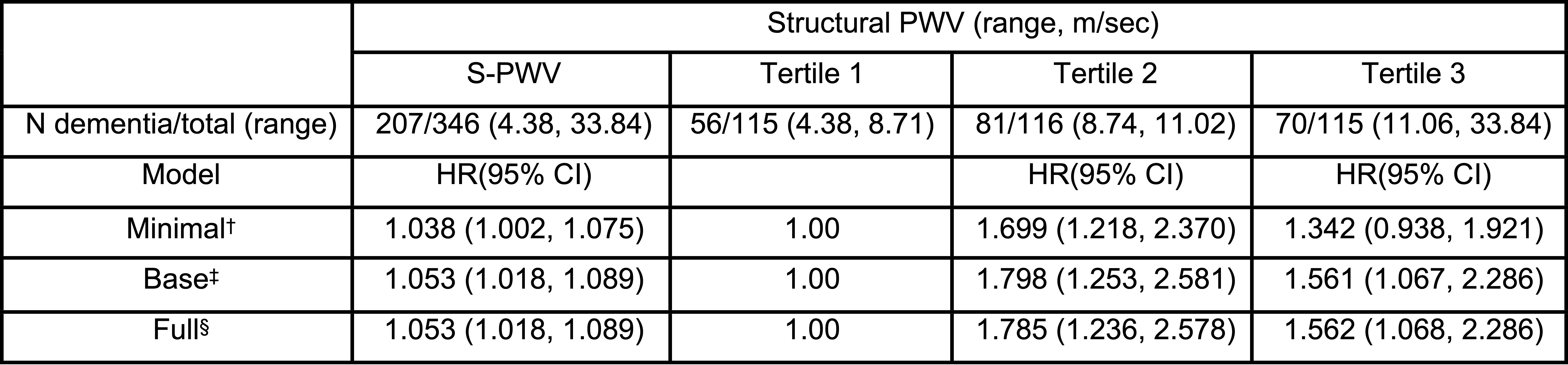
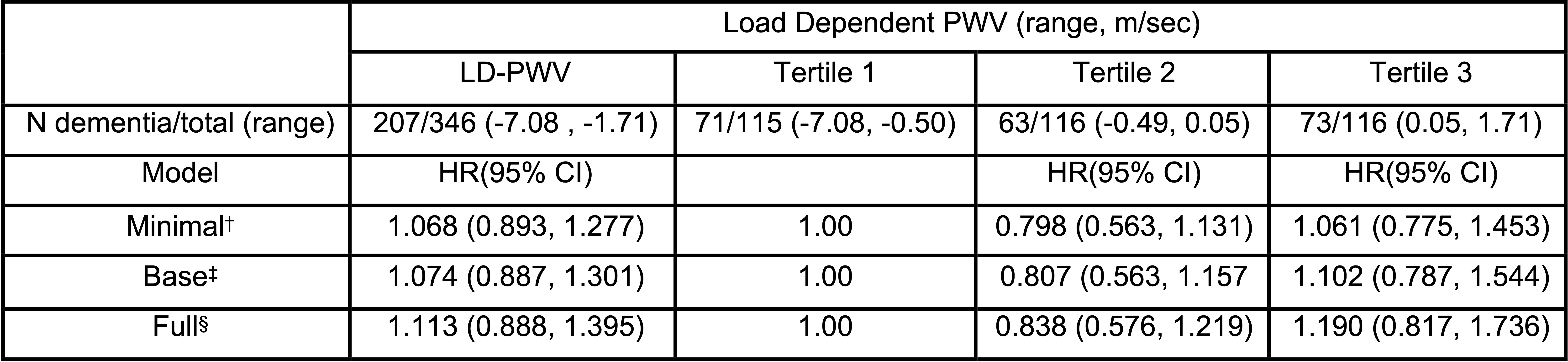
Results: During follow-up, 212 participants (59.6%) developed dementia. Baseline total cfPWV was 8.7 ± 2.9 m/s, S-PWV was 10.6 ± 3.7 m/s, and LD-PWV was -0.3 ± 0.8 m/s. Baseline blood pressure was 129.7/66.9 ± 19.5/9.9 mmHg. Higher S-PWV was significantly associated with greater dementia risk, whereas LD-PWV was not. The S-PWV association remained significant after multivariable adjustment.
Conclusions: In community-dwelling older adults, S-PWV, but not LD-PWV, was independently associated with incident dementia. These findings suggest that long-term structural changes of the arterial wall, rather than blood pressure–related stiffness, may play a critical role in the pathogenesis of dementia. Targeting mechanisms underlying structural arterial stiffening may help prevent or delay cognitive decline in aging populations.
Jacobs, Ian
(
University of Pittsburgh
, Pittsburgh , Pennsylvania , United States )
Cui, Chendi
(
University of Pittsburgh
, Pittsburgh , Pennsylvania , United States )
Mackey, Rachel
(
University of Pittsburgh
, Pittsburgh , Pennsylvania , United States )
Gepner, Adam
(
UNIVERSITY WISCONSIN HOSPITAL
, Madison , Wisconsin , United States )
Deconne, Theodore
(
Wake Forest University School of Medicine
, Winston-Salem , North Carolina , United States )
Chang, Yuefang
(
University of Pittsburgh
, Pittsburgh , Pennsylvania , United States )
Hughes, Timothy
(
Wake Forest University School of Medicine
, Winston-Salem , North Carolina , United States )
Lopez, Oscar
(
University of Pittsburgh
, Pittsburgh , Pennsylvania , United States )
Sekikawa, Akira
(
University of Pittsburgh
, Pittsburgh , Pennsylvania , United States )