
Logo

American Heart Association

  2
  0


Final ID: TH889

Equol or equol producer - which is more important for cognition?

Abstract Body: Background: Evidence from observational studies and short-duration randomized controlled trials (RCTs) suggests that equol, a gut-derived metabolite of soy isoflavone daidzein, may confer cognitive benefits through efficient blood-brain barrier permeability, high selective affinity to the estrogen receptor-beta, and anti-atherogenic properties. Only 20-30% of Westerners possess the ability to convert daidzein to equol as compared to 50-70% of East Asians. Cross-sectional studies conducted in Japan reported that equol producers exhibit fewer white matter lesions (WMLs) and better cognition. However, it is unclear whether equol or the equol producer phenotype as a surrogate for certain microbiome composition or both may protect against dementia.
Objective: To delineate the effect of equol and equol producers by testing whether equol producers have fewer WMLs and better cognitive function than non-producers in an older population with very low soy consumption.
Methods: The Arterial Stiffness, Equol, and Cognition (ACE) trial (NCT05741060) recruited dementia-free infrequent soy consumers aged 65-85 to test whether equol supplementation can slow the progression of arterial stiffness, WMLs, and cognitive impairment. This analysis included 362 ACE participants (mean age 72.0 ± 4.7 years; 52% female; 21% African American) who underwent brain magnetic resonance imaging (MRI) scans and NIH Toolbox Cognitive Battery assessments. Equol producer phenotype was defined as the urinary equol-to-daidzein ratio (log10 ≥ -1.75) after a three-day soy challenge. Associations of equol producer phenotype with WMLs normalized to total intracranial volume (WML%) and cognitive tests were assessed using gamma-distributed generalized linear regression and linear regression adjusting for demographics, APOE-e4 status, and cardiovascular risk factors.
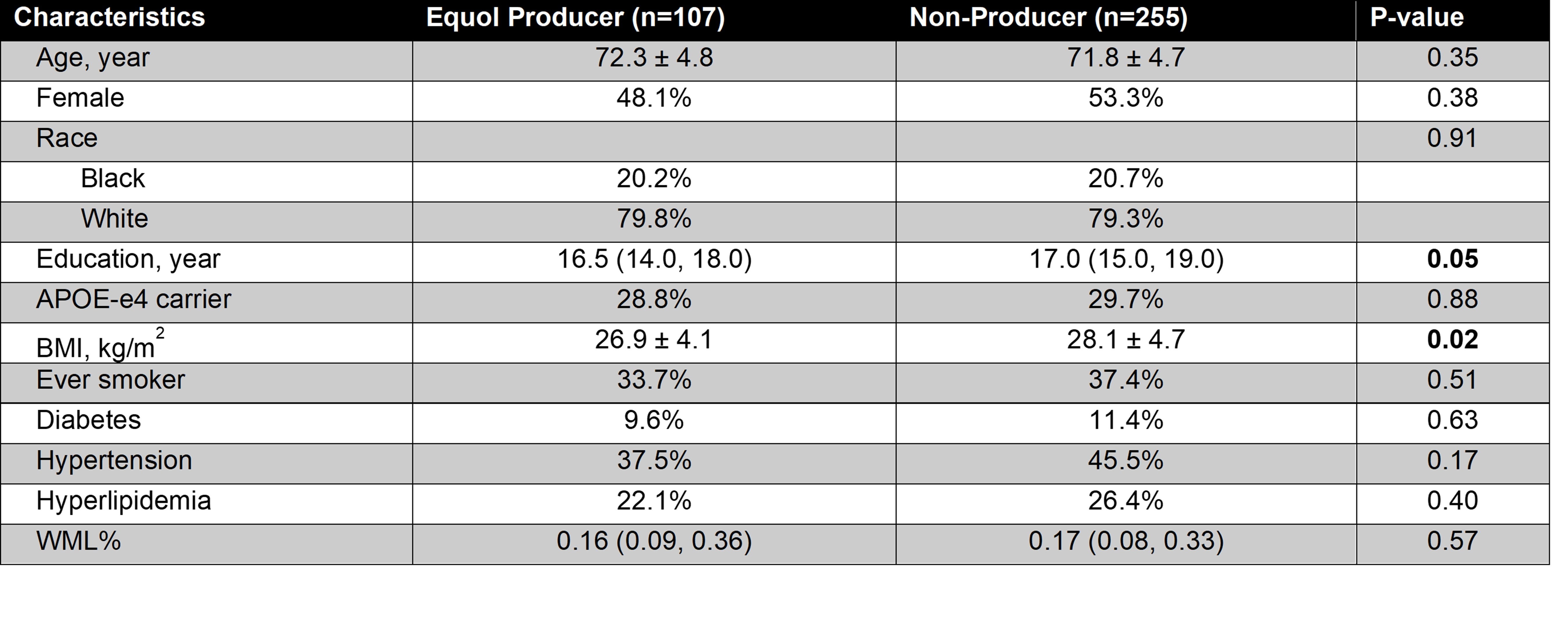
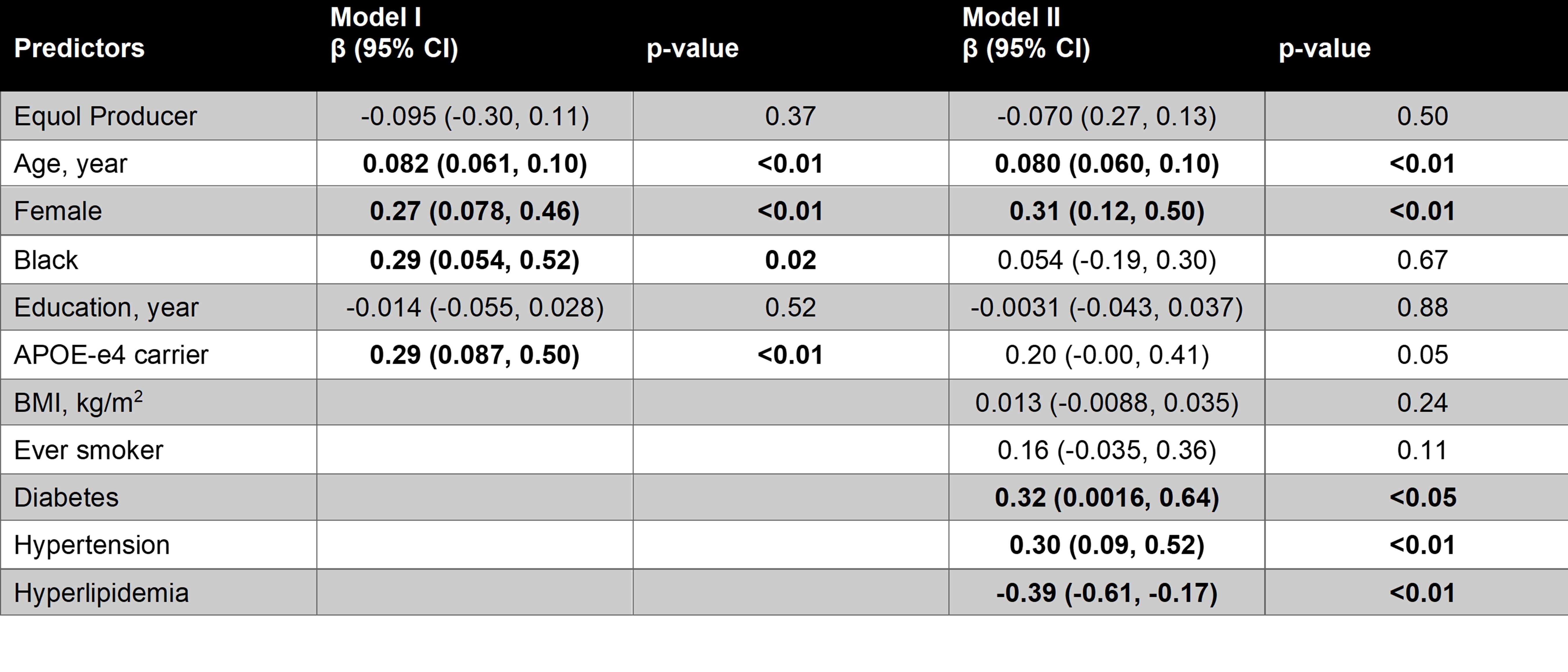
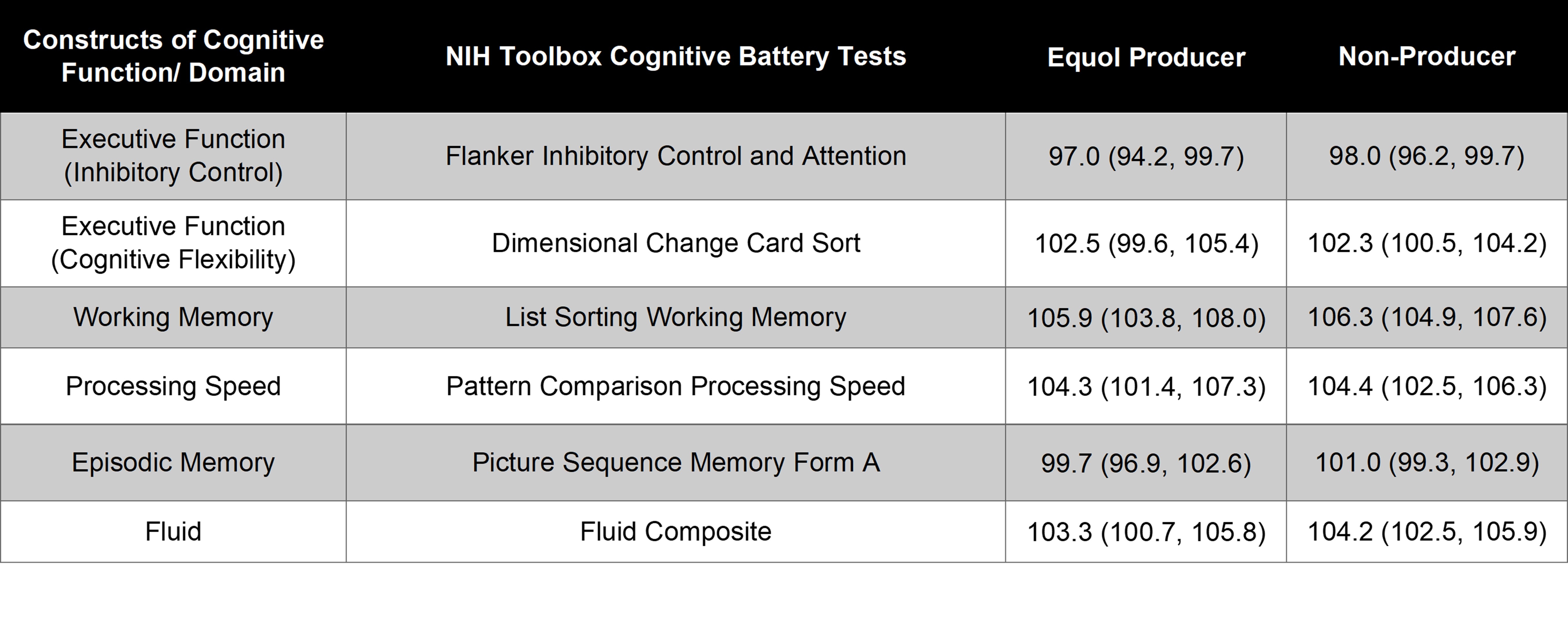
Results: 30% of the participants were equol producers (Table 1). There is no statistically significant difference in WML% (Table 2) or cognitive performance (Table 3) between equol producers and non-producers.
Conclusions: Among infrequent soy consumers, equol producer phenotype is not associated with WMLs or cognitive performance. Without soy intake, equol producers do not show a similar cognitive advantage as observed in East Asians. The results suggest that equol is critical for the cognitive benefits.
  • Li, Mengyi  ( University of Pittsburgh , Pittsburgh , Pennsylvania , United States )
  • Murray-krezan, Cristina  ( University of Pittsburgh , Pittsburgh , Pennsylvania , United States )
  • Wharton, Whitney  ( Emory University , Atlanta , Georgia , United States )
  • Hughes, Timothy  ( Wake Forest University , Winston-Salem , North Carolina , United States )
  • Sekikawa, Akira  ( University of Pittsburgh , Pittsburgh , Pennsylvania , United States )
  • Li, Jiatong  ( University of Pittsburgh , Pittsburgh , Pennsylvania , United States )
  • Gusmanov, Arnur  ( University of Pittsburgh , Pittsburgh , Pennsylvania , United States )
  • Jacobs, Ian  ( University of Pittsburgh , Pittsburgh , Pennsylvania , United States )
  • Chang, Yuefang  ( University of Pittsburgh , Pittsburgh , Pennsylvania , United States )
  • Snitz, Beth  ( University of Pittsburgh , Pittsburgh , Pennsylvania , United States )
  • Wu, Minjie  ( University of Pittsburgh , Pittsburgh , Pennsylvania , United States )
  • Aizenstein, Howard  ( University of Pittsburgh , Pittsburgh , Pennsylvania , United States )
  • Yang, Shaolin  ( University of Pittsburgh , Pittsburgh , Pennsylvania , United States )
  • Author Disclosures:
Meeting Info:

EPI-Lifestyle Scientific Sessions 2026

2026

Boston, Massachusetts

Session Info:

Poster Session 3

Thursday, 03/19/2026 , 05:00PM - 07:00PM

Poster Session

More abstracts on this topic:
Are U.S. Women Meeting Nutritional Guidelines Across Pregnancy? Data from a Multicenter National Cohort

Oshiro Caryn, Leblanc Erin, Catalano Patrick, Powe Camille, Andrei Adi, Gray Elizabeth, Considine Elizabeth, Feghali Maisa, Vesco Kimberly, Zork Noelia

Advanced Complementary Imaging Analysis of Single Ventricle Patients Using Cardiac Magnetic Resonance and Echocardiography

Naum Athanasios, Loke Yue-hin, Meyers Brett, Payne Ronald, Vlachos Pavlos

More abstracts from these authors:
You have to be authorized to contact abstract author. Please, Login
Not Available