Leveraging Pleiotropy to Improve Polygenic Risk Scores for Dyslipidemia Prediction
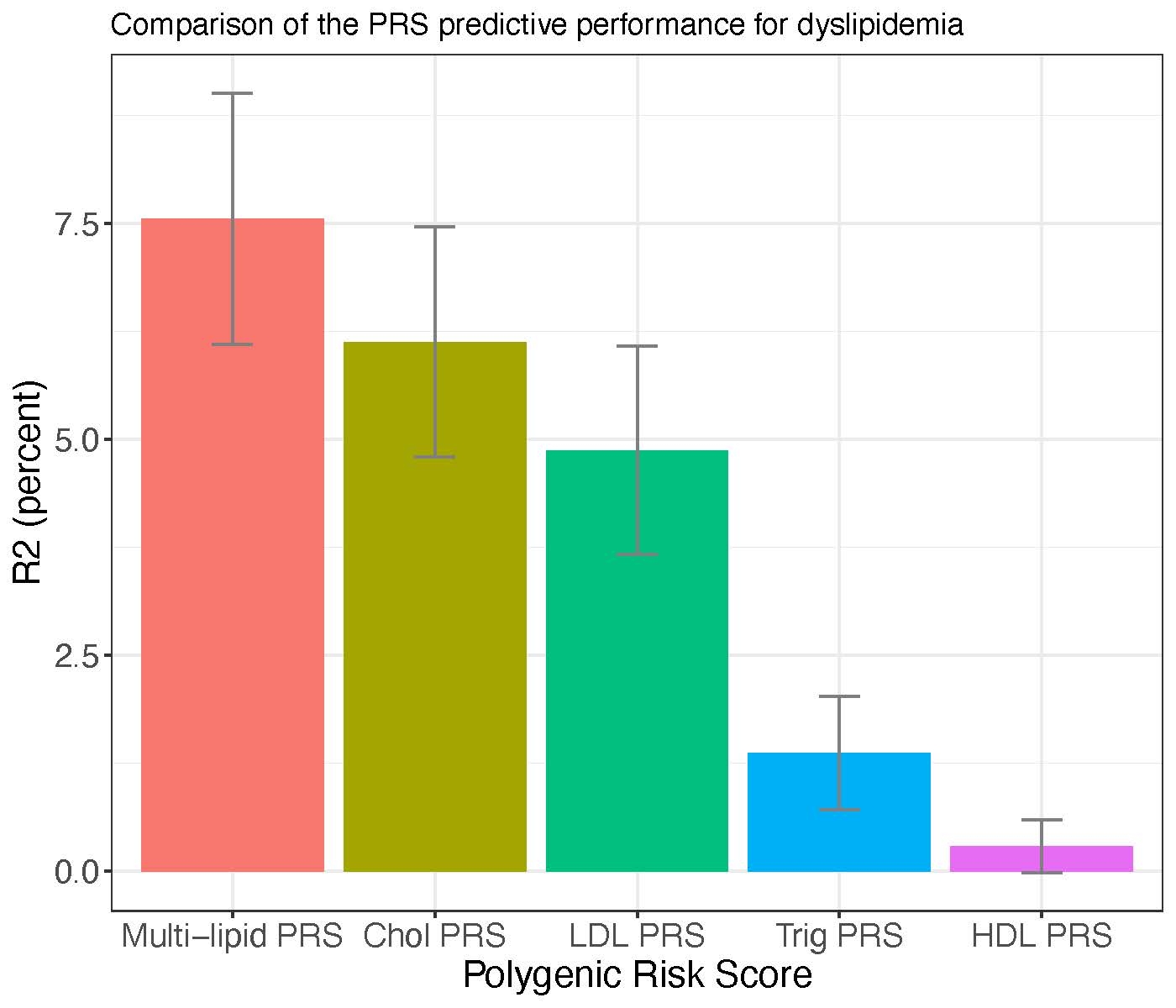
Abstract Body: Background: Current genomic risk prediction models explain only a small fraction of lipid variability and often underperform in non-European populations. Because many lipid-associated variants exert shared effects across multiple lipid traits, integrating pleiotropic genetic information provides an opportunity to enhance prediction accuracy and clinical utility of polygenic risk scores (PRS) in diverse populations. Methods: Genome-wide association summary statistics for HDL, LDL, triglycerides, and total cholesterol were meta-analyzed from three African-ancestry cohorts, ACCME (~8,800), AWI-Gen (~11,700), and GRC-Uganda (~6,400), using METAL. Trait-specific PRS were constructed with PRSice2 and combined using PRSmixPlus to generate a multi-trait PRS that leverages pleiotropic effects across lipid traits. Dyslipidemia was defined by NCEP ATP III criteria. Model performance was evaluated in the UK Biobank African-ancestry cohort (~6,000; 75 % training, 25 % test) using logistic regression adjusted for age, sex, and ancestry principal components, with discrimination assessed by R squared and AUC. Results: In the UK Biobank African-ancestry cohort, the multi-lipid PRS that integrated pleiotropic effects across HDL, LDL, triglycerides, and total cholesterol outperformed all single-trait PRS models for predicting dyslipidemia. The multi-lipid PRS explained 7.6 percent of phenotypic variance (R-squared = 0.076, 95 percent CI 0.047 to 0.104, p = 2 x 10^-7), representing a 23 percent improvement over the best-performing single-trait PRS based on total cholesterol (R-squared = 0.061, 95 percent CI 0.035 to 0.087, p = 4 x 10^-6). Single-trait PRS for LDL and triglycerides showed smaller predictive power (R-squared = 0.049 and 0.014, respectively), while the HDL PRS did not contribute significantly. Conclusions: Integrating pleiotropic genetic effects across lipid traits modestly improves genomic prediction of dyslipidemia in African-ancestry populations. This approach could enhance early identification of individuals at elevated cardiovascular risk and inform precision prevention strategies tailored to diverse populations.
Adebamowo, Sally
(
University of Maryland School of Me
, Ellicott City , Maryland , United States )
Study Investigators, Cardinal
(
University of Maryland School of Me
, Ellicott City , Maryland , United States )