EPI-Lifestyle Scientific Sessions 2026
/
Poster Session 3
/
Depression and Cancer History Interact to Exacerbate Clinical Cardiovascular Disease Burden Within the Cardiometabolic–Kidney Framework Among US Women, 2017–2024 Behavioral Risk Factor Surveillance System
American Heart Association
58
0
Final ID: TH803
Depression and Cancer History Interact to Exacerbate Clinical Cardiovascular Disease Burden Within the Cardiometabolic–Kidney Framework Among US Women, 2017–2024 Behavioral Risk Factor Surveillance System
Abstract Body: Introduction: Women show a stronger depression-cardiovascular disease (CVD) link yet receive 20% less guideline-directed cardiopreventive care. Using nationally representative data, we estimate how depression modifies the cancer-CVD association in women on synergistic scales within the cardiometabolic-kidney (CKM) disease framework. We hypothesized that comorbid cancer and depression yield excess absolute risk of clinical CVD-in-CKM beyond the sum of their independent effects.
Methods: We analyzed pooled 2017–2024 Behavioral Risk Factor Surveillance System data for adult women with cancer (excluding skin). Clinical CVD-in-CKM was defined per the 2023 AHA CKM framework as self-reported myocardial infarction, stroke, or coronary heart disease among those with prediabetes/diabetes, kidney disease, or overweight/obesity. Age- and year-adjusted prevalence estimates and multivariable logistic regression models assessed cancer-CVD associations. Additive interaction quantified the joint effects of cancer and depression overall and by age, income, and race using relative excess risk due to interaction (RERI), attributable proportion (AP), and synergy index (S). Analyses accounted for the complex survey design.
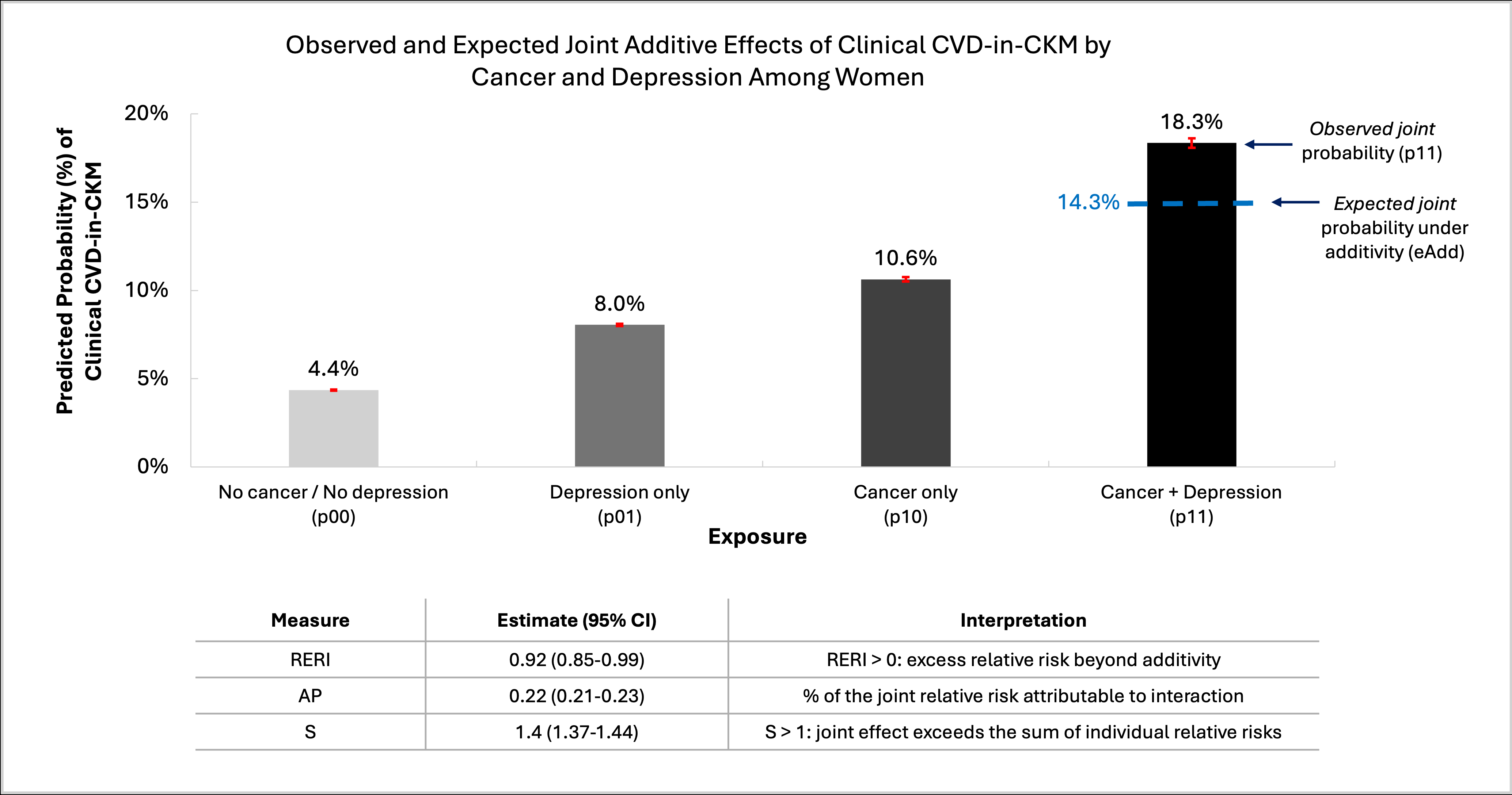
Results: Among 84.4 million women (n=1,242,574), 8.6% (95% CI 8.5–8.7) reported cancer history. Depression was more common in women with cancer than without (30.5% vs 25.8%; p<.001). Adjusted prevalence of clinical CVD-in-CKM was higher in women with cancer than without (9.5% vs 5.6%; p<.001). Among survivors, overweight/obesity (66.4%), diabetes (18.5%), and kidney disease (8.6%) were the most common CKM components. Cancer history was linked to 42% higher odds of clinical CVD-in-CKM (aOR 1.42; 95% CI 1.35–1.49; p<.001). The cancer×depression interaction term showed excess joint risk (RERI=0.92; AP=0.22; S=1.4) (Figure 1). About 22% of the CVD-in-CKM burden among women with both exposures was attributable to their interaction. The combined impact of both exposures was strongest among younger, higher-income, Hispanic, and other race/multiracial women, with smaller but positive combined effects in older and lower-income groups.
Conclusion: Depression and cancer synergistically increased CVD-in-CKM burden, producing greater-than-expected risk among U.S. women. These findings emphasize the need for integrated cardiometabolic and psychosocial risk management in female cancer survivors.
Mercer, Julianne
(
UT Health San Antonio, UT Austin College of Pharmacy
, San Antonio , Texas , United States )
Encino, Benjamin
(
UT Health San Antonio, UT Austin College of Pharmacy
, San Antonio , Texas , United States )
Ryan, Laurajo
(
UT Health San Antonio, UT Austin College of Pharmacy, University Health System
, San Antonio , Texas , United States )
Lipscomb, Justina
(
UT Health San Antonio, UT Austin College of Pharmacy, University Health System
, San Antonio , Texas , United States )
Lee, Grace
(
UT Health San Antonio, UT Austin College of Pharmacy, VA Center for Personalized Medicine
, San Antonio , Texas , United States )