Logo

American Heart Association

  17
  0


Final ID: MPTH63

Effects Of Exercise Training On Predicted ASCVD Risk: Meta-Analysis Across Eight Exercise Training Studies

Abstract Body: BACKGROUND: Atherosclerotic cardiovascular disease (ASCVD) risk scores are commonly used to inform therapeutic strategies in the clinical setting. Although previous studies have shown that individual risk score components, such as HDL-C and total cholesterol, can be improved with regular exercise, few studies have investigated the effect of exercise interventions on composite measures of predicted ASCVD risk.
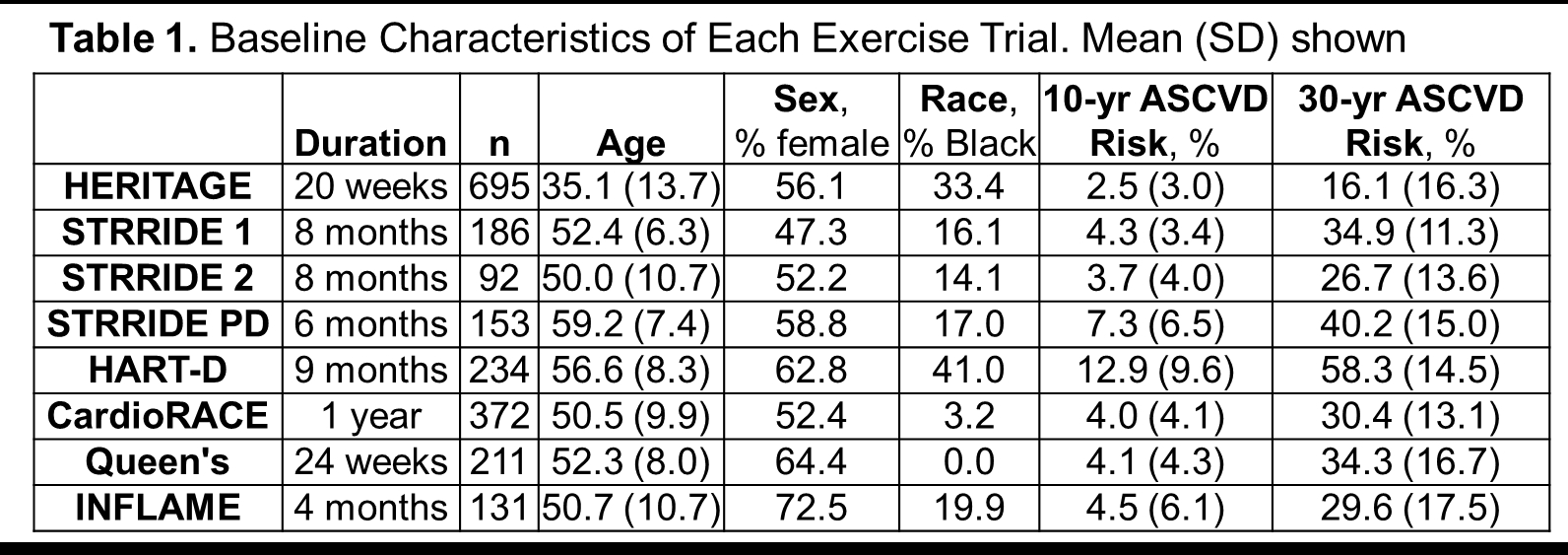
METHODS: Data from eight exercise trials (INFLAME; HART-D; CardioRACE; Queen’s; STRRIDEs 1, 2, and PD; HERITAGE) with 21 different interventions varying in exercise mode, amount, and/or intensity were analyzed. ASCVD risk scores were calculated for each participant (n=2,074) at baseline and after exercise training using the pooled cohort equations and Framingham Heart Study algorithm for 10- and 30-year risk, respectively (Table 1). Meta-analysis of study group-specific mean changes in ASCVD risk with training was performed. When available, changes in exercise groups were compared against changes in the respective control group for each study. Since age is the strongest predictor of risk in the equations, additional meta-analysis was performed to examine changes in risk due to age only (phenotype levels held constant between time points), with all groups analyzed individually with no comparison to controls.
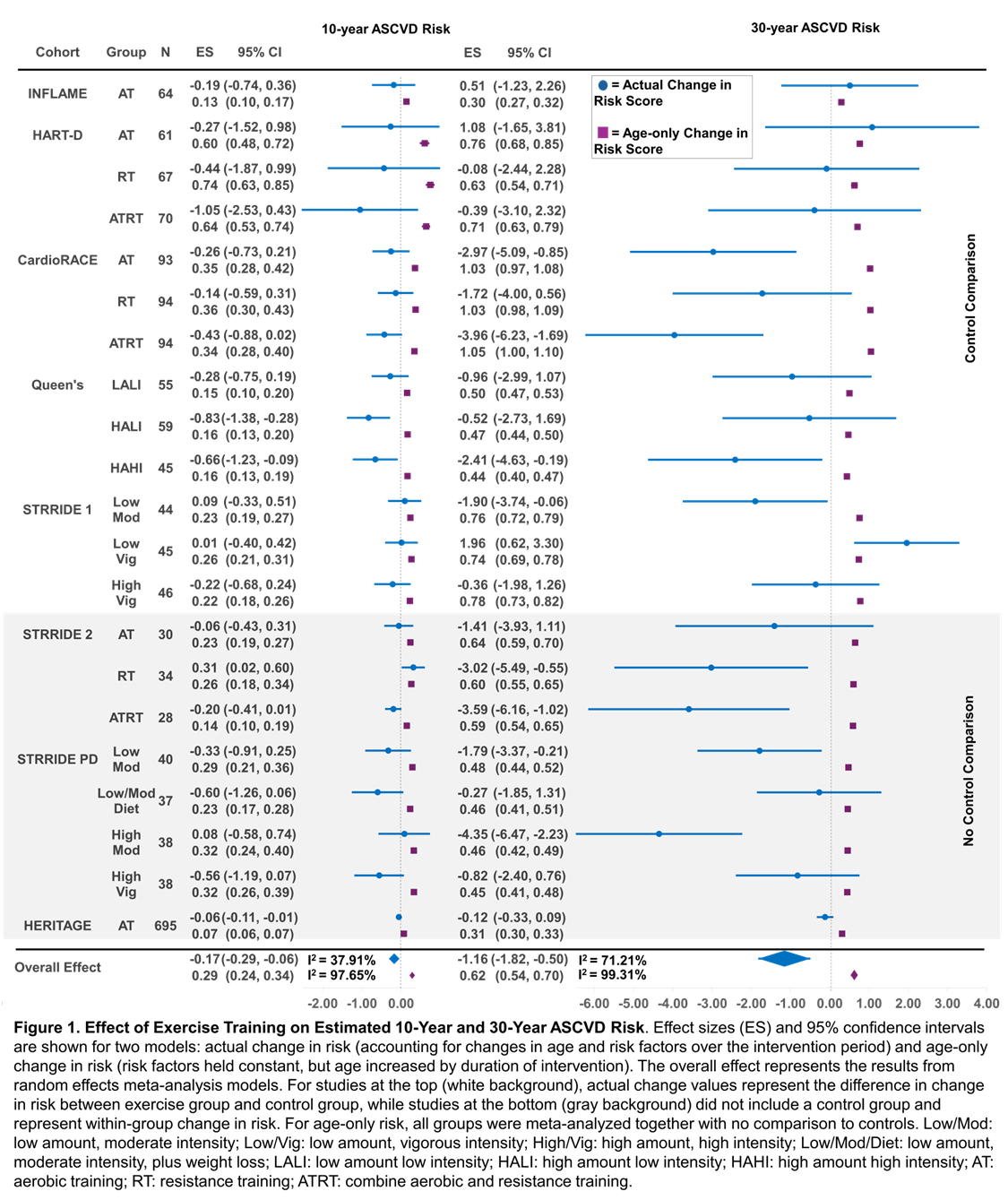
RESULTS: Exercise training resulted in an absolute decrease in 10-year ASCVD risk of -0.2% (95% CI: -0.3 to -0.1) and -1.2% (95% CI: -1.8 to -0.5) in 30-year risk, with low and high heterogeneity, respectively (Figure 1). An increase in age only would have significantly increased 10- and 30-year risk across all exercise intervention groups by 0.3% (95% CI: 0.2 to 0.3), and 0.6% (95% CI: 0.5 to 0.7), respectively (Figure 1). However, this age-related increase was abolished in all exercise groups except for the resistance training groups in STRRIDE 2 and CardioRACE.
CONCLUSIONS: We found that a relatively short period of endurance exercise training of differing amounts and/or intensity performed alone or in combination with resistance training can prevent and even reverse the age-related increases in both short- and long-term ASCVD risk.
  • Pitre, Michael  ( University of South Carolina , Columbia , South Carolina , United States )
  • Leszczynski, Eric  ( Michigan State University , East Lansing , Michigan , United States )
  • Jacobs, Kiani  ( University of South Carolina , Columbia , South Carolina , United States )
  • Kiely, Keagan  ( University of South Carolina , Columbia , South Carolina , United States )
  • Schwartz, Charles  ( University of South Carolina , Columbia , South Carolina , United States )
  • Mcbride, Margaret  ( University of South Carolina SOM , Columbia , South Carolina , United States )
  • Nayak, Shivangi  ( University of South Carolina , Columbia , South Carolina , United States )
  • Robbins, Jeremy  ( Beth Israel Deaconess Medical Ctr , Boston , Massachusetts , United States )
  • Rao, Prashant  ( Beth Israel Deaconess Medical Ctr , Boston , Massachusetts , United States )
  • Mi, Michael  ( Beth Israel Deaconess Medical Ctr , Boston , Massachusetts , United States )
  • Ghosh, Sujoy  ( Pennington Biomedical Research Ctr , Baton Rouge , Louisiana , United States )
  • Gerszten, Robert  ( Beth Israel Deaconess Medical Ctr , Boston , Massachusetts , United States )
  • Swift, Damon  ( University of Virginia , Charlottesville , Virginia , United States )
  • Michael Beets, Michael Beets  ( University of South Carolina , Columbia , South Carolina , United States )
  • Johannsen, Neil  ( Louisiana State University , Baton Rouge , Louisiana , United States )
  • Church, Timothy  ( Wondr Health , Dallas , Texas , United States )
  • Ross, Robert  ( QUEENS UNIVERSITY , Kingston , Ontario , Canada )
  • Lee, Duck-chul  ( University of Pittsburgh , Pittsburgh , Pennsylvania , United States )
  • Bouchard, Claude  ( Pennington Biomedical Research Ctr , Baton Rouge , Louisiana , United States )
  • Kraus, William  ( Duke University School of Medicine , Durham , North Carolina , United States )
  • Ross, Leanna  ( Duke University School of Medicine , Durham , North Carolina , United States )
  • Weaver, R. Glenn  ( University of South Carolina , Columbia , South Carolina , United States )
  • Sarzynski, Mark  ( University of South Carolina , Columbia , South Carolina , United States )
  • Author Disclosures:
Meeting Info:

EPI-Lifestyle Scientific Sessions 2026

2026

Boston, Massachusetts

Session Info:

Physical Activity

Thursday, 03/19/2026 , 05:00PM - 07:00PM

Moderated Poster Session

More abstracts on this topic:
Advanced maternal age and association with major adverse cardiovascular events from NHANES from 1999 to 2018

Mehta Adhya, Honigberg Michael, Kennedy Jamie, Spitz Jared, Sharma Garima, Agboola Olayinka, Satti Danish Iltaf, Harrington Colleen, Scott Nandita, Sarma Amy, Saad Antonio, Sullivan Scott, Epps Kelly

Characterization of Cardiac, Autonomic, and Exercise Physiology in Patients with Long COVID

Suckow Emmett, Mcdonnell Barry, Stöhr Eric, Cornwell William, Pierce Kate, Wulff Kyla, Arent Chelsea, Kreye Shelanna, Rosenberg Michael, Sabin Katie, Parker Hugh, Forbes Lindsay

More abstracts from these authors:
Association of the IgG and Plasma Glycomes with Cardiometabolic Risk Factors

Jacobs Kiani, Bouchard Claude, Simunic-briski Nina, Lauc Gordan, Sarzynski Mark, Leszczynski Eric, Schwartz Charles, Pitre Michael, Rao Prashant, Mi Michael, Ghosh Sujoy, Robbins Jeremy, Gerszten Robert

Plasma Proteins Underlying Changes In Triglyceride Metabolism With Exercise Training

Mcbride Margaret, Clish Clary, Silbernagel Gunther, Bouchard Claude, Robbins Jeremy, Gerszten Robert, Sarzynski Mark, Leszczynski Eric, Jacobs Kiani, Barber Jacob, Pitre Michael, Rao Prashant, Mi Michael, Schwartz Charles, Ghosh Sujoy

You have to be authorized to contact abstract author. Please, Login
Not Available