Logo

American Heart Association

  21
  0


Final ID: TU188

Association of the IgG and Plasma Glycomes with Cardiometabolic Risk Factors

Abstract Body: Background. The immunoglobulin G (IgG) and plasma N-glycomes represent biomarkers of cardiovascular disease. However, few studies have examined relationships between glycomic profiles and an extensive list of cardiometabolic risk factors in healthy adults.
Hypothesis. Specific subsets of IgG and plasma glycans will associate with specific cardiometabolic traits.
Methods. Plasma and IgG glycans were analyzed using HILIC-UPLC and MALDI-TOF-MS (25 IgG N-glycans and 39 plasma N-glycans) in samples from 652 HERITAGE Family Study participants (57% female, 44% Black, 17-65 years old). Spearman correlations adjusted for age, sex, and race were performed between glycans and 68 cardiometabolic traits. Sparse multiple canonical correlation analysis (SMCCA) was used to identify a parsimonious set of glycans maximally related to cardiometabolic risk factors.
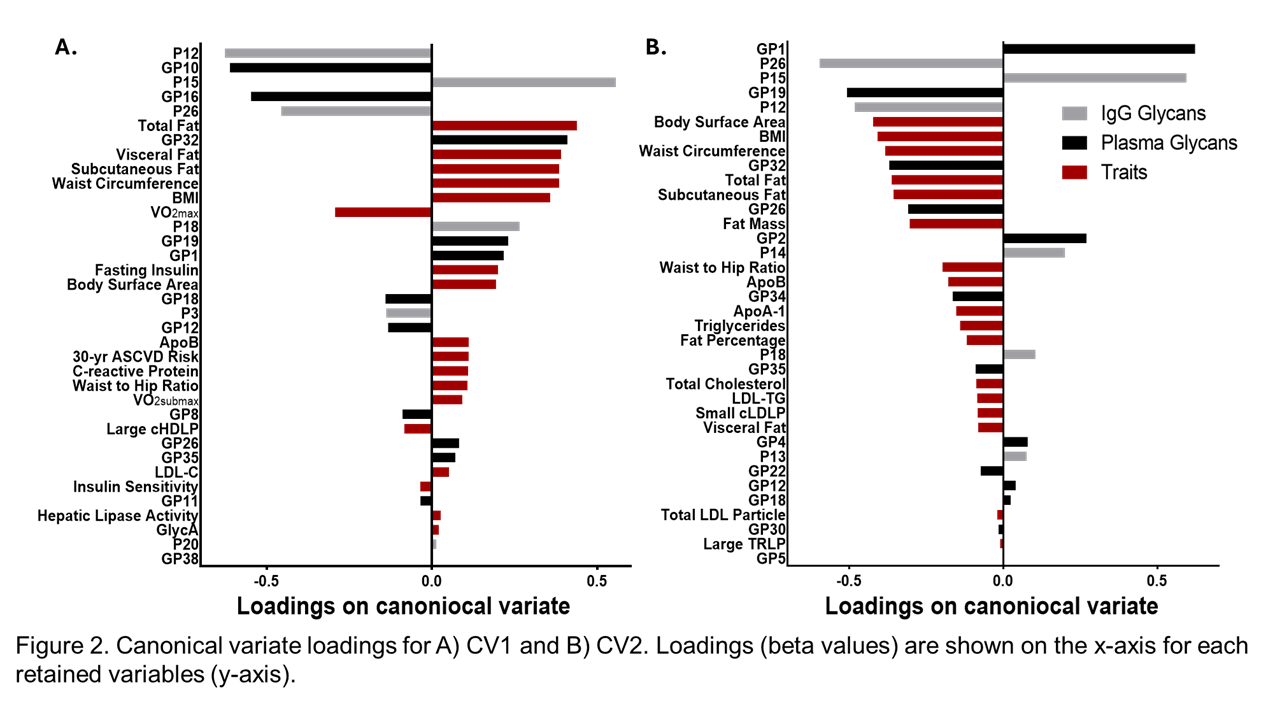
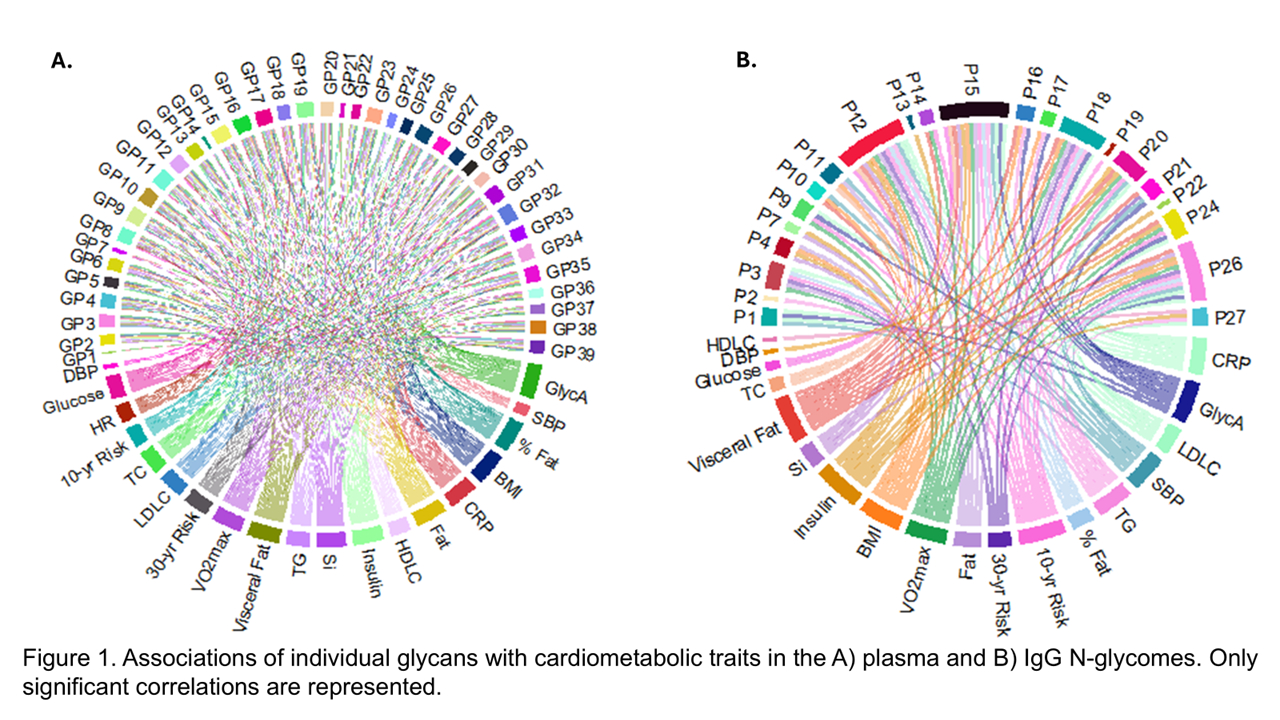
Results. Most (29/39) plasma glycans were associated with 10 or more traits (Fig 1A), while four IgG glycans were associated with 10 or more traits (Fig 1B). The SMCCA identified two canonical variates (CV) of groups of IgG and plasma glycans correlated with groups of phenotypes. CV1 was comprised of six IgG glycans, 12 plasma glycans, and 18 traits mostly related to body composition and indicative of worse cardiometabolic profiles (e.g., higher glycan abundance related to lower VO2max and insulin sensitivity, higher visceral fat and BMI; Fig 2A). Conversely, CV2 was comprised of six IgG glycans, 13 plasma glycans, and 17 traits related to mostly body composition and lipids and indicative of better cardiometabolic profiles (e.g., higher glycan abundance related to lower triglycerides, total cholesterol, visceral fat, and BMI; Fig 2B). Seven plasma and four IgG glycans were found in both CVs, while five and six plasma glycans and two IgG glycans each were unique to CV1 and CV2, respectively. Although eight traits mainly related to body composition overlapped between CVs, traits related to insulin sensitivity and cardiorespiratory fitness were uniquely included in CV1 and lipoprotein-related traits in CV2.
Conclusions. We identified subsets of IgG and plasma glycans related to better or worse cardiometabolic profiles. Within the CVs, some associations between glycans and body composition traits overlapped. However, each CV is also related to a unique set of cardiometabolic traits. Future studies should investigate how changes in glycans relate to changes in cardiometabolic health.
  • Jacobs, Kiani  ( University of South Carolina , Columbia , South Carolina , United States )
  • Leszczynski, Eric  ( Michigan State University , East Lansing , Michigan , United States )
  • Schwartz, Charles  ( University of South Carolina , Columbia , South Carolina , United States )
  • Pitre, Michael  ( University of South Carolina , Columbia , South Carolina , United States )
  • Rao, Prashant  ( Beth Israel Deaconess Medical Cente , Boston , Massachusetts , United States )
  • Mi, Michael  ( Beth Israel Deaconess Medical Ctr , Boston , Massachusetts , United States )
  • Ghosh, Sujoy  ( Pennington Biomedical Research Ctr , Baton Rouge , Louisiana , United States )
  • Robbins, Jeremy  ( Beth Israel Deaconess Medical Ctr , Boston , Massachusetts , United States )
  • Gerszten, Robert  ( Beth Israel Deaconess Medical Ctr , Boston , Massachusetts , United States )
  • Bouchard, Claude  ( Pennington Biomedical Research Ctr , Baton Rouge , Louisiana , United States )
  • Simunic-briski, Nina  ( University of Zagreb , Zagreb , Croatia )
  • Lauc, Gordan  ( University of Zagreb , Zagreb , Croatia )
  • Sarzynski, Mark  ( University of South Carolina , Columbia , South Carolina , United States )
  • Author Disclosures:
Meeting Info:

EPI-Lifestyle Scientific Sessions 2026

2026

Boston, Massachusetts

Session Info:

Poster Session 1

Tuesday, 03/17/2026 , 05:00PM - 07:00PM

Poster Session

More abstracts on this topic:
Characterizing Exercise-Induced Myocardial Perfusion Response in Hypertrophic Cardiomyopathy and Heart Failure with Preserved Ejection Fraction

Schulz Alexander, Nezafat Reza, Wallace Tess, Ghanbari Fahime, Rodriguez Jennifer, Chow Kelvin, Kellman Peter, Rowin Ethan, Maron Martin, Manning Warren

Advanced waveform analysis of the electrocardiogram signals using complementary signal processing techniques to investigate the response to a QTc prolonging drug vs control including food effect.

Serna Pascual Miquel, Nandi Manasi, Taubel Jorg, Lorch Ulrike, Djumanov Dilshat, Sadsad Tyrone-joshua, Mejia Elisa, Rickard James

More abstracts from these authors:
Plasma Proteins Underlying Changes In Triglyceride Metabolism With Exercise Training

Mcbride Margaret, Clish Clary, Silbernagel Gunther, Bouchard Claude, Robbins Jeremy, Gerszten Robert, Sarzynski Mark, Leszczynski Eric, Jacobs Kiani, Barber Jacob, Pitre Michael, Rao Prashant, Mi Michael, Schwartz Charles, Ghosh Sujoy

Sex Differences in the Plasma Metabolome Before and After Exercise Training

Leszczynski Eric, Clish Clary, Robbins Jeremy, Gerszten Robert, Sarzynski Mark, Barber Jacob, Rao Prashant, Jacobs Kiani, Mi Michael, Dev Prasun, Schwartz Charles, Ghosh Sujoy, Bouchard Claude

You have to be authorized to contact abstract author. Please, Login
Not Available