Plasma Proteins Underlying Changes In Triglyceride Metabolism With Exercise Training
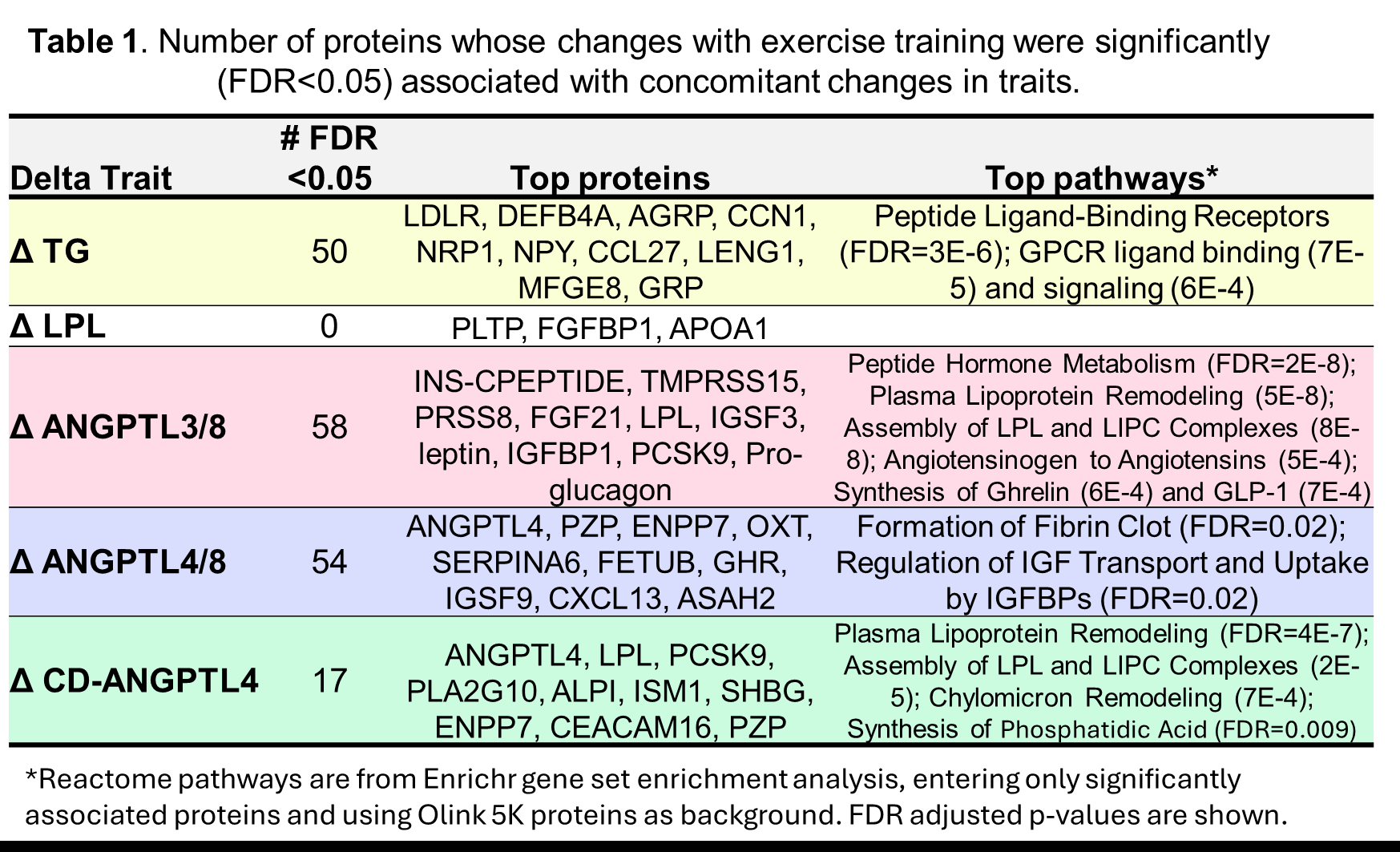
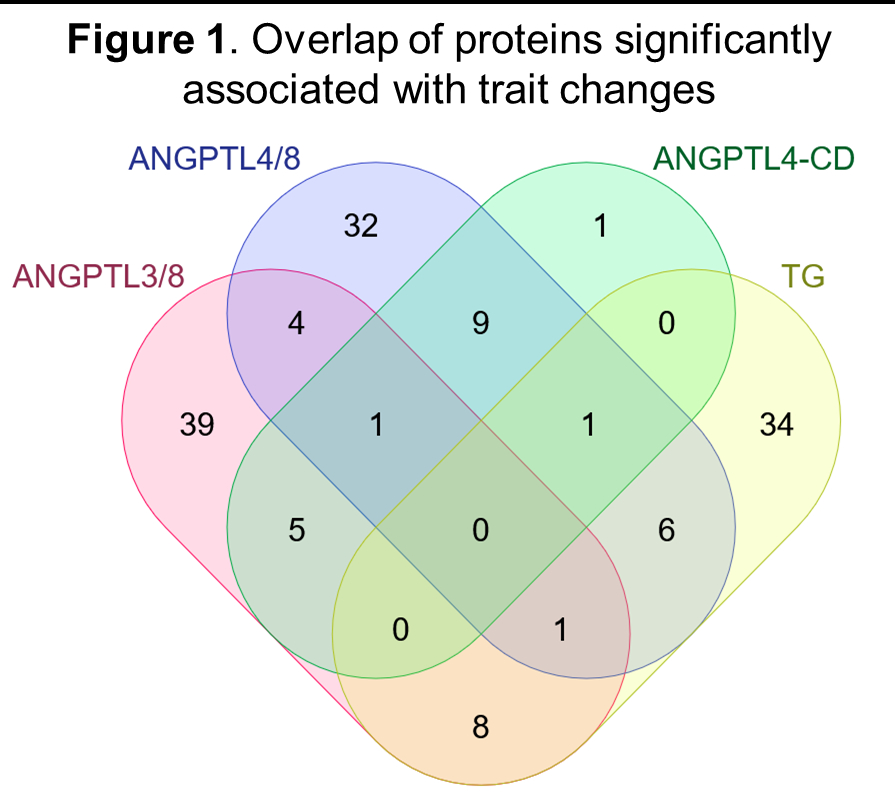
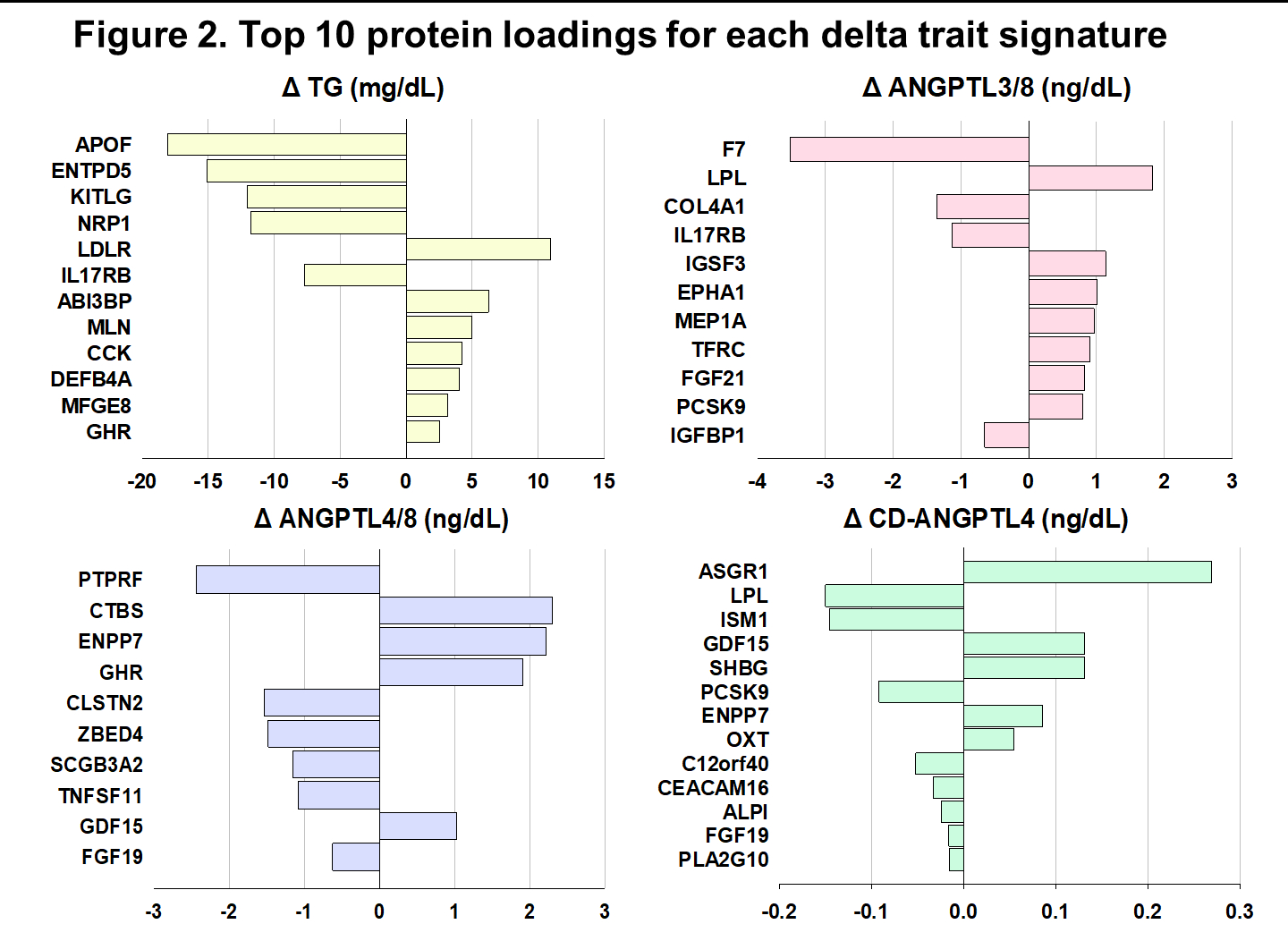
Abstract Body: INTRODUCTION. Angiopoietin like proteins (ANGPTL) 3, 4, and 8 and their complexes (ANGPTL 3/8 and 4/8) are established inhibitors of lipoprotein lipase (LPL), all of which regulate triglyceride (TG) metabolism. Regular exercise is known to decrease plasma TG levels and increase LPL activity, and we recently showed that exercise training decreases ANGPTL3/8 levels. However, the molecular underpinnings of exercise-induced changes in regulators of TG metabolism have not been fully elucidated. The purpose of this study was to identify proteins associated with TG, LPL activity, C-terminal domain-containing (CD)-ANGPTL4, ANGPTL3/8, and ANGPTL4/8 responses to exercise training. METHODS. Data on cardiometabolic phenotypes and plasma proteins (Olink 5K) measured before and after 20 weeks of endurance training were available in 617 adults (55% Female, 37% Black, 17-65 yrs) of the HERITAGE Family Study. Linear mixed models were used to test the associations of change in individual proteins with changes in TG-related traits, adjusting for age, sex, race, and baseline trait and baseline protein levels. Significant (FDR<0.05) proteins were entered in LASSO regression models with 10-fold cross-validation to identify proteomic signatures of exercise-induced changes in TG-related traits. RESULTS. At baseline, mean age was 35 yrs, BMI 26 kg/m2, and lipid profile values were within the normal range. Changes in the abundance of 141 unique proteins were associated with the exercise training changes of at least one of the four traits (none associated with ΔLPL; Table 1), with little overlap of associated proteins across traits (Figure 1). The associated proteins were overrepresented in pathways related to peptide hormone metabolism, lipoprotein assembly, remodeling and clearance, assembly of LPL and LIPC complexes, G protein-coupled receptor signaling, and clotting cascade (Table 1). Proteomic signatures consisting of 24, 28, 22, and 13 proteins explained 20%, 22%, 21%, and 28% of the variance in training-induced changes in TG, ANGPTL3/8, ANGPTL4/8, and CD-ANGPTL4, respectively. Top contributing proteins for each signature are shown in Figure 2. CONCLUSIONS. We identified several plasma proteins whose changes in response to regular exercise were associated with concomitant changes in TG and ANGPTL complex and protein traits. Our findings indicate several shared but also unique biological pathways underlying the exercise responsiveness of key regulators of TG metabolism.
Mcbride, Margaret
(
University of South Carolina SOM
, Columbia , South Carolina , United States )
Leszczynski, Eric
(
Michigan State University
, East Lansing , Michigan , United States )
Jacobs, Kiani
(
University of South Carolina
, Columbia , South Carolina , United States )
Barber, Jacob
(
Beth Israel Deaconess Medical Ctr
, Boston , Massachusetts , United States )
Pitre, Michael
(
University of South Carolina
, Columbia , South Carolina , United States )
Rao, Prashant
(
Beth Israel Deaconess Medical Ctr
, Boston , Massachusetts , United States )
Mi, Michael
(
Beth Israel Deaconess Medical Ctr
, Boston , Massachusetts , United States )
Schwartz, Charles
(
University of South Carolina
, Columbia , South Carolina , United States )
Ghosh, Sujoy
(
Pennington Biomedical Research Ctr
, Baton Rouge , Louisiana , United States )
Clish, Clary
(
Broad Institute of MIT and Harvard
, Cambridge , Massachusetts , United States )
Silbernagel, Gunther
(
Medical University of Graz
, Graz , Austria )
Bouchard, Claude
(
PENNINGTON BIOMEDICAL RESEARCH CTR
, Baton Rouge , Louisiana , United States )
Robbins, Jeremy
(
Beth Israel Deaconess Medical Ctr
, Boston , Massachusetts , United States )
Gerszten, Robert
(
Beth Israel Deaconess Medical Ctr
, Boston , Massachusetts , United States )
Sarzynski, Mark
(
University of South Carolina
, Columbia , South Carolina , United States )