
Logo

American Heart Association

  22
  0


Final ID: MP1222

Following the implementation of a prevention policy : Improved survival after sudden cardiac arrest in train stations.

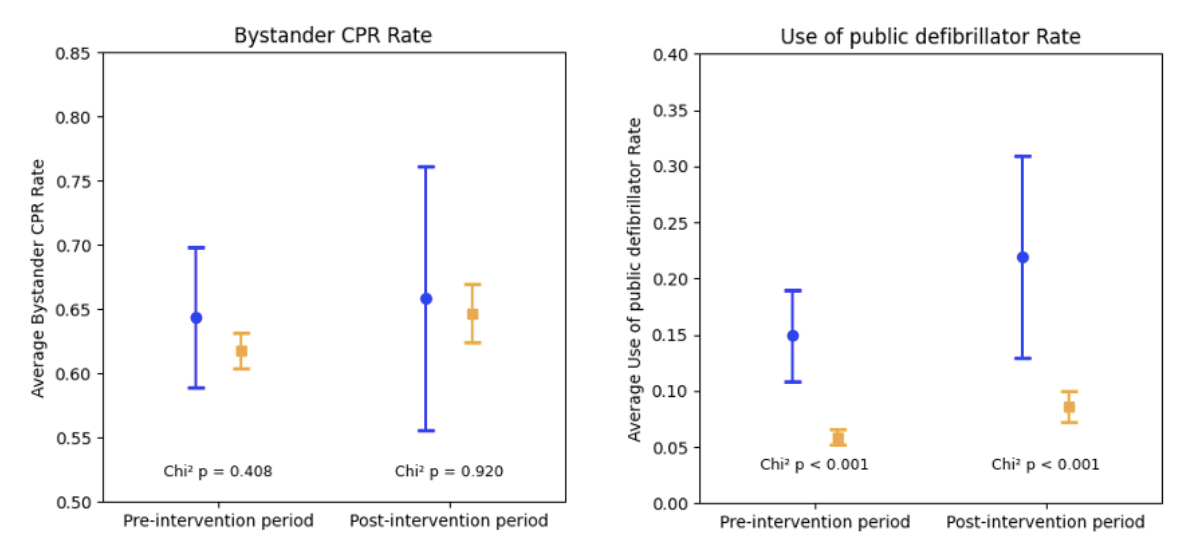
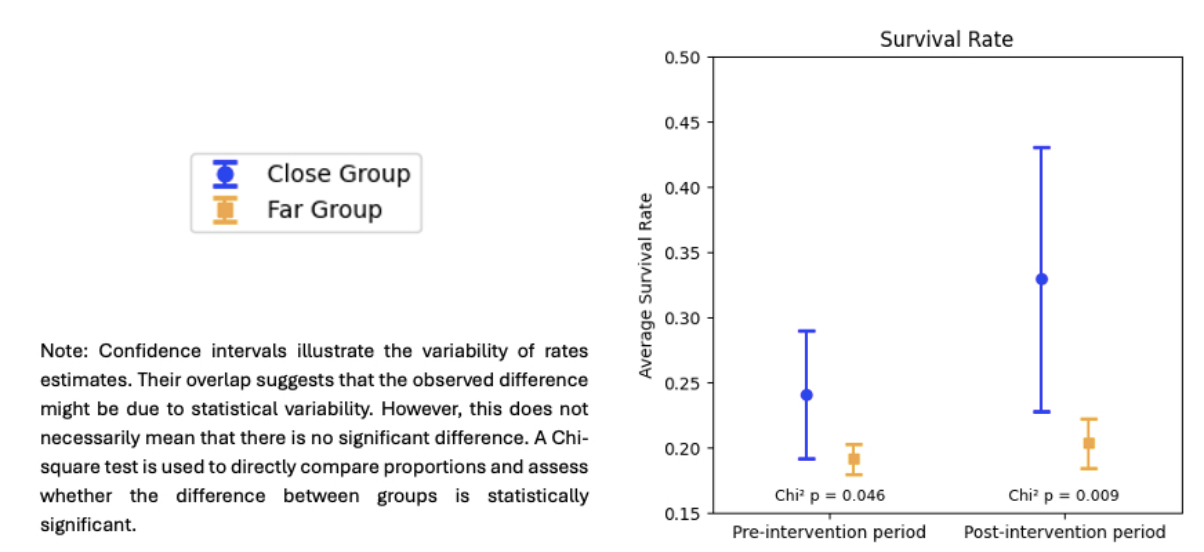
Abstract Body (Do not enter title and authors here): Background: Due to the high passenger flow, train stations are at high risk sites for sudden cardiac arrest (SCA) occurrences. Recognizing the importance of early defibrillation and cardiopulmonary resuscitation (CPR) for survival, train stations are key locations for assessing public health interventions to improve SCA outcomes. Beginning progressively in 2019, train stations in one city implemented targeted personnel training and installed automated external defibrillators (AEDs). This study aimed to assess the effectiveness of these interventions. Methods: We prospectively collected all SCA events occurring in train stations (“close”) in one city and compared them with SCAs that occurred outside the home at locations more than 500 meters from any train station (“far”). Cases were divided into two temporal cohorts: a pre-intervention group (2015–2019) and a post-intervention group (2020–2023). Key outcomes—including bystander CPR, AED use, and survival rates—were compared between the “close” and “far” groups within each period using chi-square tests. Comparisons of survival rates were further quantified with odds ratio estimation and 95% confidence intervals (CIs). Results: Among 6,296 SCAs occurring in areas distant (“far”) from train stations, 1,225 patients survived, compared with 98 of 377 SCAs occurring near train stations (“close”). In the close group, bystander CPR rates were 80% in the pre-intervention period and 90% in the post-intervention period (p > 0.05). Similarly, in the far group, CPR rates increased from 74% to 84% (p > 0.05). AED use was significantly higher in the close group compared to the far group (p < 0.001), with rates increasing from 18% to 30% versus 7% to 11%. Survival rates were significantly higher in the close group than in the far group in the pre-intervention period (24% vs. 19%; p ≈ 0.04) and became even more pronounced in the post-intervention period (34% vs. 21%; p ≈ 0.009). Conclusion: These findings support the efficacy of targeted personnel training and the strategic placement of AEDs in public spaces. The significant improvements in AED use and the observed differences in survival underscore the potential benefits of such interventions in reducing SCA mortality.
  • Chocron, Richard  ( Paris Research Center Cardiovascular , Paris , France )
  • Laurenceau, Thomas  ( Paris Research Center Cardiovascular , Paris , France )
  • Meli, Ugo  ( Paris Research Center Cardiovascular , Paris , France )
  • Cezard, Pierre  ( Paris Cardiac Arrest Center , Paris , France )
  • Jouven, Xavier  ( Jouven , Clamart , France )
  • Author Disclosures:
    Richard Chocron: DO NOT have relevant financial relationships | Thomas Laurenceau: No Answer | Ugo Meli: No Answer | Pierre Cezard: DO NOT have relevant financial relationships | Xavier Jouven: DO NOT have relevant financial relationships
Meeting Info:

Scientific Sessions 2025

2025

New Orleans, Louisiana

Session Info:

From Collapse to Comeback: Cutting Edge Advances in Cardiac Arrest

Sunday, 11/09/2025 , 03:15PM - 04:25PM

Moderated Digital Poster Session

More abstracts on this topic:
A Multicentre Study for Hands Only CPR (HOCPR) training assessment towards building a ‘Nation of Life Savers” in India

Ravikumar Thanjavur, Sarma Kvs, Ravikumar Thanjavur, Sarkar Manuj, Debnath Dhrubajyoti, Behera Priyamadhaba, Ghate Jayshri, Trikha Divay, Samantaray A, Madhavi K

A Recalled Experience of Death Among Cardiac Arrest Survivors Is Associated with Improved Psychological Outcomes

Goins Imani, Ingram Cambell, Wei Lijing, Gonzales Anelly, He Tun, Moore Sacha, Parnia Sam

More abstracts from these authors:
Use of AI in young cases of sudden cardiac arrest: Implications for treatments and neuropsychiatric pathologies.

Laurenceau Thomas, Chocron Richard, Meli Ugo, Cezard Pierre, Jouven Xavier

Sex Differences in Sudden Cardiac Arrest During Endurance Races: Could Acceleration Variability Account for the Disparity?

Chocron Richard, Levy Bernard, Beganton Franckie, Bougouin Wulfran, Empana Jean-philippe, Jouven Xavier, Laurenceau Thomas, Chabrol Marion, Mignot Soline, Meli Ugo, Langlois Camille, Cezard Pierre, Schwartz Peter, Kaab Stefan

You have to be authorized to contact abstract author. Please, Login
Not Available