EPI-Lifestyle Scientific Sessions 2026
/
Poster Session 3
/
Blood Pressure at Intensive and Conservative Thresholds has Sex/Gender-Specific Associations With Cognition Function and Decline: a Quantile Regression Analysis in the Health and Retirement Study
American Heart Association
70
0
Final ID: TH894
Blood Pressure at Intensive and Conservative Thresholds has Sex/Gender-Specific Associations With Cognition Function and Decline: a Quantile Regression Analysis in the Health and Retirement Study
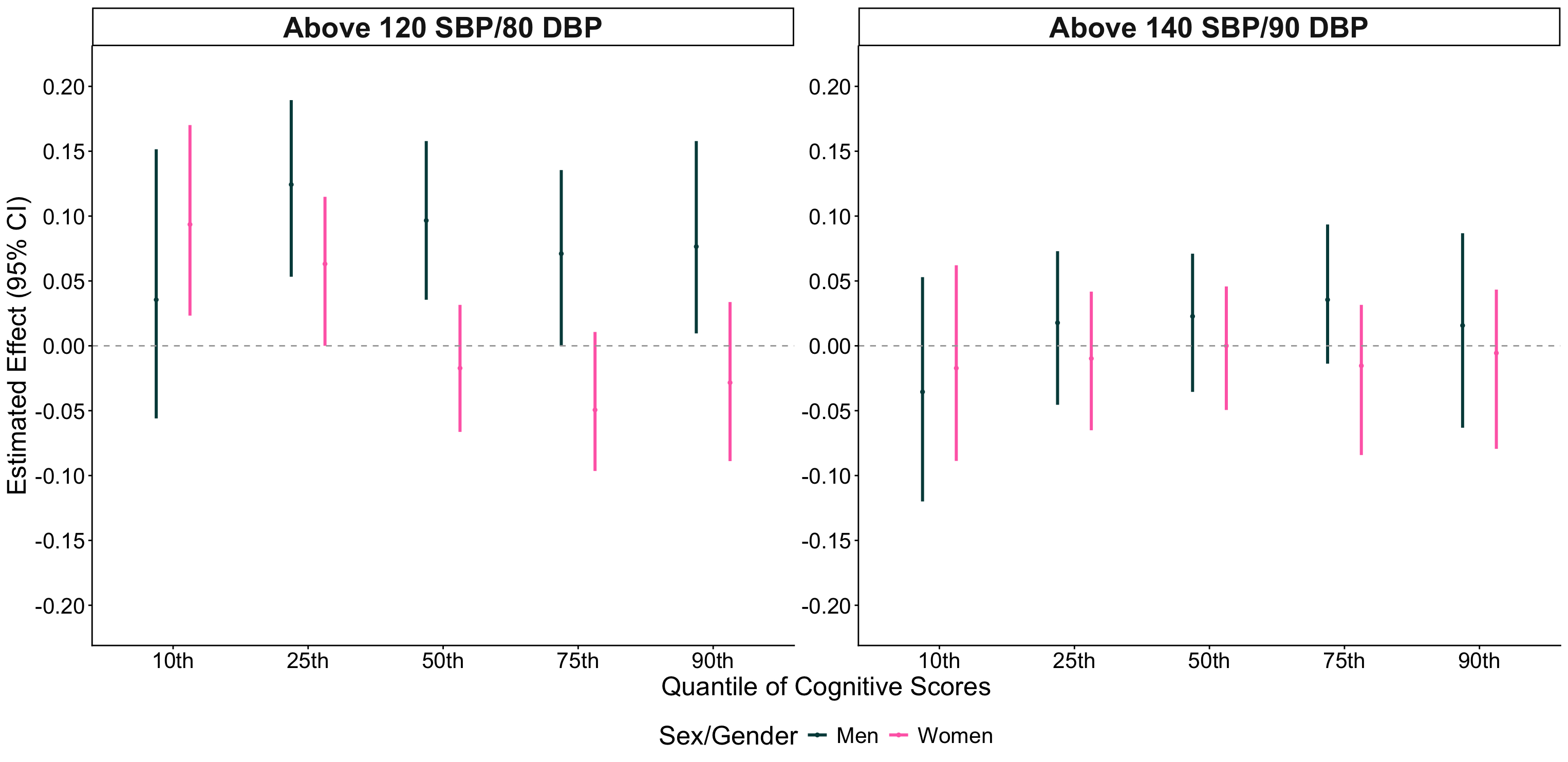
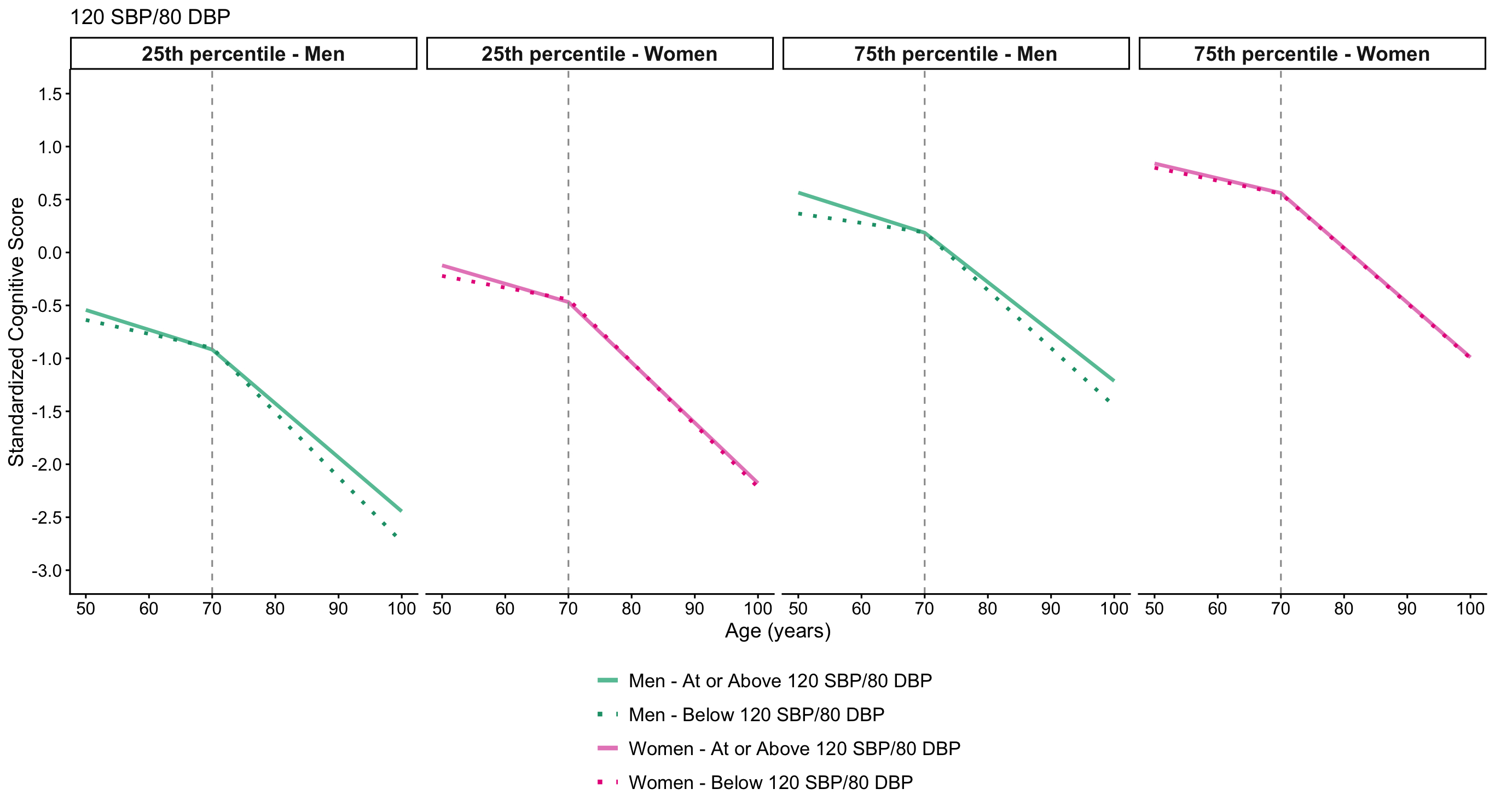
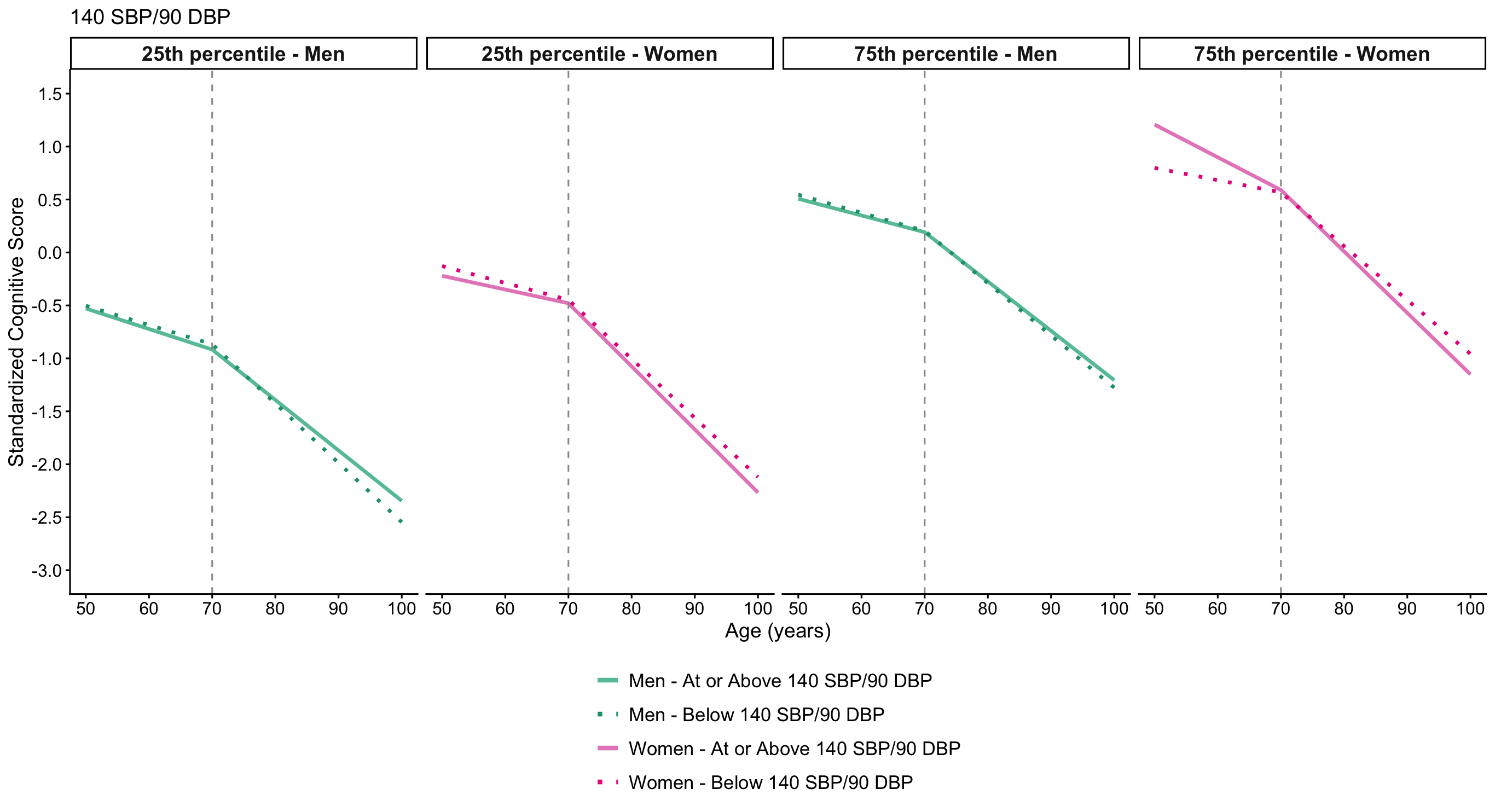
Abstract Body: Introduction: Sex/gender and age variability in the impact of elevated blood pressure (BP) on older adult cognitive function remains understudied across the continuum of cognition. Hypothesis: Older women at elevated dementia risk (i.e., lower quantiles of cognition) receive less cognitive benefit than men from intensive systolic and diastolic BP (SBP and DBP) control, especially in late-life. Methods: We used Health and Retirement Study participants (n = 13,318, aged 51-104, 57.8% women, 76.3% Non-Hispanic White) with data on our biennially-collected outcome of interest: averaged 10-word immediate and delayed word recall scores. Our primary exposures were exceeding intensive (≥120/80 SBP/DBP) or conservative (≥140/90 SBP/DBP) BP thresholds, measured by sphygmomanometer readings in 2006 or 2008. We estimated linear quantile models for associations of exceeding each BP threshold with level (2006/2008) as well as linear quantile mixed effects models for per-year change (2006-2018) in word recall across 10th, 25th, 50th, 75th and 90th percentiles, evaluating heterogeneity by sex/gender and age (≤ versus > 70 years). Results: Men had higher average BP (mean SBP/DBP: 134/79 (SD: 20/12)) than women (mean SBP/DBP: 130/79 (SD: 21/12)). Both sex/genders scored comparably on baseline word recall (mean: 5 (SD: 1.7)). Exceeding intensive BP thresholds was associated with better baseline cognitive function among women at quantiles indicating higher dementia risk (e.g., β10th = 0.094, 95% CI = 0.023 to 0.170) and among men at most cognitive quantiles (e.g., β90th = 0.076, 95% CI = 0.010 to 0.156)). Among women before age 70 at lower risk for dementia, exceeding conservative (β75th = -0.019, 95% CI = -0.034 to -0.005) but not intensive (β75th = 0.001, 95% CI = -0.002 to 0.004) BP thresholds were associated with faster per-year decline. After age 70, exceeding intensive BP thresholds was associated with slower per-year decline for men at higher as well as lower dementia risk (e.g., β25th = 0.006, 95% CI = 0.000 to 0.012), though estimated effects were imprecise. Conclusions: In conclusion, BP below intensive thresholds was associated with worse cognitive function and faster decline, particularly among men. BP below conservative thresholds was associated with slower decline among women after age 70. Future work should evaluate whether the health benefits of intensive BP control should be weighed against cerebrovascular pathologies such as reduced cerebral perfusion.
Sims, Kendra
(
Boston University
, Boston , Massachusetts , United States )
Bibbins-domingo, Kirsten
(
JAMA and UCSF
, Chicago , Illinois , United States )
Glymour, Maria
(
Boston University - Epidemiology
, Boston , Massachusetts , United States )