Multiple Markers of Autonomic Dysfunction are Related to an Increased Risk of Cancer Mortality in Healthy Adults
Abstract Body: Introduction: Dysfunction of the autonomic nervous system—which regulates involuntary physiological functions throughout the body such as heart rate—increases the risk of cardiovascular disease (CVD) and CVD-related mortality. The health implications of autonomic dysfunction may also extend beyond CVD, including to cancer outcomes, although these associations are less well-understood.
Methods: We studied a prospective cohort of healthy adults in the Cooper Center Longitudinal Study who completed a preventive medicine exam, which included assessment of heart rate and blood pressure before, during, and after a maximal treadmill test. We examined the associations between multiple established markers of autonomic dysfunction—resting heart rate, heart rate recovery at 1-, 2- and 5-minutes, heart rate reserve, and systolic blood pressure [SBP] response to exercise—with all-site and site-specific cancer mortality (lung, prostate, pancreas, colorectal) ascertained through the National Death Index. Gompertz mortality models were used to estimate the associations between each marker of autonomic dysfunction and cancer mortality, adjusted for demographic and health-related variables. Analyses were sex-stratified when a significant sex interaction was present.
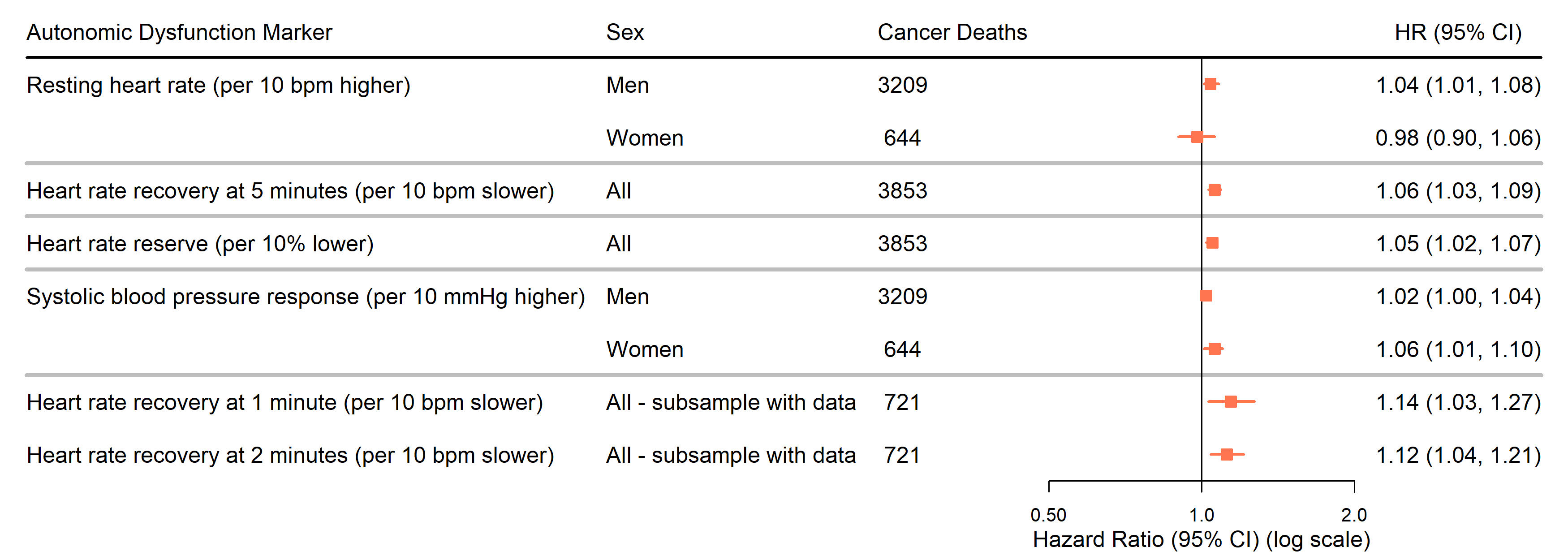
Results: Among 75,222 participants (26.8% women), 3853 cancer deaths (644 among women) were identified during a median follow-up of 21.9 years. Each marker of autonomic dysfunction was related to higher cancer mortality risk, including: higher resting heart among men (hazard ratio [HR] per 10 beats per minute [bpm]: 1.04; 95% CI: 1.01, 1.08), though not women; slower heart rate recovery among men and women combined (e.g., at 5-minutes, HR per 10 bpm slower recovery: 1.06; 95% CI: 1.03, 1.09); lower heart rate reserve among men and women combined (HR per 10% lower reserve: 1.05; 95% CI: 1.02, 1.07); and higher SBP response among men (HR per 10 mmHg: 1.02; 95% CI: 1.00, 1.04) and women (HR per 10 mmHg: 1.06; 95% CI: 1.01, 1.10). Slower heart rate recovery, lower heart rate reserve, and higher SBP response were similarly associated with increased lung cancer mortality (687 deaths). No other site-specific associations were statistically significant.
Conclusions: Multiple non-invasive markers of autonomic function routinely obtained during exercise testing were related to the risk of cancer mortality in healthy adults. Autonomic dysfunction may represent an early marker linking cardiovascular health with cancer risk.
Meernik, Clare
(
Texas Tech University Health Sciences Center
, Dallas , Texas , United States )
Leonard, David
(
Texas Tech University Health Sciences Center
, Dallas , Texas , United States )
Shuval, Kerem
(
Texas Tech University Health Sciences Center
, Dallas , Texas , United States )
Wright, Beth
(
Texas Tech University Health Sciences Center
, Dallas , Texas , United States )
Pavlovic, Andjelka
(
Texas Tech University Health Sciences Center
, Dallas , Texas , United States )
Jones, Lee
(
City of Hope
, Duarte , California , United States )
Gabriel, Kelley
(
University of Alabama at Birmingham
, Birmingham , Alabama , United States )
Radford, Nina
(
Cooper Clinic
, Dallas , Texas , United States )
Berry, Jarett
(
UT Tyler School of Medicine
, Tyler , Texas , United States )
Defina, Laura
(
Texas Tech University Health Sciences Center
, Dallas , Texas , United States )
Gilchrist, Susan
(
University of North Carolina at Chapel Hill School of Medicine
, Chapel Hill , North Carolina , United States )