Cardiac projecting NPY2r expressing neurons in stellate ganglia remodel myocardium in cardiac injury-related settings
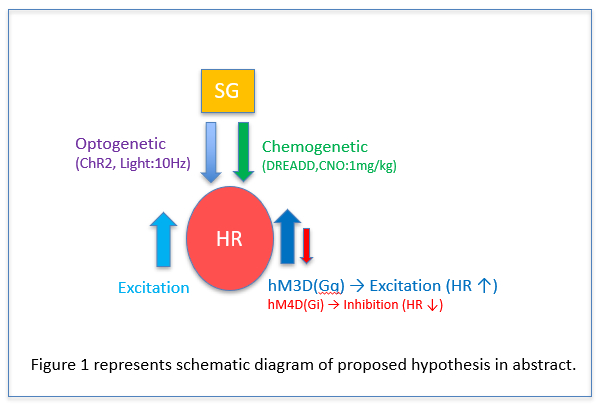
Abstract Body (Do not enter title and authors here): Introduction: Sympathetic regulatory aspects of cardiac functions are imbedded in the neural circuits of postganglionic sympathetic neurons residing in the stellate ganglia. Postganglionic neuronal subtypes innervating myocardium regulate cardiac functions and remodel myocardium during cardiac pathology. Hypothesis: In our previous study, leveraged by single-cell RNA sequencing (scRNAseq)analysis and viral tracing, we identified cardiac-innervating neuronal subtypes: NA1a, enriched in Neuropeptide-Y (NPY), and NA1b, enriched in the NPY2r receptor. The NA1a subtype mediates cardiac sympatho-excitation maximally. Therefore, we hypothesize that NPY via NPY2r receptor may play a mechanistic role in cardiac remodeling during cardiac injury. Methods: We used C57BL/6J, Npy-ires-Cre, Npy2r-ires-Cre, and Ai32 strains. Mice were anesthetized with Isoflurane (induction at 3–5%, maintenance at 1–3% vol/vol), intubated, and mechanically ventilated. For chemogenetic experiment, control mice (C57BL/6J) were injected with plasmids pAAV-hSyn-DIO-mCherry, pAAV-hSyn-hM3D(Gq)-mCherry, and pAAV-hSyn-hM4D(Gi)-mCherry in the stellate ganglia. For optogenetic stimulations, Npy-ires-Cre and Npy2r-ires-Cre mice were crossed with Ai32-(ChR2(H134R)/EYFP) and 8-10 weeks old, male, from colonies (Npy-ires-Cre::Ai32 and Npy2r-ires-Cre::Ai32) were chosen. An optical fiber connected to (473nm, 400mW, Optic Engine) was positioned for focal illumination of craniomedial right stellate ganglion stimulation. An electrocardiogram (ECG) was continuously acquired using a differential amplifier (A-M Systems, Model 1700 and Grass, P511) and recorded via PowerLab 8/35. Results: Heart rate was increased (103.53±14.64 bpm, n=3) in hM3D(Gq)-mCherry injected mice and were significantly reduced (~76 bpm) in hM4D(Gi)-mCherry injected C57BL/6J mice post-CNO (1.0mg/kg body-weight) administration compared to those injected with either i saline (0.9%W/V) or the inoculated plasmid pAAV-hSyn-DIO-mCherry and administered with either CNO (1.0mg/kg) or saline (0.9%W/V). Npy2r-ires-cre::Ai32 mice showed the highest change in heart rate (79.265±13.46 bpm, n=6) vs. controls (08.89±4.56 bpm, n=4) at 10 Hz stimulation frequency. Conclusion: Our results indicate that Npy2r-expressing NA1b cardiac-projecting neuronal subtypes, along with NA1a, modulate cardiac sympatho-excitation. These findings suggest that NPY2r may be a novel therapeutic target, either alone or in combination, for sympathetic blockade in cardiac disease.
Sharma, Sachin
(
Graphic Era University
, Dehradun , India )
Author Disclosures:
Sachin Sharma:DO NOT have relevant financial relationships
Lin Ruizhu, Yang Xia, Ajijola Olujimi, Zhao Yutian, Ang Kaitlyn, Sharma Sachin, Arreola Nigel, Ettipio Joseph, Ahn In Sook, Valenzuela Ripoll Carla, Javaheri Ali
4345580_File000000.jpg
You have to be authorized to contact abstract author. Please, Login