The Importance of Specific Guidance on Trans-fat Elimination in a Healthy Food Procurement Policy: An Evaluation from Schools in Nepal
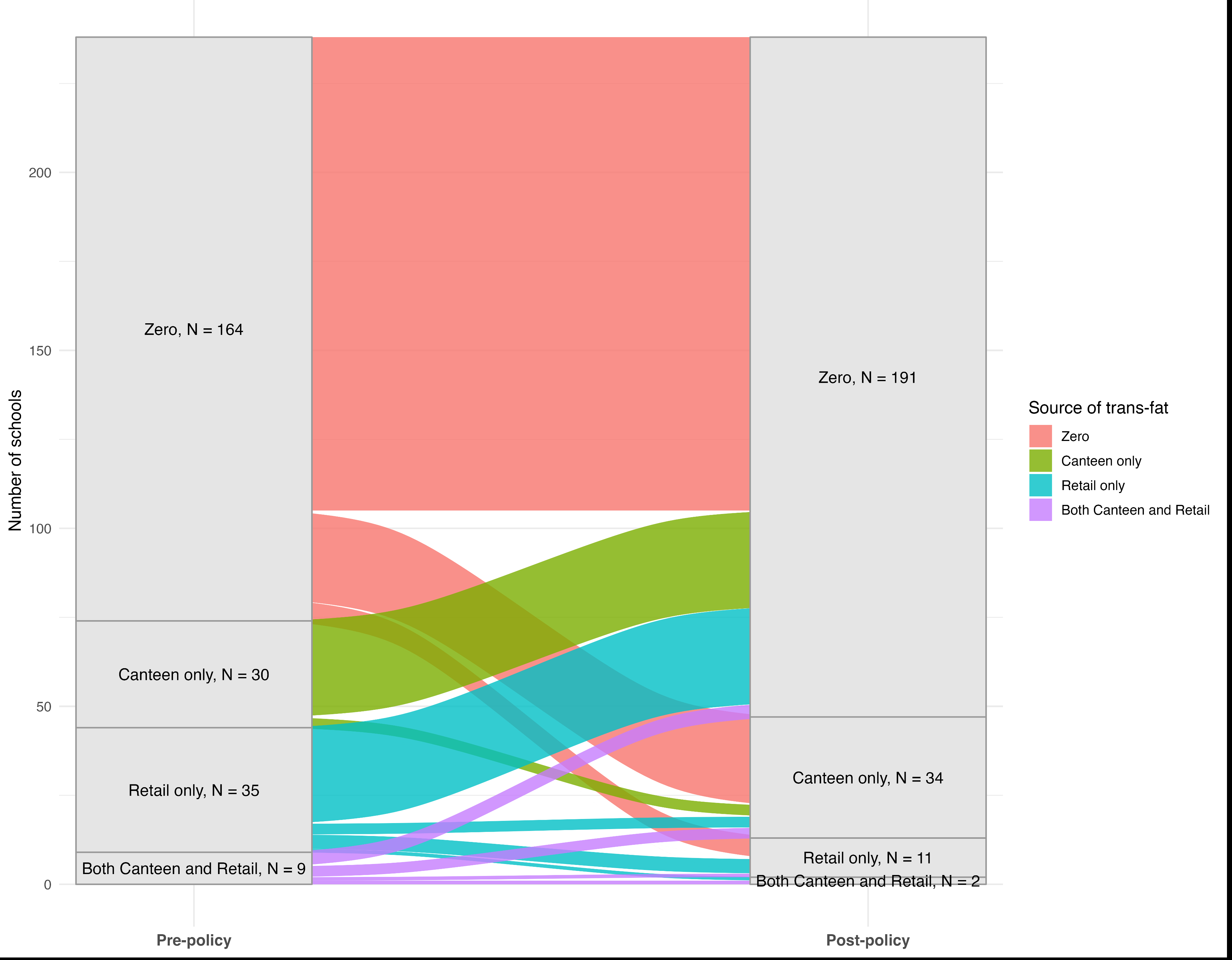
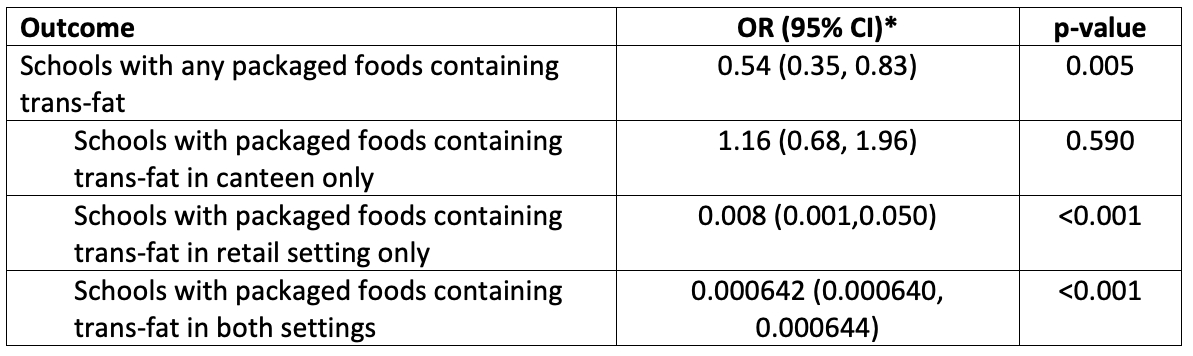
Abstract Body: Background: 540,000 deaths per year are attributed to industrially produced trans-fatty acids. Trans-fat has no known health benefits and is a major dietary risk factor for cardiovascular disease. Nepal passed national legislation in 2024, joining over 50 countries in restricting trans-fat. Healthy public food procurement and service policies were implemented at the municipality level and included language to limit or prohibit availability and purchase of trans-fat foods, a one-day training, nutrition posters, and follow-up visits in schools. Objective: To assess the change in availability of packaged foods containing trans-fat in school canteens and retail settings after policy implementation in Nepal. Methods: A quasi-experimental pre-post study was conducted in 238 schools in Nepal in 2024-25. Packaged foods were determined to contain trans-fat if non-zero levels of trans-fat were declared on nutrition information labels. Mutually exclusive categories were created for schools where packaged foods containing trans-fat were 1) unavailable, or available in 2) canteens only, 3) retail settings only, or 4) both. A Sankey plot was used to visualize the distribution. A mixed-effects logistic regression (MELR) model with random intercepts for schools and adjusting for different municipalities was used to assess change. Results: 74 schools (31%) had packaged foods containing trans-fat in canteen and/or retail settings prior to policy implementation, and 47 (20%) after, a decrease of 11%. Schools with packaged foods containing trans-fat in retail settings dropped from 35 to 11, but the number rose from 30 to 34 for canteens (Figure). MELR showed a lower odds ratio for schools with packaged foods that contained trans-fat after policy implementation (OR 0.54, 95%CI [0.35, 0.83]), consistent with a lower odds ratio in retail settings (OR 0.008, [0.001, 0.050]) and both retail settings and canteens (OR 0.000642, [0.000640, 0.000644]), but not in canteens only (OR 1.16, [0.68, 1.96]). Conclusions: Although schools reduced the availability of packaged foods containing trans-fat by about half after policy implementation, they were not eliminated. Significant decreases were observed in retail settings only, whereas canteens showed higher but nonsignificant levels. Without strong national enforcement of trans-fat elimination, a robust food procurement policy at the municipality level presents an opportunity to monitor and replace products containing trans-fat in schools.
Liu, Hairong
(
Johns Hopkins University
, Baltimore , Maryland , United States )
Hu, Xiao
(
Johns Hopkins University
, Baltimore , Maryland , United States )
Henry, Megan
(
Johns Hopkins University
, Baltimore , Maryland , United States )