D3 Creatine Dilution – Assessed Muscle Mass is Associated with Lower Perceived Physical Fatigability Among Older African Caribbean Men
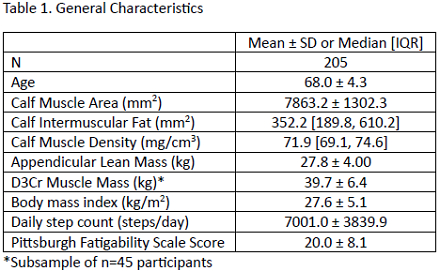
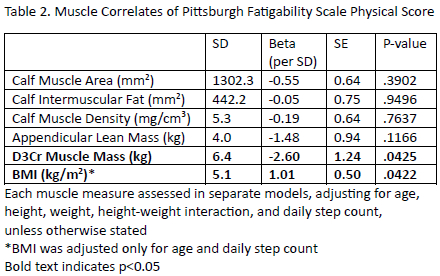
Abstract Body: Background: Fatigability, the degree of fatigue experienced in response to activities of standardized intensity and duration, is a well-recognized marker of functional decline, morbidity, and mortality, and is emerging as a potential risk factor for cardiovascular disease (CVD). In the disablement pathway, greater fatigability tends to follow lower muscle quantity and quality, known risk factors for CVD, highlighting a potential area for intervention. Older African ancestry individuals also have higher levels of muscle fat and a greater burden of cardio-metabolic disease than those of European ancestry. Therefore, we leveraged data from the Tobago Health Study with the aim of identifying which measures of muscle mass and quality were most closely associated cross-sectionally with lower perceived fatigability among 205 older African Caribbean men. Methods: Calf muscle area (MA), intermuscular fat (IMF), and muscle density (MD) were assessed via peripheral quantitative computed tomography. IMF and MD are measures of ectopic fat within muscle, and by extension, muscle quality. Appendicular lean mass (ALM) was assessed using dual-energy x-ray absorptiometry. In a subset of 45 men, total body muscle mass was assessed directly using the novel D3 creatine dilution assay (D3CrMM). Perceived physical fatigability was assessed using the Pittsburgh Fatigability Scale – Caribbean Version (PFS; range 0–50; higher PFS score=greater fatigability). Associations of muscle values with PFS were tested using linear regression adjusted for age, height, weight, height-weight interaction, and device-measured daily step count. BMI was also included as a comparator. Results: Men on average were 68.0 ± 4.3 years old, generally overweight (BMI = 27.6 ± 5.1 kg/m2), highly active (7001 ± 3940 steps/day), and had higher PFS Physical scores (20.0 ± 8.1). Each 1 SD increment higher D3CrMM (6.4kg) was associated with 2.6 points lower PFS score (p=.0425). MA, IMF, MD, and ALM were not associated with PFS Physical score. Conclusion: Higher levels of the novel D3 creatine dilution measure of total body muscle mass were cross-sectionally associated with lower perceived physical fatigability in this sample of African Caribbean men. Further study is warranted with larger samples, but our study provides new evidence that increasing muscle mass could be a target for intervention in reducing the burden of physical fatigability and its sequelae.
Cvejkus, Ryan
( University of Pittsburgh
, Pittsburgh
, Pennsylvania
, United States
)
Miljkovic, Iva
( University of Pittsburgh
, Pittsburgh
, Pennsylvania
, United States
)
Kim, Namhyun
( University of Pittsburgh
, Pittsburgh
, Pennsylvania
, United States
)
Zmuda, Joseph
( University of Pittsburgh
, Pittsburgh
, Pennsylvania
, United States
)
Cawthon, Peggy
( University of California San Francisco
, San Francisco
, California
, United States
)
Wheeler, Victor
( Tobago Health Studies Office
, Scarborough
, Trinidad and Tobago
)
Glynn, Nancy
( University of Pittsburgh
, Pittsburgh
, Pennsylvania
, United States
)