
Scientific Sessions 2024
/
PVD Potpourri 2
/
Analysis of Near-Infrared Spectroscopy Vascular Occlusion Test as a Complement to Ankle-Brachial Index and 6-Minute Walk Test in Patients Diagnosed with Peripheral Artery Disease
American Heart Association
122
0
Final ID: Su1147
Analysis of Near-Infrared Spectroscopy Vascular Occlusion Test as a Complement to Ankle-Brachial Index and 6-Minute Walk Test in Patients Diagnosed with Peripheral Artery Disease
Abstract Body (Do not enter title and authors here): Introduction Peripheral arterial disease (PAD) is caused by a lack of blood flow to the musculature relative to its metabolism which results in pain. PAD impacts up to 20% of patients around the world. PAD involves macrovascular and microvascular dysfunction. Near-infrared spectroscopy (NIRS) measures muscle oxygenation levels and assesses microvascular function. The standard of care for diagnosing PAD is the ankle-brachial index (ABI), which assesses macrovascular disease, and the 6-minute walk test (6MWT), which measures gait speed and claudication. NIRS has the potential to monitor progression of PAD.
Hypothesis NIRS measurement of muscle oxygenation, during a standard test of vascular occlusion and post-occlusive hyperemia, the vascular occlusion test (VOT), is predictive of PAD severity as determined by ABI and 6MWT.
Methods We studied 24 patients diagnosed with PAD. The mean age of the patients was 71.3 years, including 54% (n=13) males and 46% (n=11) females. The VOT consisted of rest, occlusion, and reperfusion phases each lasting 5 min (15 min total). Muscle oxygen saturation levels were recorded at 2 hertz. For every patient, 6 features were extracted from the VOT data using computational methods. The VOT features from 15 patients were used to train function-fitting neural network models to predict ABI and 6MWT Continuous Distance. The models were then used to predict ABI and 6MWT Continuous Distance from the VOT features of 9 test patients not used in the training,
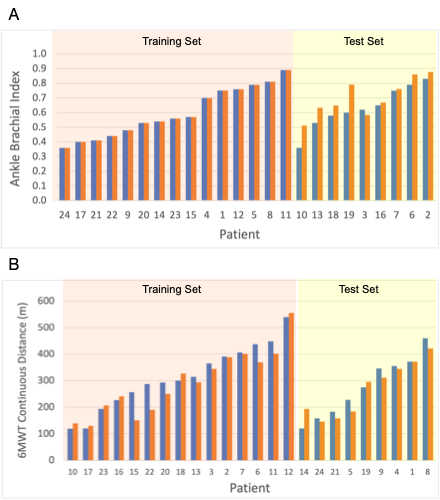
Results For patients in the test set, the ABI and 6MWT Continuous Distance predicted by the models differed from the actual measurements by 14%±13% and 15%±17%, respectively (Figure 1). For patients in the training set, the ABI and 6MWT Continuous Distance predicted by the models differed from the actual measurements by 0±0% and 12%±11%, respectively (Figure 1).
Conclusion The VOT has the potential to predict the ABI and 6MWT Continuous Distance of patients diagnosed with PAD, suggesting that the VOT can be automated and used to monitor the severity of PAD. With more data from both healthy patients and PAD patients, and improvement of the model, we anticipate that the VOT will complement ABI and 6MWT in the diagnosis and monitoring of PAD.
Rodriguez, Cesar
( Florida State University
, Tallahassee
, Florida
, United States
)
Lanka, Santh Prakash
( Mayo Clinic
, Jacksonville
, Florida
, United States
)
Maraj, Joshua
( University of Tennessee
, Knoxville
, Tennessee
, United States
)
Alsabbagh, Yaman
( Mayo Clinic
, Jacksonville
, Florida
, United States
)
Farres, Sam
( Mayo Clinic
, Jacksonville
, Florida
, United States
)
Ade, Carl
( Kansas State University
, Manhattan
, Kansas
, United States
)
Liu, Xiuwen
( Florida State University
, Tallahassee
, Florida
, United States
)
Delp, Judy
( Kansas State University
, Manhattan
, Kansas
, United States
)
Author Disclosures:
Cesar Rodriguez:DO NOT have relevant financial relationships
| Santh Prakash Lanka:DO NOT have relevant financial relationships
| Joshua Maraj:DO NOT have relevant financial relationships
| Yaman Alsabbagh:DO NOT have relevant financial relationships
| Sam Farres:DO NOT have relevant financial relationships
| Carl Ade:DO NOT have relevant financial relationships
| Xiuwen Liu:No Answer
| Judy Delp:DO NOT have relevant financial relationships