
Objectively Measured vs. Self-Reported Physical Activity and Coronary Artery Calcification: The Atherosclerosis Risk in Communities Study
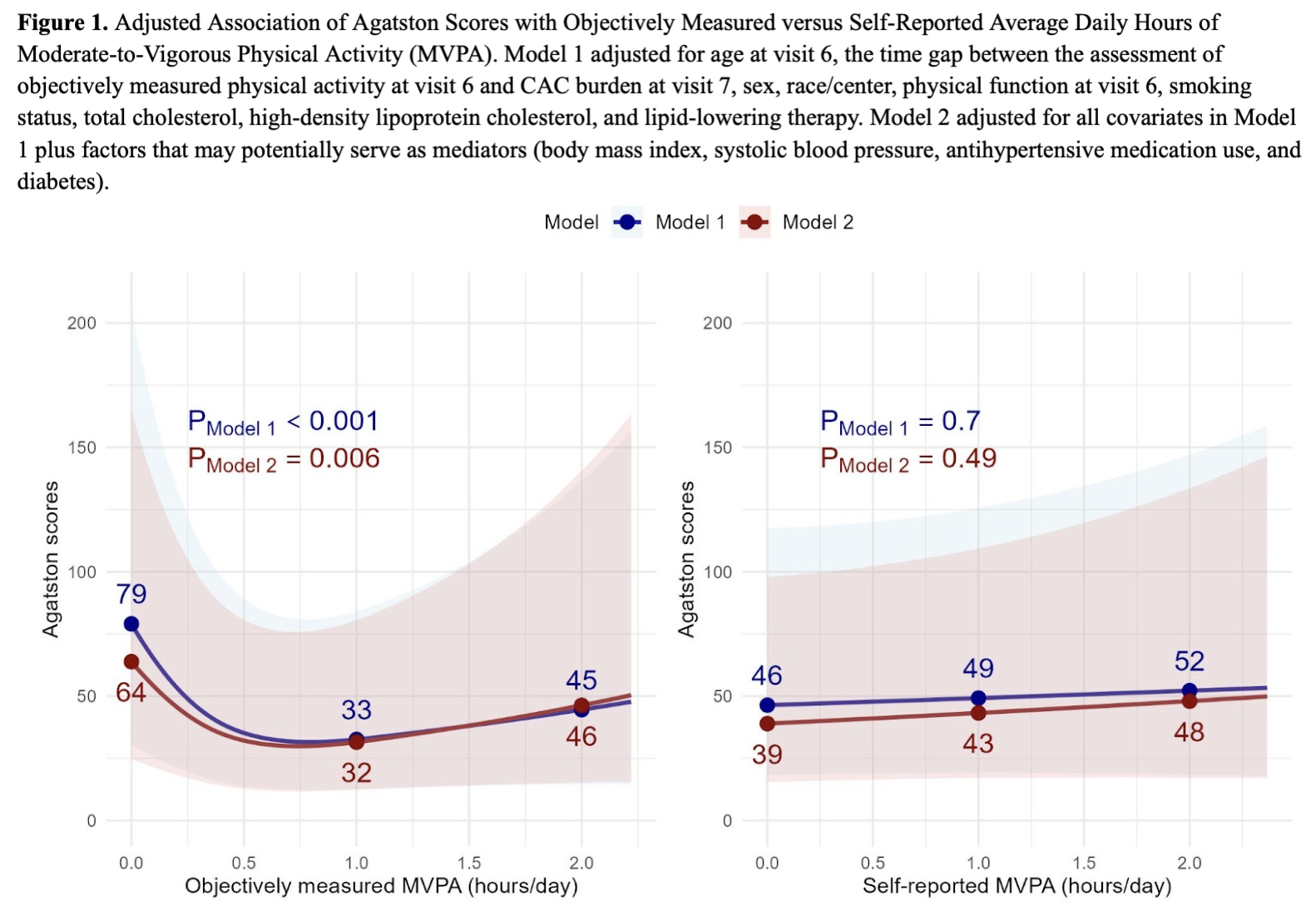
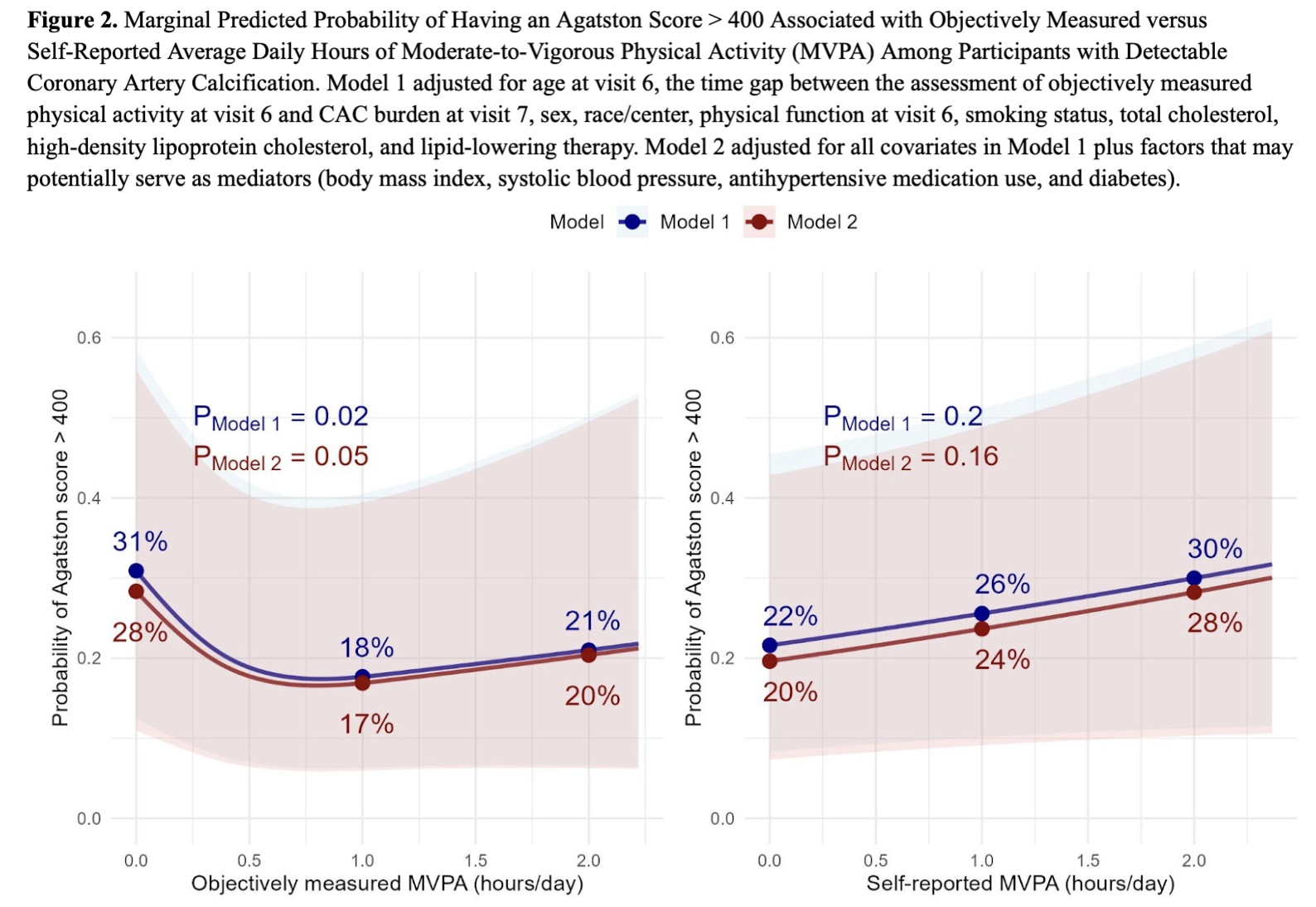
Abstract Body: Introduction: Coronary artery calcification (CAC) is a marker of subclinical atherosclerosis with important implications for cardiovascular risk assessment. Despite established cardiovascular benefits of physical activity, its relationship with CAC remains unclear. Hypothesis: The CAC Agatston score has an inverse association with both objectively measured and self-reported physical activity. Methods: We analyzed data from 1,449 participants in the Atherosclerosis Risk in Communities (ARIC) study to investigate the cross-sectional association of objective and self-reported physical activity at visit 6 (2016-17) with Agatston scores from cardiac CT at visit 7 (2018-19). Objective physical activity was measured using an accelerometer embedded in the Zio® XT ECG monitor, which provided continuous monitoring for up to 14 days. Self-reported activity in the past year was assessed via modified Baecke Questionnaire. Multivariable linear regression and logistic regression were used for analysis. Results: Objective and self-reported physical activity assessments were obtained at a median (IQR) age of 78 (75-81) years; 60.4% were females, and 23.1% were Black. The Spearman correlation coefficient between objectively measured and self-reported average daily hours of moderate-to-vigorous physical activity (MVPA) was 0.40. Cardiac CT scan was performed at a median (IQR) of 1.7 (1.5-2.0) years thereafter. Overall, the Agatston score was 0 in 10.1% and was > 400 in 39.1% of the participants. We observed a significant J-shaped association between objectively measured MVPA and Agatston score (Figure 1). The estimated mean Agatston score was highest at 64 (at 0 hours/day of MVPA) and reached its nadir of 30 at 0.74 hours/day of MVPA. Beyond 0.74 hours/day of MVPA, the estimated mean Agatston score showed a slight upward trend. Similarly, among participants with detectable CAC (Agatston score > 0), 0.80 hours/day of MVPA corresponded to the lowest marginal predicted probability (17%) of severe CAC (Agatston score > 400) (Figure 2). In contrast, there was no significant association between self-reported MVPA and Agatston scores. Conclusions: Objectively measured physical activity demonstrated a J-shaped relationship with CAC, with the lowest Agatston score observed at approximately 45 minutes daily of MVPA. Self-reported activity may inadequately capture this association, highlighting the importance of objective assessment in cardiovascular risk evaluation.
Sun, Daokun
(
University of Minnesota
, Minneapolis , Minnesota , United States )
Etzkorn, Lacey
(
Johns Hopkins University
, Baltimore , Maryland , United States )
Mok, Yejin
(
Johns Hopkins University
, Baltimore , Maryland , United States )
Zhang, Chunxiao
(
University of Minnesota
, Minneapolis , Minnesota , United States )
Cui, Erjia
(
University of Minnesota
, Minneapolis , Minnesota , United States )
Norby, Faye
(
University of Minnesota
, Minneapolis , Minnesota , United States )
Tang, Weihong
(
UNIVERSITY OF MINNESOTA
, Minneapolis , Minnesota , United States )
Pankow, Jim
(
UNIV MINNESOTA
, Minneapolis , Minnesota , United States )
Schrack, Jennifer
(
Johns Hopkins University
, Baltimore , Maryland , United States )
Blaha, Michael
(
JOHNS HOPKINS HOSPITAL
, Baltimore , Maryland , United States )
Matsushita, Kunihiro
(
JOHNS HOPKINS UNIVERSITY
, Baltimore , Maryland , United States )
Chen, Lin Yee
(
UNIVERSITY OF MINNESOTA
, Minneapolis , Minnesota , United States )