Logo

American Heart Association

  5
  0


Final ID: WE481

Disrupted Circadian Rest-Activity Rhythms and Incident Heart Failure in the Aging Population: The Atherosclerosis Risk in Communities Study

Abstract Body: Introduction: Circadian rhythm disruption is prevalent in older adults and has been linked to autonomic dysfunction, chronic inflammation, and metabolic dysregulation, which are key pathological processes implicated in the development of heart failure (HF). Despite these shared mechanistic pathways, the association between disrupted circadian rest-activity rhythms (RARs) and HF remains unknown. This longitudinal study investigated the association between circadian RARs and incident HF among older adults from the Atherosclerosis Risk in Communities (ARIC) study.
Hypothesis: Disrupted circadian RARs are associated with increased risk of incident HF.
Methods: We included participants free of HF at visit 6 (2016-17) when RARs were assessed using an accelerometer embedded in the Zio® XT ECG monitor. RARs were quantified using three nonparametric indices: relative amplitude (rhythm strength), interdaily stability (rhythm regularity), and intradaily variability (rhythm fragmentation). All three RAR measures were standardized to a mean of 0 and a standard deviation of 1 to enable direct comparison of effect sizes across metrics. Cox proportional hazards regression was used for analysis.
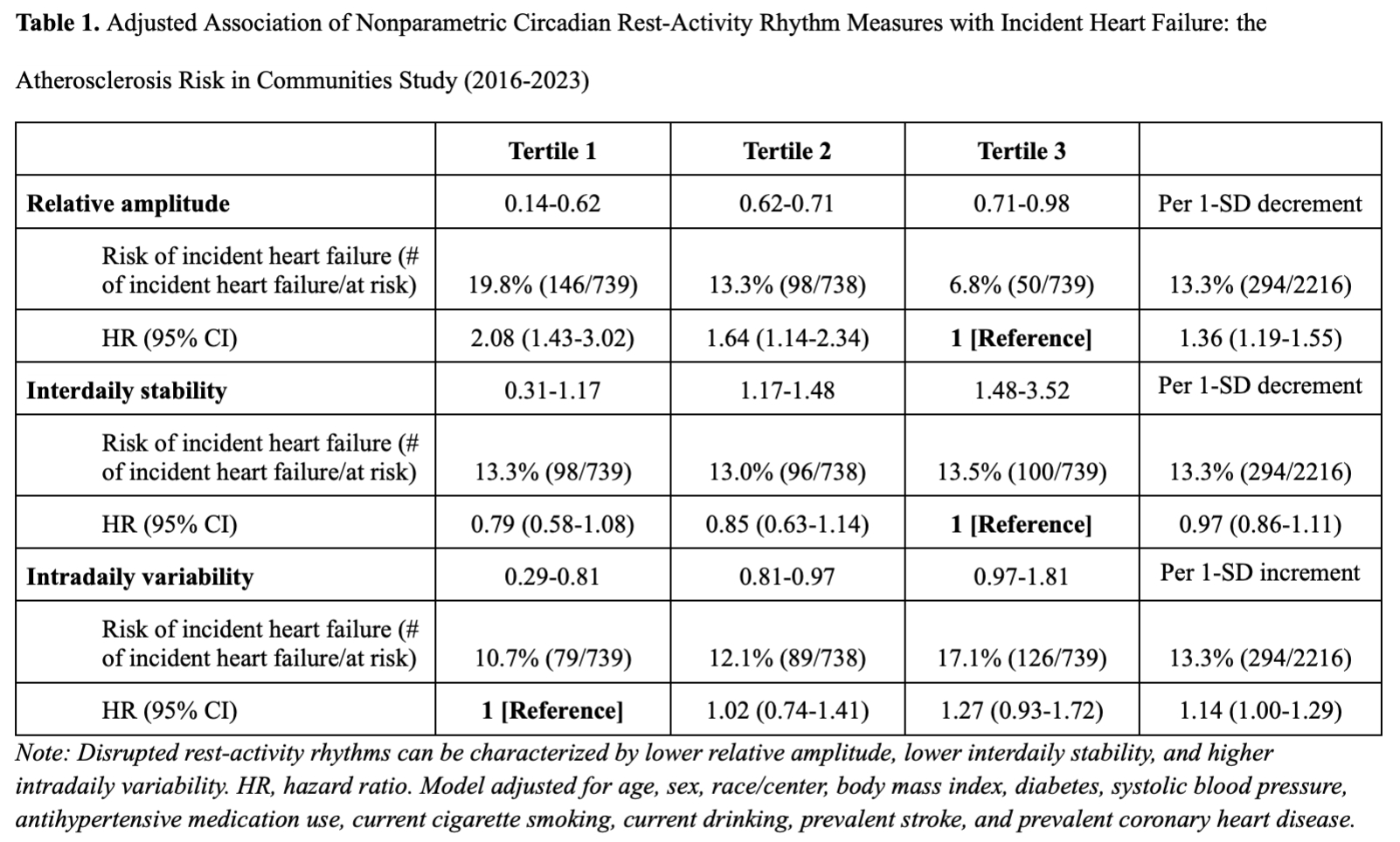
Results: We analyzed data from 2,216 participants (median age, 78 years) with RAR evaluation over a median (IQR) of 13.8 (13.1-14.0) days of uninterrupted monitoring. During a median (IQR) follow-up of 6.6 (5.0-7.0) years, 294 (13.3%) participants developed incident HF. Lower relative amplitude, indicating reduced circadian rhythm strength, was significantly associated with elevated HF risk. After adjusting for baseline characteristics and prevalent cardiovascular disease, each one-standard-deviation decrease in relative amplitude was associated with a 36% (HR (95% CI), 1.36 (1.19-1.55)) higher risk of HF (Table 1). Compared to those in the highest tertile, participants in the lowest tertile had a more than 2-fold higher risk of developing HF, while those in the middle tertile had a 64% higher risk. However, the risk of incident HF was not significantly different across tertiles of interdaily stability and intradaily variability.
Conclusions: In this longitudinal study of community-dwelling older adults without prevalent HF, lower circadian rhythm strength (i.e., lower relative amplitude) was significantly associated with higher risk of developing HF. Circadian rhythm disruption may be a novel risk marker for early identification of individuals at elevated risk of HF.
  • Sun, Daokun  ( University of Minnesota , Minneapolis , Minnesota , United States )
  • Etzkorn, Lacey  ( Johns Hopkins University , Baltimore , Maryland , United States )
  • Wang, Wendy  ( UT Southwestern Medical Center , Dallas , Texas , United States )
  • Spira, Adam  ( Johns Hopkins University , Baltimore , Maryland , United States )
  • Shah, Amil  ( UT Southwestern Medical Center , Dallas , Texas , United States )
  • Schrack, Jennifer  ( Johns Hopkins University , Baltimore , Maryland , United States )
  • Chen, Lin Yee  ( UNIVERSITY OF MINNESOTA , Minneapolis , Minnesota , United States )
  • Author Disclosures:
Meeting Info:

EPI-Lifestyle Scientific Sessions 2026

2026

Boston, Massachusetts

Session Info:

Poster Session 2

Wednesday, 03/18/2026 , 05:00PM - 07:00PM

Poster Session

More abstracts on this topic:
A Case of Dilated Cardiomyopathy and Systemic Thromboembolism in a Young Patient on Testosterone Replacement Therapy

Sabri Muhammad, Ijaz Naila, Nadeem Ramsha, Checchio Lucy, Riaz Faiza

4D Flow MRI Evaluation of Cardiovascular Risk-Related Alterations in Heart-Brain Hemodynamics in Cognitively Healthy Aging Adults

Najafi Anahita, Rogalski Emily, Jarvis Kelly, Richter Adam, Lytchakov Anna, Benson Theresa, Jin Ning, Davids Rachel, Schnell Susanne, Ragin Ann, Weintraub Sandra

More abstracts from these authors:
Association Between Circadian Rest/Activity Rhythms and Incident Dementia in Older Adults: The Atherosclerosis Risk in Communities (ARIC) Study

Wang Wendy, Crainiceanu Ciprian, Spira Adam, Schrack Jennifer, Chen Lin, Wanigatunga Amal, Etzkorn Lacey, Rabinowitz Jill, Palta Priya, Pike James, Dougherty Ryan, Zipunnikov Vadim, Marino Francesca

Objectively Measured vs. Self-Reported Physical Activity and Coronary Artery Calcification: The Atherosclerosis Risk in Communities Study

Sun Daokun, Blaha Michael, Matsushita Kunihiro, Chen Lin Yee, Etzkorn Lacey, Mok Yejin, Zhang Chunxiao, Cui Erjia, Norby Faye, Tang Weihong, Pankow Jim, Schrack Jennifer

You have to be authorized to contact abstract author. Please, Login
Not Available