
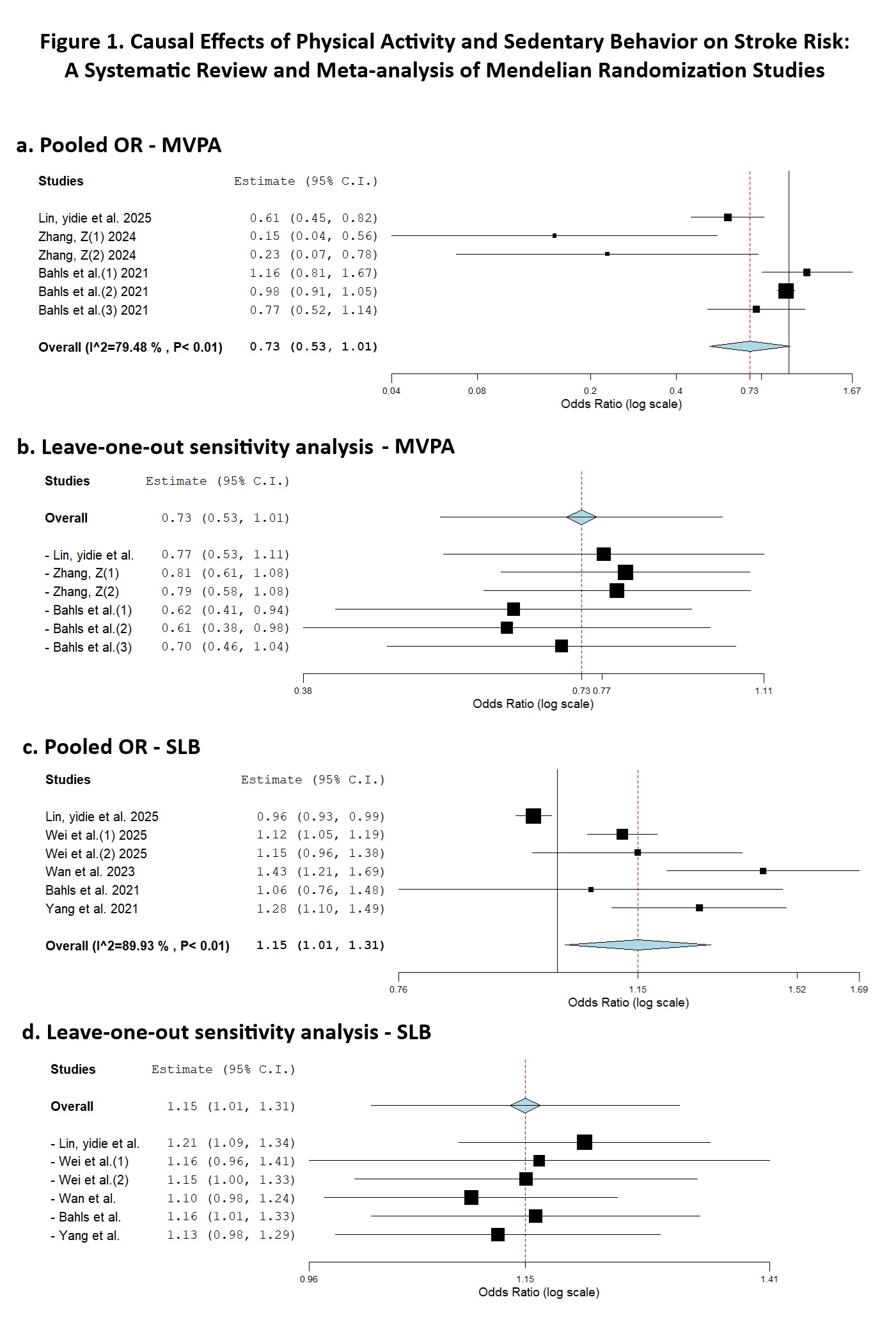
Causal Effects of Physical Activity and Sedentary Behavior on Stroke Risk: A Systematic Review and Meta-analysis of Mendelian Randomization Studies
Abstract Body: Background: Stroke is a major health burden and the second leading cause of death globally, only after ischemic heart disease. While observational studies have elaborated on the effect of physical activity (PA) and sedentary behavior (SB) on stroke risk, their findings remain inconsistent and are often influenced by confounding factors and reverse causation. Mendelian randomization (MR) can help overcome these shortcomings and assess potential causal relationships using genetic variants as proxies for exposures.
Methods: We conducted a systematic review and meta-analysis of MR studies investigating the effects of PA and SB on stroke risk. Following PRISMA guidelines, we searched PubMed and Google Scholar through May 2025. Eligible studies used two-sample MR designs to estimate the impact of moderate-to-vigorous physical activity (MVPA) and sedentary leisure behavior (SLB) on stroke outcomes. MVPA exposures included self-reported activity and accelerometer-derived measures (e.g., leisure time MVPA ≥425 mg), while SLB included television, screen time, sitting, etc. Key outcomes of interest were any stroke and ischemic stroke events. Random-effects models were used for meta-analysis and heterogeneity was assessed with the I2 statistic. Leave-one-out sensitivity analyses were performed to ensure robustness of the results.
Results: Six studies met inclusion criteria. Genetically predicted MVPA was associated with a lower risk of stroke (pooled OR = 0.73; 95% CI: 0.53–1.01; p = 0.06), though the result was not statistically significant (I2= 79.5%). In contrast, SLB showed a significant association with increased stroke risk (pooled OR = 1.15; 95% CI: 1.01–1.31; p = 0.03; I2 = 89.9%). Sensitivity analyses confirmed that findings were not influenced by any single study.
Conclusion: These findings support a causal association between SLB and increased stroke risk, with suggestive but non-significant evidence for MVPA’s protective role. Despite significant association, high heterogeneity warrants conscious interpretation of findings. Further MR studies using standardized exposure definitions and updated genetic data are needed to strengthen the results.
Suchday, Pooja
(
GCS medical college, Ahmedabad
, Bhuj, kutch , India )
Bhanushali, Aditi
(
Mayo Clinic, Rochester, Minnesota
, Rochester , Minnesota , United States )
Karumanchi, Abhimanyu
(
Kamineni institute of medical sciences
, Narketpalli , India )
Birdi, Jiya
(
Phoenix Country Day School
, Scottsdale , Arizona , United States )
Potlabathini, Tejaswini
(
Malla Reddy Institute of Medical Sciences
, Hyderabad , India )
Singh, Vartika
(
Mercy Catholic Medical Center
, Darby , Pennsylvania , United States )
Shah, Dhwani
(
Grant Government Medical College
, Mumbai , India )
Battula, Tanvi
(
Gandhi Medical College
, Hyderabad , India )
Adrejiya, Parth
(
Wellstar Health System
, Griffin , Georgia , United States )
Desai, Rupak
(
Independent Researcher
, Atlanta , Georgia , United States )