Vegetable Intake and Coronary Heart Disease Risk: Discovery, Replication, and Application of Food Biomarkers
Abstract Body: Introduction: Few studies have evaluated the associations between total, subgroup, and individual vegetable intake and coronary heart disease (CHD) risk using objective biomarkers of specific vegetables.
Hypothesis: Urinary biomarkers reflecting specific vegetable intake can be identified in an observational study setting and may predict CHD risk.
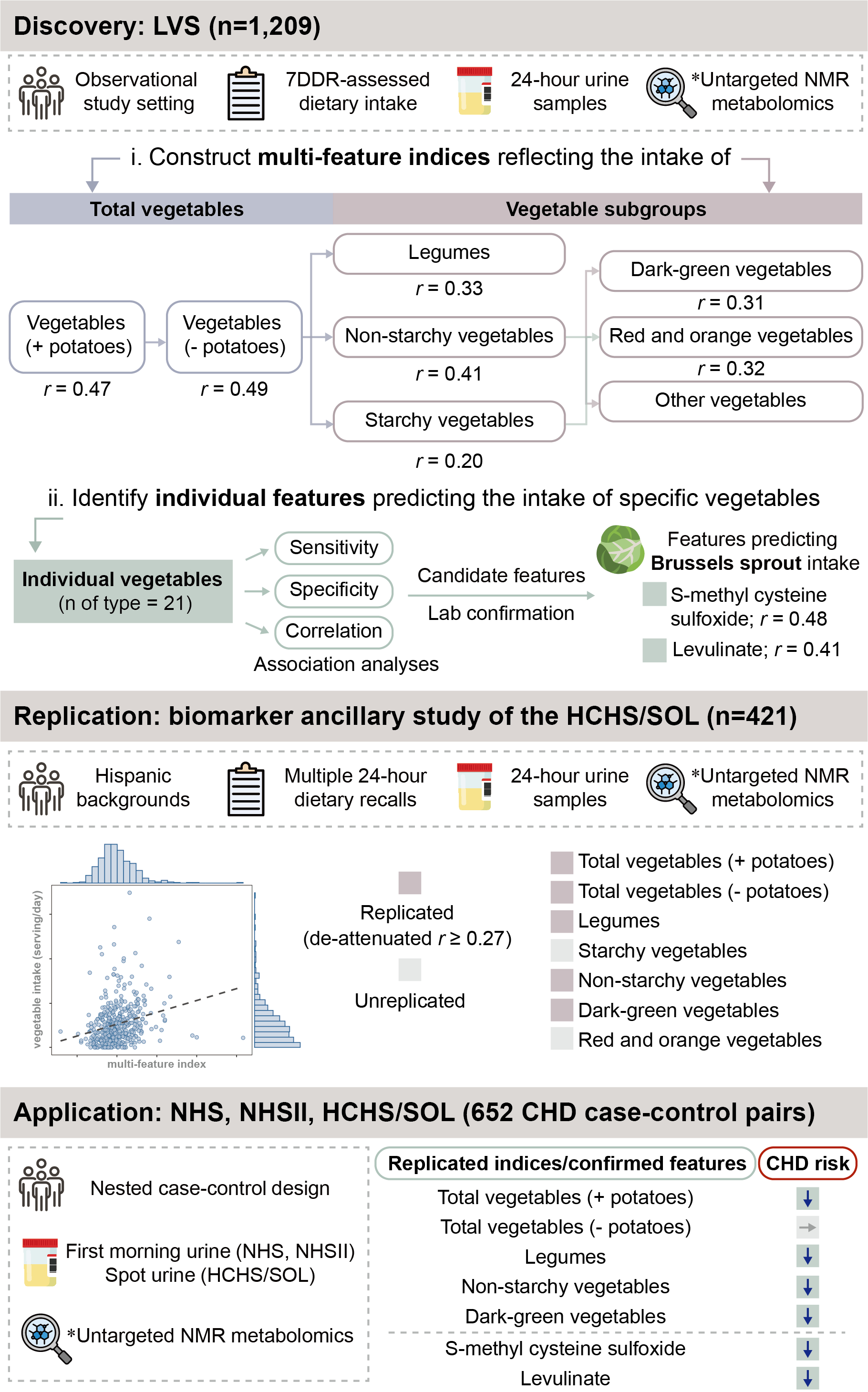
Methods: Using untargeted proton nuclear magnetic resonance (1H-NMR) metabolomics and 7-day diet record data from 1,209 participants in the Lifestyle Validation Study, we used the Least Absolute Shrinkage and Selection Operator (LASSO) to construct urinary multi-feature indices for total and subgroup vegetable intake. Index replication was performed in an ancillary study ofthe Hispanic Community Health Study/Study of Latinos (HCHS/SOL). Two-part models were used to identify features specifically associated with individual vegetable intake. Associations of urinary features with CHD risk were examined using conditional logistic regression in nested case-control studies within the Nurses’ Health Study (NHS), NHSII, and HCHS/SOL (652 matched pairs).
Results: Among the 589 NMR features, LASSO selected 9 to 55 features to construct urinary indices reflecting the intake of total vegetables, legumes, starchy vegetables [SVs], non-starchy vegetables, dark-green vegetables, and red/orange vegetables, respectively. These indices showed moderate correlations with their respective intakes (Pearson r = 0.31-0.49; Figure), except for SV (r = 0.20). Indices for total and most subgroups, except for red/orange and SVs, were externally replicated, with de-attenuated r ranging from 0.27 to 0.49. Multivariable-adjusted ORs (95% CIs) for CHD risk per 1-SD increase in urinary indices were 0.88 (0.77-0.99) for total vegetables including potatoes, 0.92 (0.81-1.04) excluding potatoes, 0.88 (0.77-1.00) for legumes, 0.83 (0.75-0.93) for non-starchy vegetables, and 0.81 (0.73-0.91) for dark-green vegetables. For NMR features reflecting specific vegetable intake, the strongest correlations were found for S-methyl cysteine sulfoxide and levulinate with Brussels sprout intake, with r of 0.48 and 0.41 among consumers. Both features were associated with a lower CHD risk.
Conclusions: Urinary biomarkers for the intake of total, subgroup, and individual vegetables were identified and replicated across free-living populations. Higher biomarker-assessed intake of total vegetables, legumes, and non-starchy vegetables was associated with a lower CHD risk.
Han, Han
(
Harvard T.H. Chan School of Public Health
, Boston , Massachusetts , United States )
Hu, Yang
(
Harvard T.H. Chan School of Public Health
, Boston , Massachusetts , United States )
Liang, Liming
(
Harvard T.H. Chan School of Public Health
, Boston , Massachusetts , United States )
Rimm, Eric
(
Harvard T.H. Chan School of Public Health
, Boston , Massachusetts , United States )
Stampfer, Meir
(
Harvard T.H. Chan School of Public Health
, Boston , Massachusetts , United States )
Mossavar-rahmani, Yasmin
(
Albert Einstein College of Medicine
, Bronx , New York , United States )
Van Horn, Linda
(
Northwestern University
, Elmhurst , Illinois , United States )
Daviglus, Martha
(
University of Illinois at Chicago
, Chicago , Illinois , United States )
Mcclain, Amanda
(
San Diego State University
, San Diego , California , United States )
Woodside, Jayne
(
Queens University Belfast
, Belfast , United Kingdom )
Hu, Frank
(
Harvard T.H. Chan School of Public Health
, Boston , Massachusetts , United States )
Kaplan, Robert
(
Albert Einstein College of Medicine
, Bronx , New York , United States )
Brennan, Lorraine
(
University College Dublin
, Dublin , United Kingdom )
Qi, Qibin
(
Albert Einstein College of Medicine
, Bronx , New York , United States )
Sun, Qi
(
Harvard T.H. Chan School of Public Health
, Boston , Massachusetts , United States )