Plasma Lipidome, Apolipoprotein-Defined High-Density Lipoprotein Subspecies, and Their Associations with Coronary Heart Disease Risk
Abstract Body: Introduction: HDL subspecies defined by functional apolipoproteins (apo) exhibit different associations with coronary heart disease (CHD) risk; however, the underlying mechanism, particularly from a lipidomic perspective, is unclear.
Hypothesis: Apo-defined HDL subspecies may be characterized by distinct lipid profiles that are associated with differential CHD risk.
Methods: We measured the apoA1 concentrations of 15 apo-defined HDL subspecies and 176 plasma lipids among 446 women in Nurses’ Health Study (NHS). The proportion of each HDL subspecies was calculated as the ratio of apoA1 concentrations in HDL containing a specific protein to total plasma apoA1 concentration. Linear regression was used to identify individual lipids associated with the proportions of HDL subspecies, and elastic net regression was used to define predictive lipidomic signatures. Associations between lipidomic signatures and CHD risk were examined using conditional logistic regression in a nested case-control study (400 matched pairs) and Cox regression in 13,495 participants from NHS, NHSII, and Health Professionals Follow-Up Study.
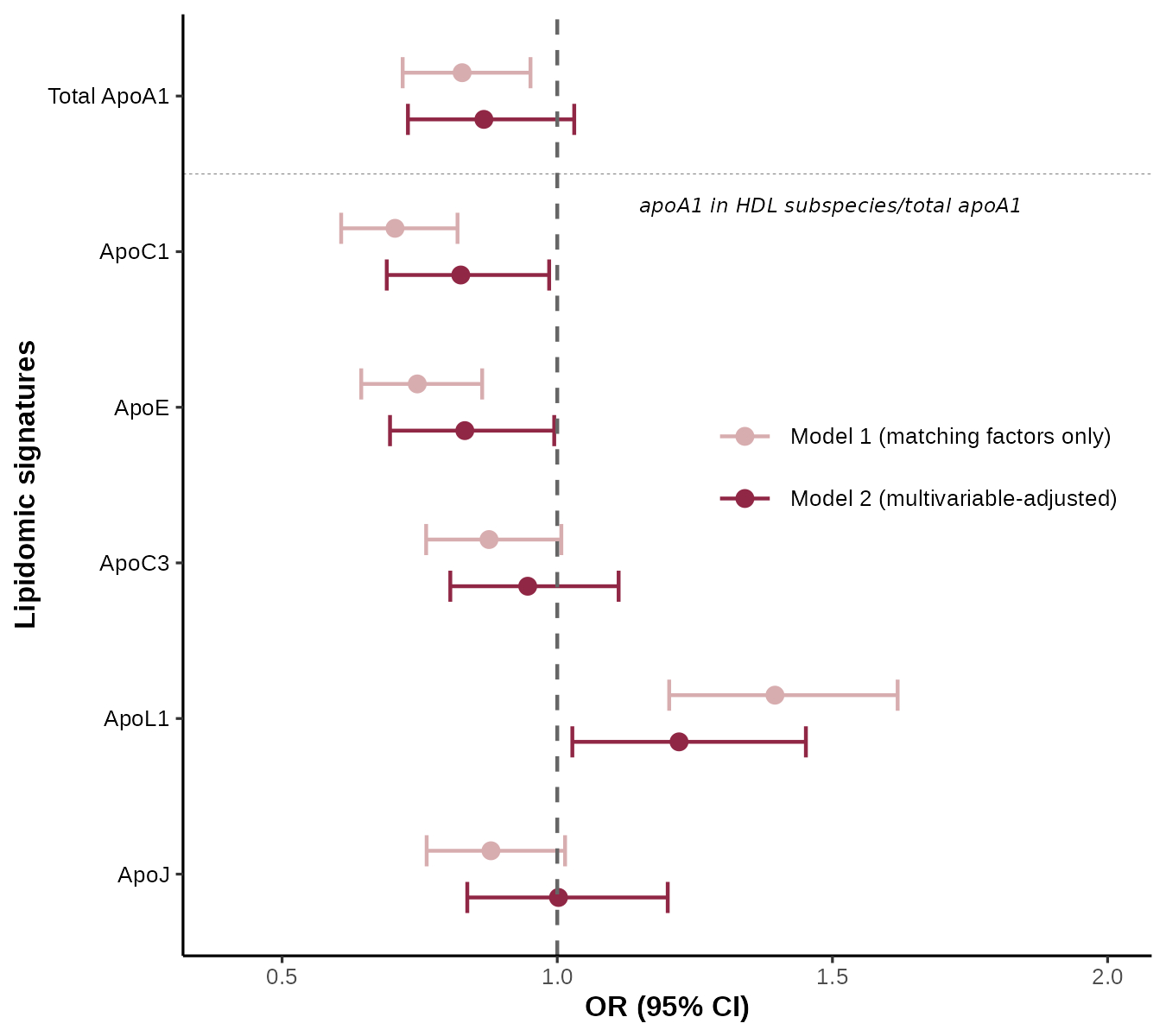
Results: HDL subspecies showed different associations with lipidomic features: proportions of HDL containing apoC1, apoE, apoL1, apoC3, and apoJ were associated with specific lipids, while few associations were found for the other ten subspecies. The lipid profile of HDL containing apoC1 closely resembled that of total apoA1, whereas HDL containing apoL1 showed a distinct pattern. Several TAGs and DAGs were negatively associated with apoC1 but positively with apoL1; conversely, certain phospholipids showed positive associations with apoC1 and negative associations with apoL1. The Pearson r between the lipidomic signatures and their corresponding HDL subspecies was 0.76 for total apoA1 (total HDL), 0.67 for apoC1, 0.63 for apoE, 0.55 for apoC3, 0.50 for apoL1, and 0.34 for apoJ. Multivariable-adjusted ORs (95% CIs) for CHD risk per 1-SD increase in lipidomic signatures were 0.85 (0.72, 1.00) for total apoA1, 0.77 (0.65, 0.91) for apoC1, 0.79 (0.66, 0.94) for apoE, 0.92 (0.79, 1.08) for apoC3, 1.30 (1.10, 1.53) for apoL1, and 0.97 (0.81, 1.15) for apoJ (Figure). Individual lipids positively associated with HDL containing apoL1, including specific TAGs, DAGs, and ceramides, were also related to a higher CHD risk in the cohorts.
Conclusions: Lipid profiles vary across apo-defined HDL subspecies and may contribute to their different associations with CHD risk.
Han, Han
(
Harvard T.H. Chan School of Public Health
, Boston , Massachusetts , United States )
Hu, Yang
(
Harvard T.H. Chan School of Public Health
, Boston , Massachusetts , United States )
Wang, Molin
(
Harvard T.H. Chan School of Public Health
, Boston , Massachusetts , United States )
Zhang, Bo
(
Fukuoka University
, Fukuoka University , Japan )
Hu, Frank
(
Harvard T.H. Chan School of Public Health
, Boston , Massachusetts , United States )
Rimm, Eric
(
Harvard T.H. Chan School of Public Health
, Boston , Massachusetts , United States )
Sacks, Frank
(
Harvard T.H. Chan School of Public Health
, Boston , Massachusetts , United States )
Furtado, Jeremy
(
Harvard T.H. Chan School of Public Health
, Boston , Massachusetts , United States )
Hui, Sheng
(
Harvard T.H. Chan School of Public Health
, Boston , Massachusetts , United States )
Sun, Qi
(
Harvard T.H. Chan School of Public Health
, Boston , Massachusetts , United States )