
Logo

American Heart Association

  1
  0


Final ID: TU109

Sex Differences in Frailty Phenotypes among Older Adults with Cardiovascular Disease

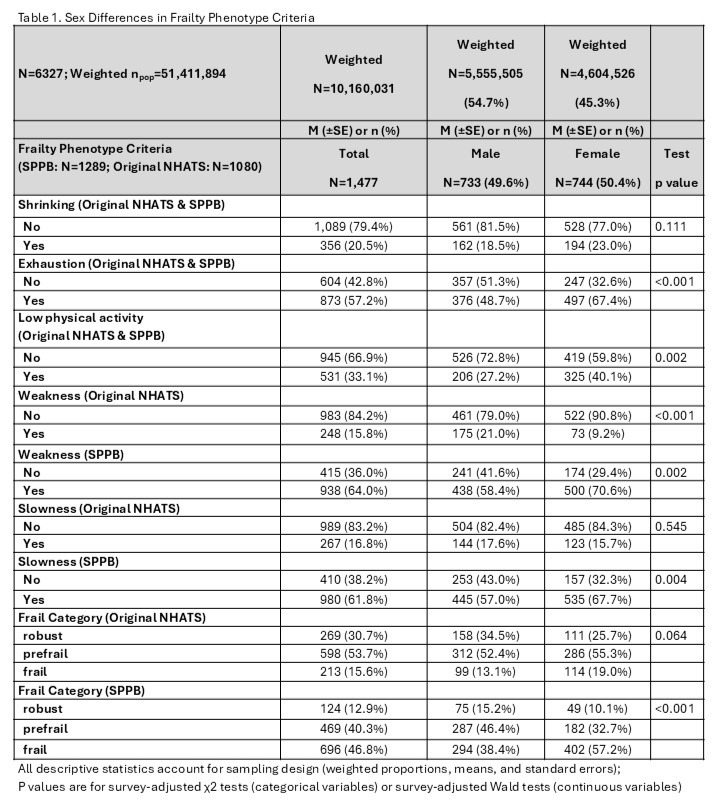
Abstract Body: Introduction: Frailty is highly prevalent and prognostically significant among older adults with cardiovascular disease (CVD). Studies have shown that women are more likely to be frail compared with men; however, sex differences in frailty phenotypes remain underexplored in CVD. Purpose: We quantified sex differences in frailty phenotypes among community-dwelling older adults with CVD. Methods: We used data from participants in Round 12 of the National Health and Aging Trends Study (NHATS) with a reported history of CVD (history of heart disease and myocardial infarction). The Frailty Phenotype Criteria were used to assess frailty: unintentional weight loss, weakness, slowness, physical exhaustion, and low physical activity. To determine if participants met these criteria, we 1) applied original operationalized definitions for NHATS data (Original NHATS), and 2) replaced the weakness (based on 5-repeat chair stands, not grip strength) and slowness criteria with measures from the Short Physical Performance Battery (SPPB). Weighted descriptive and comparative statistics were used to compare frailty phenotypes between women and men. Results: Of the 1477 community-dwelling older adults in Round 12 with a reported history of CVD, the average age (±standard error) was 76.4±0.2 years, 45.3% were female, and 81.3% were non-Hispanic White (Table 1). Using the original NHATS criteria measures (N=1080), 15.6% were frail, but there was no significant sex difference (p = 0.064). Replacing weakness and slowness criteria with the SPPB measures (N=1289), 46.8% were frail, and women were significantly more likely to be frail compared with men (p < 0.001). Conclusions: The prevalence of frailty among older adults with CVD varies depending on the criteria for weakness and slowness; however, using the SPPB measures augmented our sample size. Moreover, observed sex differences in frailty may depend on the criteria used.
  • Hiatt, Shirin  ( Oregon Health & Science University , Portland , Oregon , United States )
  • Wang, Zijiao  ( Oregon Health & Science University , Portland , Oregon , United States )
  • Bidwell, Julie  ( University of California, Davis , Granite Bay , California , United States )
  • Song, Minkyoung  ( Oregon Health & Science University , Portland , Oregon , United States )
  • Denfeld, Quin  ( Oregon Health & Science University , Portland , Oregon , United States )
  • Roberts Davis, Mary  ( Oregon Health & Science University , Portland , Oregon , United States )
  • Author Disclosures:
Meeting Info:

EPI-Lifestyle Scientific Sessions 2026

2026

Boston, Massachusetts

Session Info:

Poster Session 1

Tuesday, 03/17/2026 , 05:00PM - 07:00PM

Poster Session

More abstracts on this topic:
Association of Delayed Diagnosis of Transthyretin Cardiomyopathy with Heart Failure Hospitalizations and Mortality

Spencer-bonilla Gabriela, Huang Joanna, Witteles Ronald, Heidenreich Paul, Sandhu Alexander, Alexander Kevin, Fan Jun, Cheng Paul, Din Natasha, Rodriguez Fatima, Varshney Anubodh, Davies Marie, Venditto John, Papas Mia

Association of Daily Step Count with All-Cause Mortality Among Older Adults with Hypertension and Resistant Hypertension

Parvizi Pardis, Paluch Amanda, Lee Duck-chul

More abstracts from these authors:
Changes in N-terminal pro-B-type natriuretic peptide and soluble suppressor of tumorigenicity-2 during the transition from hospital to home in heart failure

Denfeld Quin, Hiatt Shirin, Melson Ryan, Habecker Beth, Lee Christopher

Are Females More Fraily than Males at Time of Heart Failure Diagnosis?

Roberts Davis Mary, Dieckmann Nathan, Chien Christopher, Hansen Lissi, Erickson Elise, Alkayed Nabil, Shannon Jackilen, Denfeld Quin

You have to be authorized to contact abstract author. Please, Login
Not Available