
Logo

American Heart Association

  15
  0


Final ID: MP2074

Changes in N-terminal pro-B-type natriuretic peptide and soluble suppressor of tumorigenicity-2 during the transition from hospital to home in heart failure

Abstract Body (Do not enter title and authors here):
Background: Major goals during a hospitalization for heart failure (HF) are adequate decongestion and hemodynamic optimization to avoid worsening symptom burden and rehospitalization. Tracking changes in biomarkers of HF, such as N-terminal pro-B-type natriuretic peptide (NT-proBNP) and soluble suppressor of tumorigenicity-2 (ST2), during the transition from hospital to home may help identify risk for worsening HF.
Purpose: To quantify trajectories of change in plasma NT-proBNP and ST2 and predictors thereof over 6 months post-HF hospitalization.
Methods: This is an analysis of interim data from a NIH-funded study of patients hospitalized for worsening HF. Data and plasma samples were collected prior to hospital discharge and again at 1 week and 1, 3, and 6 months post-HF hospitalization. Plasma NT-proBNP and ST2 were quantified using proximity extension assays as part of the Olink Proteomics Target 96 Cardiovascular III Panel; biomarker data are presented as normalized protein expression (NPX). Latent growth curve modelling was used to quantify trajectories of change in biomarkers and predictors thereof.
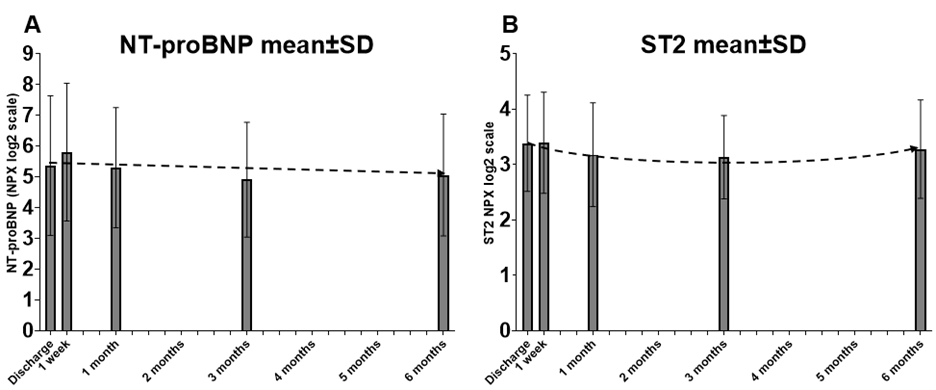
Results: The sample (n=107) was 61.2±13.3 years and 42% female. The majority were NYHA Class III (72%) and had HF with reduced ejection fraction (60%), and the median length of stay was 8 days [interquartile range 6-12]. There was a significant linear decrease in NT-proBNP over 6 months (linear change = -0.08±0.03, p = 0.008; Figure 1A) and a significant non-linear decrease in ST2 (linear change = -0.15±0.04, p = 0.001; quadratic change = 0.02±0.01, p = 0.002; Figure 1B). Women had significantly lower NT-proBNP (difference = -0.97±0.42, p = 0.02) and lower ST2 (difference = -0.34±0.16, p = 0.03) at hospital discharge, but there was no significant sex difference in trajectory of change for either biomarker. Those with HFpEF had significantly lower NT-proBNP at hospital discharge (difference = -1.01±0.43, p = 0.02) but no significant difference in trajectory of change. There was no difference by HF type for ST2.
Conclusion: There was a significant decrease in plasma NT-proBNP and ST2 over 6 months post-hospitalization for HF; although ST2 increased slightly at 6 months. Both female sex and HFpEF classification were significant predictors of baseline biomarker values.
  • Denfeld, Quin  ( Oregon Health Science University , Portland , Oregon , United States )
  • Hiatt, Shirin  ( Oregon Health Science University , Portland , Oregon , United States )
  • Melson, Ryan  ( Oregon Health Science University , Portland , Oregon , United States )
  • Habecker, Beth  ( Oregon Health Science University , Portland , Oregon , United States )
  • Lee, Christopher  ( Boston College , Chestnut Hill , Massachusetts , United States )
  • Author Disclosures:
    Quin Denfeld: DO NOT have relevant financial relationships | Shirin Hiatt: DO NOT have relevant financial relationships | Ryan Melson: DO NOT have relevant financial relationships | Beth Habecker: DO NOT have relevant financial relationships | Christopher Lee: DO NOT have relevant financial relationships
Meeting Info:

Scientific Sessions 2025

2025

New Orleans, Louisiana

Session Info:

From Molecules to Mindsets: Multidimensional Perspectives on Heart Failure

Monday, 11/10/2025 , 12:15PM - 01:00PM

Moderated Digital Poster Session

More abstracts on this topic:
More abstracts from these authors:
Plasma Proteomic Biomarkers Are Associated With Physical Frailty In Heart Failure: A Propensity Score Matched Exploratory Study

Denfeld Quin, Pavlovic Noelle, Lee Christopher, Jacobs Jon, Roberts Davis Mary, Powell Samantha, Gritsenko Marina, Joseph Susan, Habecker Beth

Addressing Frailty in the Patient with Heart Failure

Masterson Creber Ruth, Denfeld Quin

You have to be authorized to contact abstract author. Please, Login
Not Available