Logo

American Heart Association

  1
  0


Final ID: 52

Long-term Diabetes Incidence Among Young Adults By Glycemic Status And Risk Scores: 35-Year Follow-Up in the Coronary Artery Risk Development In Young Adults (CARDIA) Study

Abstract Body: Introduction
Young adulthood is increasingly recognized as an important window for diabetes prevention. While lifestyle interventions and pharmacotherapy are available to young adults, early identification of those at risk of diabetes progression is essential to targeted prevention. Diabetes risk progression has been extensively studied in other age groups, but it is unknown whether younger adults with prediabetes have similar risk of progression. Long-term studies of diabetes outcomes from young adulthood can fill this gap.

Objective
To characterize 35-year diabetes incidence among young adults in a diverse population-based cohort by baseline glycemic status and risk scores.

Methods
The Coronary Artery Risk Development in Young Adults (CARDIA) study followed a cohort of individuals aged 18-30 at enrollment, with balanced subgroups of race (Black and White), gender, and education level, in 4 US cities. Individuals had 8 glycemic examinations from 1985-1986 through 2020-2022. We determined diabetes incidence density, cumulative incidence, and Kaplan-Meier survival, by baseline glycemic status (normoglycemia or impaired fasting glucose [IFG]) and ADA-CDC Prediabetes Risk Test scores (“high-risk” defined >=4; score components gender, BMI, family history, physical inactivity, hypertension).

Results
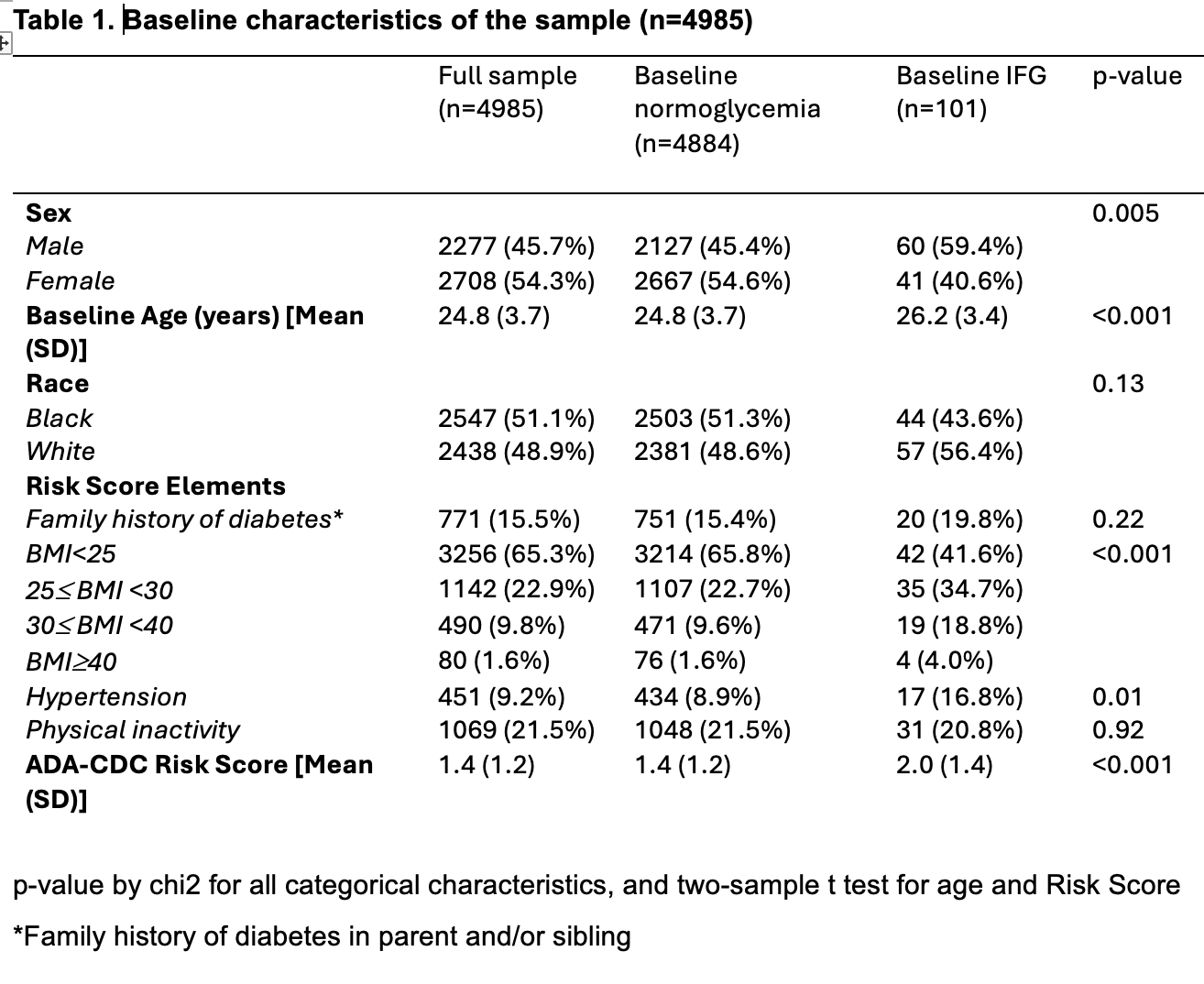
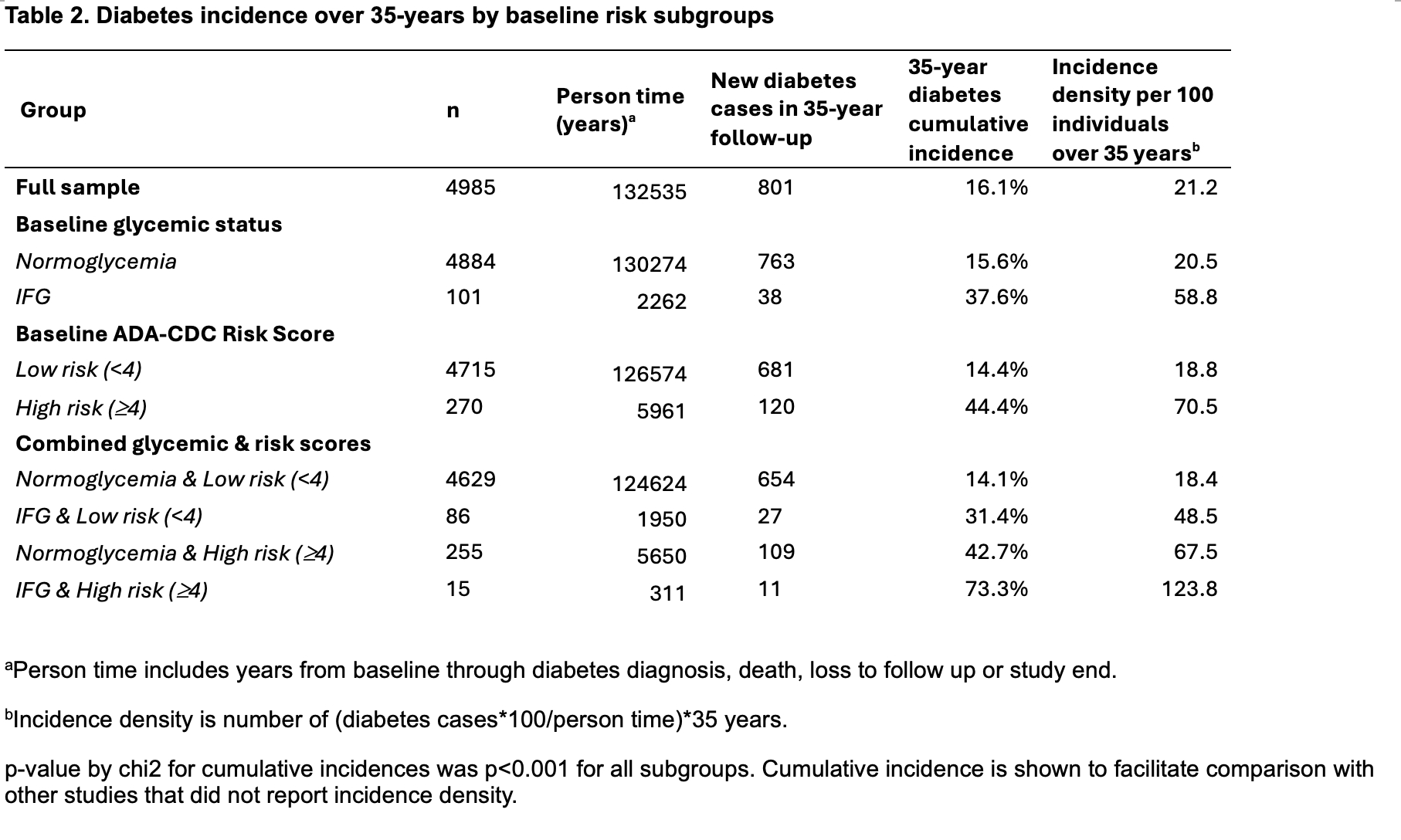
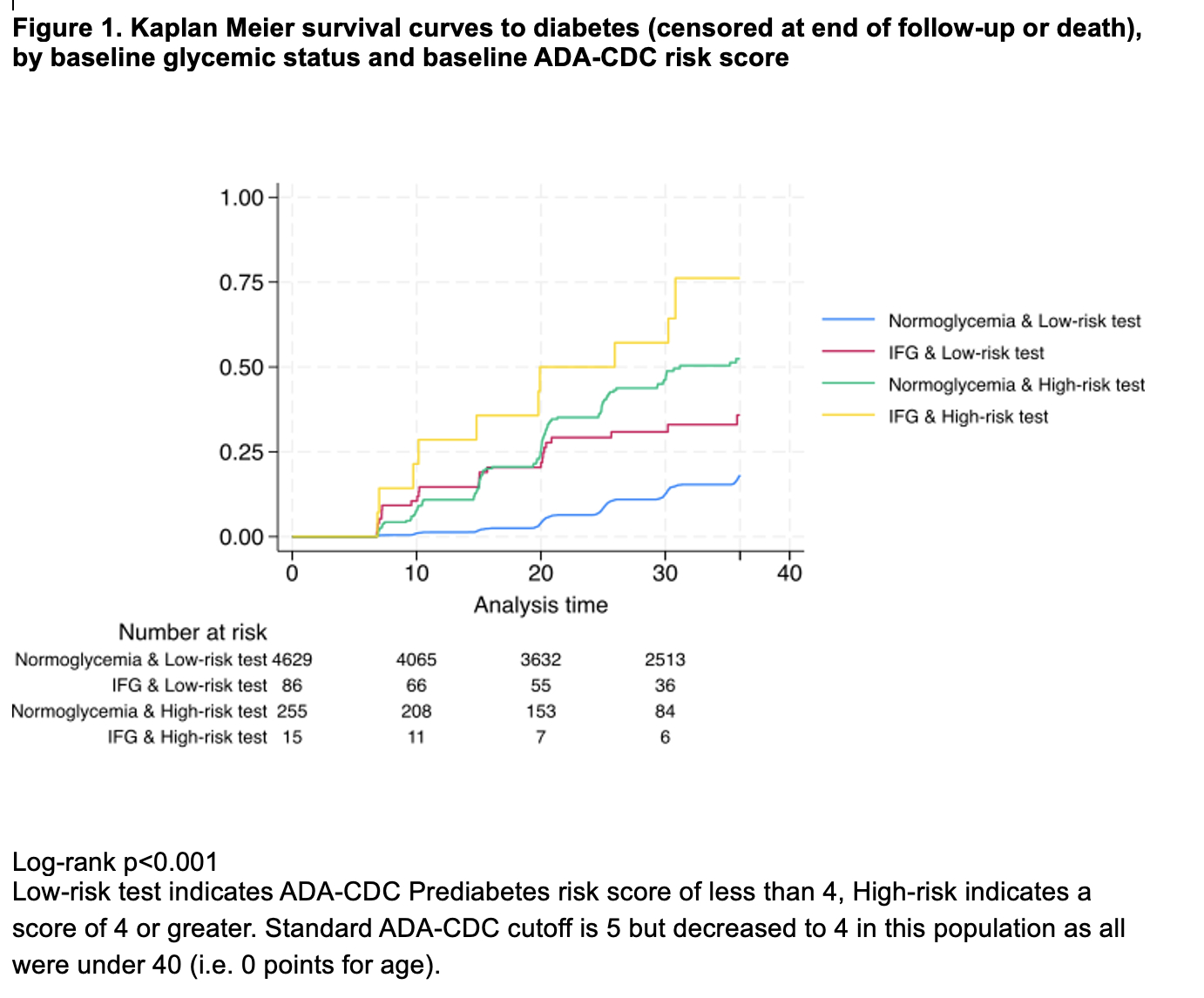
We followed 4985 participants for a median 30.1 years (Table 1). Overall diabetes incidence density was 21.2 cases per 3500 person-years (21.2 cases/100 individuals in 35 years; cumulative incidence 16%), and 58.8 cases for baseline IFG (n=101; cumulative incidence 38%). Individuals with both IFG and high-risk score had highest incidence (123.8 cases; cumulative incidence 73%), followed by baseline normoglycemia and high-risk score (67.5 cases; cumulative incidence 43%) then IFG and low-risk score (48.5 cases; cumulative incidence 31%). (Table 2; Fig 1)

Conclusions
35-year diabetes incidence among young adults with IFG was lower than prior long-term studies in middle-aged cohorts. Those with IFG with high-risk scores had highest incidence, and baseline normoglycemia with high-risk scores had higher incidence than IFG overall or IFG with low-risk scores. These findings support increased use of risk-assessment tools in young adults, lowering the threshold for ADA-CDC Prediabetes Risk Test from 5 to 4 for young adults (for Diabetes Prevention Program eligibility), and highlight a need for validated, young adult-specific diabetes risk screening approaches.
  • Arons, Abigail  ( UC Davis , San Francisco , California , United States )
  • Bhatt, Ankeet  ( Kaiser Permenante , San Francisco , California , United States )
  • Schreiner, Pamela  ( UNIV MINNESOTA , Minneapolis , Minnesota , United States )
  • Vable, Anusha  ( Washington University in St Lous , St Louis , Missouri , United States )
  • Jacobs, David  ( University of Minnesota , Minnetonka , Minnesota , United States )
  • Author Disclosures:
Meeting Info:

EPI-Lifestyle Scientific Sessions 2026

2026

Boston, Massachusetts

Session Info:

Diabetes

Friday, 03/20/2026 , 08:30AM - 10:00AM

Oral Abstract Session

More abstracts on this topic:
More abstracts from these authors:
Longitudinal associations of accelerometer-determined sedentary and physical activity behaviors with heart failure biomarkers during the midlife transition: Coronary Artery Risk Development in Young Adults (CARDIA)

Gabriel Kelley, Lima Joao Ac, Reis Jared, Schreiner Pamela, Shikany James, Sidney Stephen, Whitaker Kara, Lewis Cora, Sternfeld Barbara, Hornikel Bjoern, Dooley Erin, Chen Baojiang, Badon Sylvia, Bhatt Ankeet, Carnethon Mercedes, Jacobs David, Khan Sadiya

Stable BMI From Young Adulthood to Midlife and Long-Term CKM Risk: The Coronary Artery Risk Development in Young Adults (CARDIA)

Rai Ishita, Ning Hongyan, Bhatt Ankeet, Dooley Erin, Lewis Cora, Jacobs David, Lloyd-jones Donald

You have to be authorized to contact abstract author. Please, Login
Not Available