Stable BMI From Young Adulthood to Midlife and Long-Term CKM Risk: The Coronary Artery Risk Development in Young Adults (CARDIA)
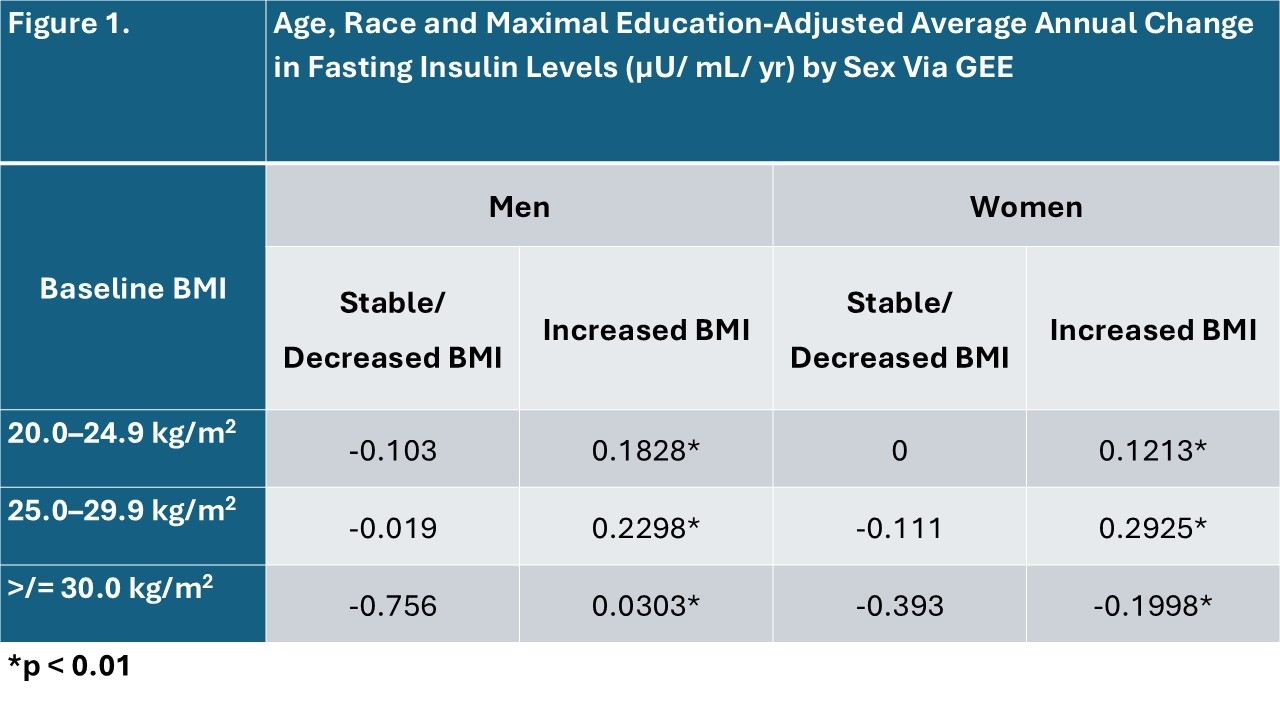
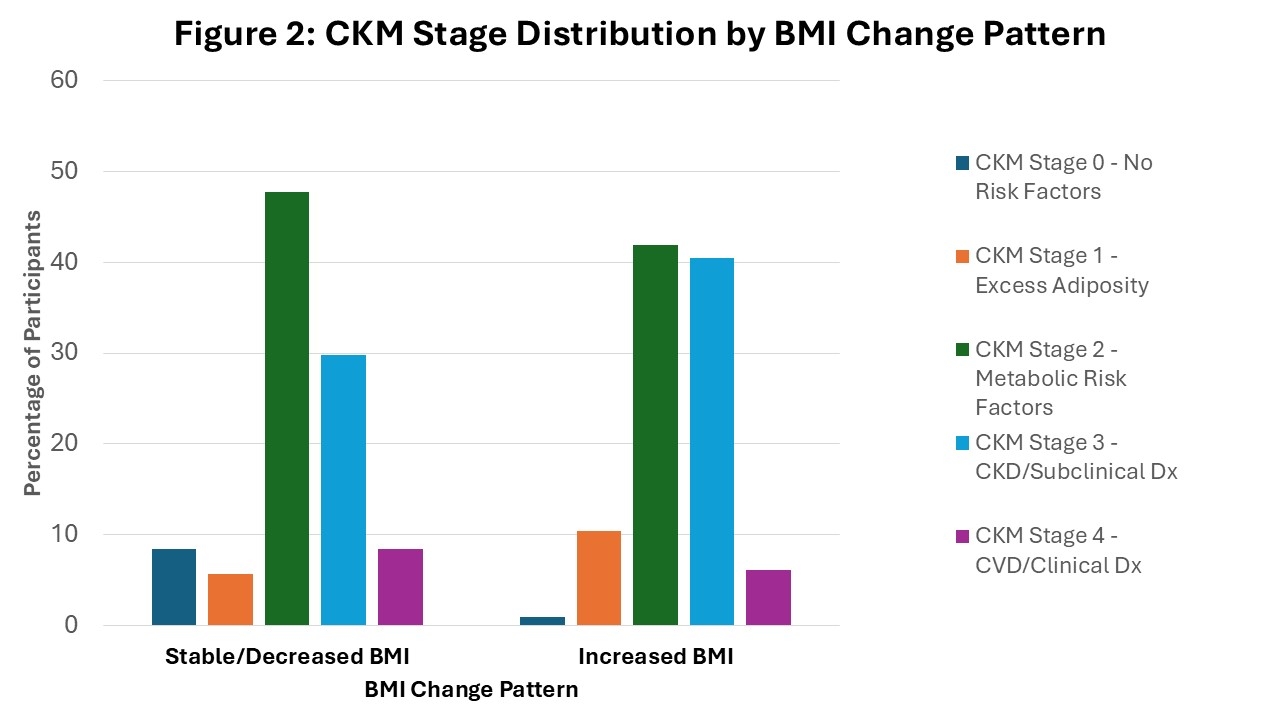
Abstract Body: Background Weight gain from young adulthood to midlife increases risk for metabolic syndrome and cardiovascular-kidney-metabolic (CKM) syndrome. We aimed to examine the longitudinal exposures of relative weight stability vs. weight gain through young adulthood on cardiovascular risk factor trajectories and CKM stages in midlife. Methods CARDIA participants (enrolled in 1985-86) who attended ≥6 of 9 in-person exams from Year (Y)0–Y30 were included; those with BMI ≥40 kg/m2 or diabetes at baseline (Y0) were excluded. Data from exams when a participant reported current pregnancy, and after reported bariatric surgery, were excluded. Participants were stratified by BMI change patterns: stable/decreased (≤3 kg/m2 difference from Y0 at every exam or >3 kg/m2 weight loss by last exam), increased (>3 kg/m2 gain by last exam), or fluctuating (>3 kg/m2 interim gain but ≤3 kg/m2 difference from Y0 by last exam); and further stratified by baseline BMI (<25, 25-29.9, 30-39.9 kg/m2). Longitudinal changes in metabolic risk factors and insulin were assessed separately by sex using generalized estimating equations (GEE), adjusted for age, race, and maximal education level. Associations between BMI change groups and CKM stage at Y30, defined per AHA criteria (Stages 0–4), were examined. Results Among all 3765 participants (56% women, 47% Black, mean age 25 at Y0), mean BMI at Y0 and Y30 were 24.1±4.2 and 30.2±7.0 kg/m2, respectively; from Y0-Y30, 18.7% had stable/decreased BMI, 67.4% had increased BMI, and 13.9% had fluctuating BMI. Participants with baseline BMI <25 comprised 79% of the stable/decreased BMI change group; however, >60% of participants in each baseline BMI stratum experienced increased BMI (>3 kg/m2 gain from Y0-Y30). Fasting insulin levels remained relatively unchanged in the stable/decreased BMI group, whereas they progressively increased among participants in the increased BMI group (Figure 1). Participants in the stable/decreased BMI change group exhibited lower Y30 CKM stages, with 52% of individuals who remained in CKM Stage 0 belonging to this group, whereas those in the increased BMI group had more participants in CKM Stages 3/4 by Y30 (p <0.01, Figure 2). Conclusions Young adults who maintained relatively stable BMI over time showed minimal risk factor progression and lower incidence of advanced CKM stages, regardless of baseline BMI. These findings suggest the importance of long-term weight stabilization as a key public health target.
Rai, Ishita
(
Boston University Medical Center
, Boston , Massachusetts , United States )
Ning, Hongyan
(
NORTHWESTERN UNIVERSITY
, Chicago , Illinois , United States )
Bhatt, Ankeet
(
Kaiser Permenante
, San Francisco , California , United States )
Dooley, Erin
(
University of Alabama at Birmingham
, Birmingham , Alabama , United States )
Lewis, Cora
(
Univeristy of Alabama at Birmingham
, Birmingham , Alabama , United States )
Jacobs, David
(
University of Minnesota
, Minnetonka , Minnesota , United States )
Lloyd-jones, Donald
(
Boston University Medical Center
, Boston , Massachusetts , United States )