Latent Classes of Health-Related Social Needs and Associated Cardiovascular Risk in US Older Adults: Findings from the National Health and Aging Trends Study (NHATS)
Abstract Body: Introduction: Health related social needs (HRSN) are associated with adverse cardiovascular (CV) outcomes in the growing US older adult population. Identifying subgroups with distinct HRSN profiles and their associated CV and geriatric risks would support the design and targeting of novel preventive interventions.
Hypothesis: Older adults form distinct HRSN-defined subgroups, with higher HRSN subgroups having higher burden of CV risk and geriatric conditions and likelihood of hospitalization.
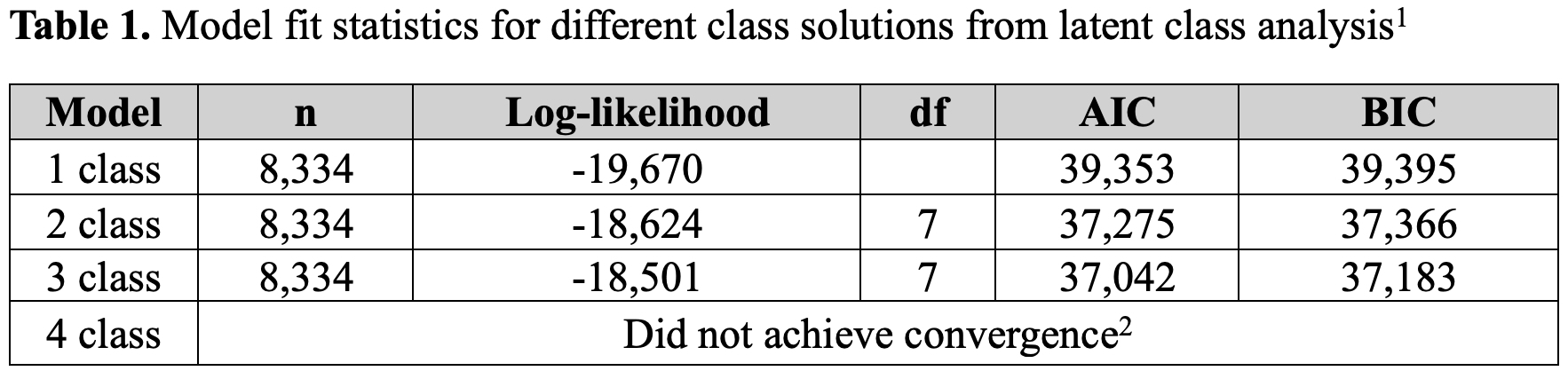
Methods: Using 2015 NHATS data, we performed latent class analysis to identify HRSN subgroups among 8,334 US adults age ≥65, representing 42.5 million Medicare beneficiaries, using the following indicator variables: homebound status, social isolation, transportation disadvantage, digital isolation, food insecurity, and financial insecurity. Optimal number of classes was determined using model fit statistics (Table 1). We assigned participants based on their posterior class membership probabilities. We compared self-reported demographics, CV conditions, and geriatric conditions across classes using χ2 tests, and compared marginal predicted probabilities of one-year hospital admission using logistic regression. Survey weights were applied to account for complex sampling design.
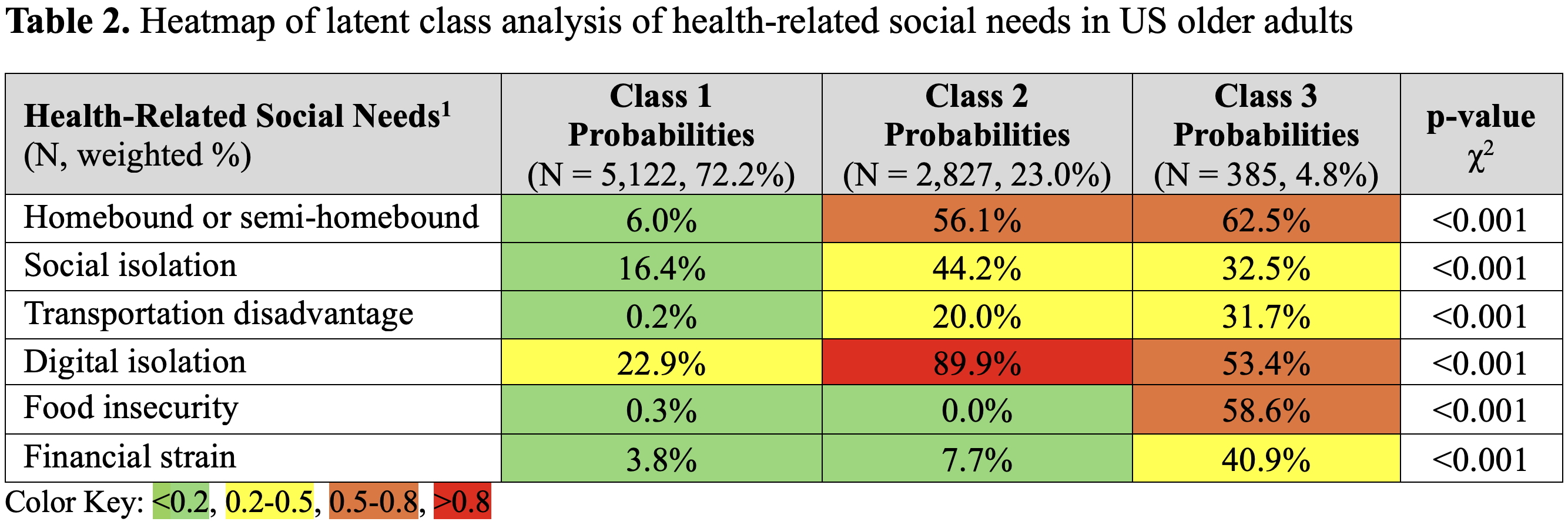
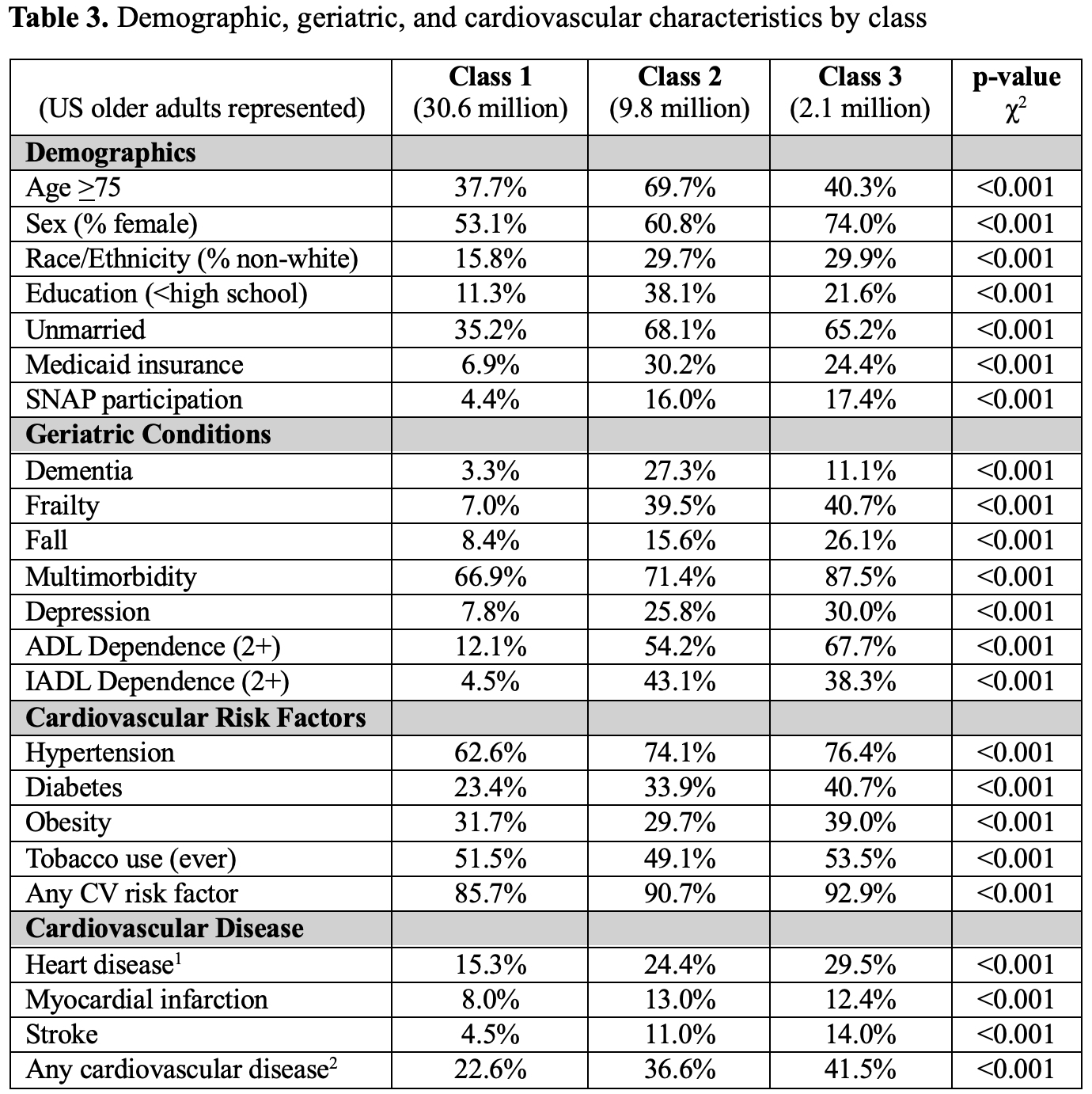
Results: Latent class analysis identified 3 distinct classes according to HRSN (Table 2). Class 1 (72% prevalence) had the lowest rates of all HRSNs. Classes 2 (23%) and 3 (5%) shared high prevalence of homebound status (56% and 63% vs. 6% in Class 1). Class 2 had the highest prevalence of digital isolation and social isolation, while Class 3 had the highest prevalence of food insecurity, financial strain, and transportation disadvantage. Both Classes 2 and 3 had higher burdens of CV risk factors and geriatric conditions, with Class 2 being older with more dementia, and Class 3 having the greatest burden of metabolic risk factors (Table 3). Classes 2 and 3 had higher prevalence of CVD than Class 1. The probability of subsequent one-year hospital admission was higher for individuals in Classes 2 (33%; 95% CI 30-36) and 3 (30%; CI 23-36) versus Class 1 (18%; CI 17-20).
Conclusions: There are distinct older subpopulations with greater HRSN burdens, higher CV risk, and greater likelihood of hospitalization. Interventions addressing HRSNs, tailored to subgroups with higher digital and social isolation, or with more food insecurity and financial strain, may improve CV outcomes in the aging US population.
Troy, Aaron
(
Johns Hopkins Hospital
, Pikesville , Maryland , United States )
Bandeen-roche, Karen
(
Johns Hopkins University
, Baltimore , Maryland , United States )
Blumenthal, Roger
(
Johns Hopkins Hospital
, Pikesville , Maryland , United States )
Ornstein, Katherine
(
Johns Hopkins University
, Baltimore , Maryland , United States )
Pavlovic, Noelle
(
Boston College School of Nursing
, Chestnut Hill , Massachusetts , United States )
Pomeroy, Mary Louise
(
Johns Hopkins University
, Baltimore , Maryland , United States )
Schrack, Jennifer
(
Johns Hopkins University
, Baltimore , Maryland , United States )
Gerstenblith, Gary
(
Johns Hopkins Hospital
, Pikesville , Maryland , United States )
Cudjoe, Thomas
(
Johns Hopkins University
, Baltimore , Maryland , United States )
Ndumele, Chiadi
(
Johns Hopkins Hospital
, Pikesville , Maryland , United States )