Navigating Stroke Recovery: The Association of Insurance Coverage on Hospital Discharge Disposition in Rural versus Urban Settings in North Carolina
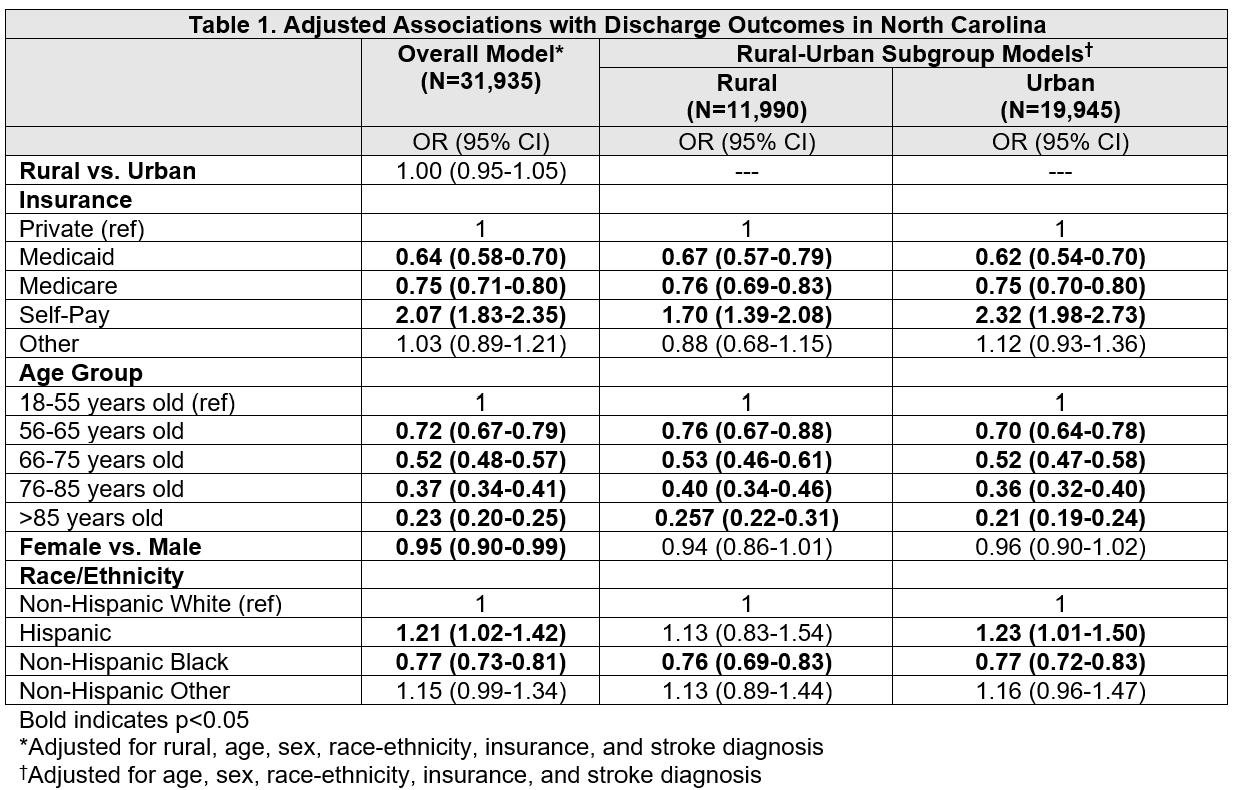
Abstract Body: Introduction/Hypothesis Hospital discharge disposition of stroke patients is influenced by various factors, including health status, recovery needs, and healthcare resource availability. Health insurance coverage as a proxy for access to post-stroke care may reveal disparities in discharge outcomes. We examined the association between insurance status and discharge outcomes for stroke patients in rural and urban North Carolina, emphasizing the importance of stratifying by rurality to explore potential differences in access to care. Methods We obtained demographics, county of residence, insurance, admission date, and discharge disposition of adult patients with principal discharge diagnosis codes for stroke (ICD-10-CM I60.xx-I63.xx) from an inpatient database of hospitalizations from January 2019 to September 2020 across 115 NC hospitals. We categorized patient insurance status as Private, Self-pay, Medicare, Medicaid, or Other. We dichotomized discharge disposition to Home or Healthcare Facility. Multivariable logistic regression estimated associations between insurance and discharge outcomes, adjusting for age, sex, stroke type, and rurality. Separate models for rural and urban populations explored differences in discharge patterns. Results Among 31,935 patients with a mean age of 69, 38% lived in rural counties, 50% were female, and 60% were discharged home. Medicaid (OR=0.64, 95% CI: 0.58-0.70) and Medicare (OR=0.75, 95% CI: 0.71-0.80) patients had lower odds, and Self-pay (OR=2.07, 95% CI: 1.83-2.35) patients had higher odds of being discharged home compared to patients with private insurance. Discharge outcomes based on insurance status were consistent across rural and urban subgroups. Conclusions Insurance status is significantly associated with discharge outcomes, with Medicaid and Medicare patients less likely and Self-Pay patients more likely to be discharged home compared to private insurance, regardless of rurality. Understanding discharge dynamics can inform policies to improve access and equity in post-stroke care. Further research should explore discharge disparities for vulnerable patient groups.
Pinapaka, Mahesh
(
University of North Carolina
, Chapel Hill , North Carolina , United States )
Patel, Mehul
(
UNC - CHAPEL HILL
, Chapel Hill , North Carolina , United States )
Rosamond, Wayne
(
University of North Carolina
, Chapel Hill , North Carolina , United States )
Author Disclosures:
Mahesh Pinapaka:DO NOT have relevant financial relationships
| Mehul Patel:No Answer
| Wayne Rosamond:DO NOT have relevant financial relationships