Dietary patterns, serum metabolites and risk of cardiovascular disease in the US Hispanic/Latino adults: the Hispanic Community Health Study/Study of Latinos
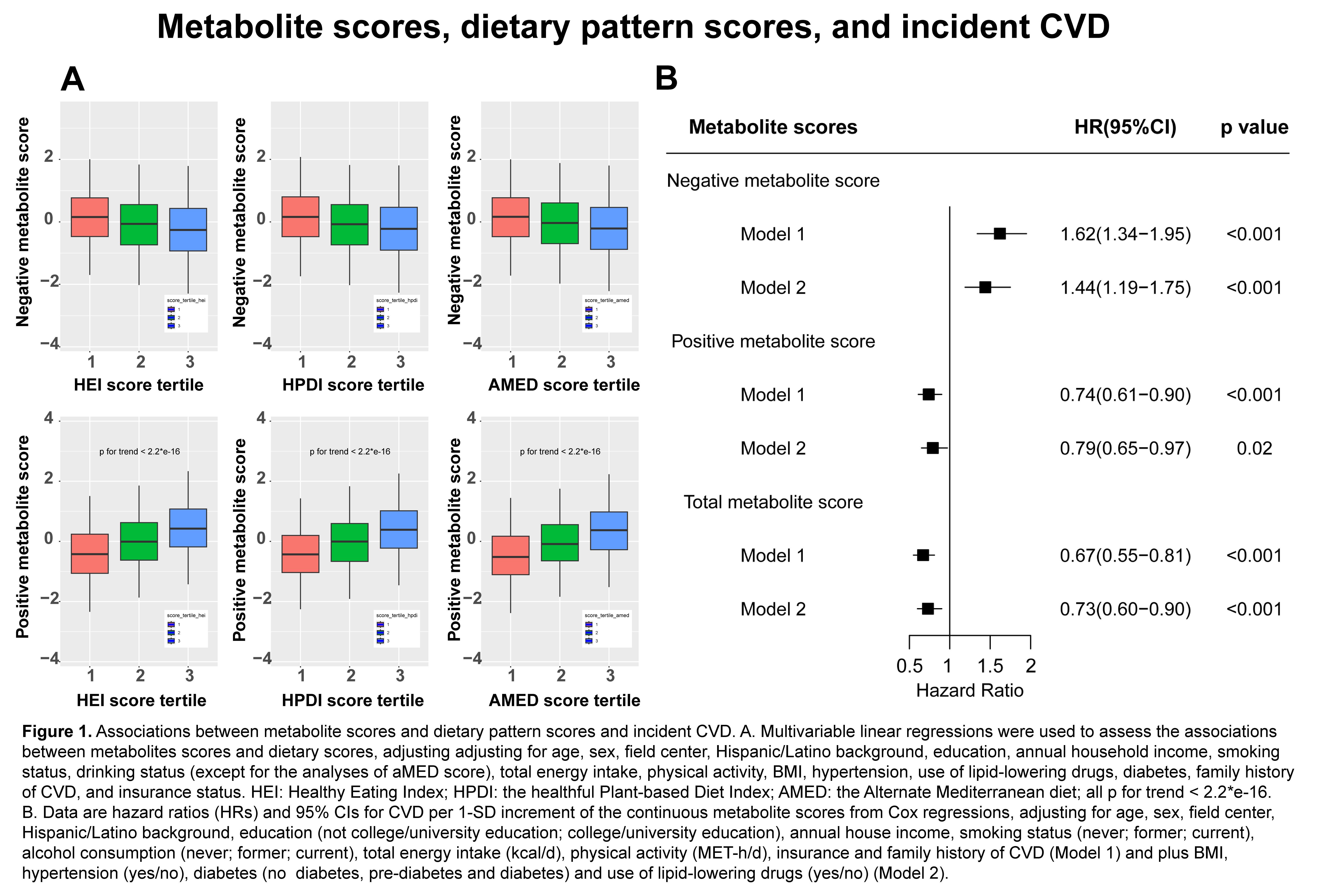
Abstract Body: Objective: Healthy dietary patterns are recommended to prevent cardiovascular disease (CVD), yet the molecular mechanisms underlying the association between dietary patterns and CVD are not well-understood. We aimed to assess the associations of healthy dietary patterns and related serum metabolites with incident CVD in US Hispanics/Latinos. Methods: The study included 13,922 participants free of CVD at baseline aged 18-74 years from the Hispanic Community Health Study/Study of Latinos. Dietary pattern scores, including Healthy Eating Index (HEI)-2015, healthful Plant-based Diet Index (hPDI), and alternate Mediterranean diet (aMED), were constructed at baseline (2008-2011) using two 24-hour dietary recalls data. The primary outcome was incident CVD, encompassing myocardial infarction, heart failure, and stroke. Dietary-pattern-associated metabolite scores were calculated based on 40 serum metabolites measured in a subsample of baseline participants (n=5,154). Associations of dietary pattern scores, individual metabolites and metabolite scores with incident CVD were evaluated using multivariable Cox regression. Results: After adjusting for demographic, socioeconomic and behavioral factors, a 1-standard deviation (SD) increase in dietary pattern scores was associated with a lower risk of CVD with hazard ratios of 0.68 (95% confidential interval [CI], 0.47-0.98), 0.71 (0.58-0.88), and 0.69 (0.47-1.02) for HEI-2015, hPDI, and aMED, respectively. A negative metabolite score derived from 8 dietary-pattern-inverse metabolites showed a strong inverse association with three dietary scores, while a positive metabolite score based on 32 dietary-pattern-positive metabolites exhibited a robust positive association with three dietary scores (Figure 1A). The metabolite scores were significantly associated with risk of CVD, with hazard ratios of 1.44 (95% CI, 1.19, 1.75) and 0.79 (95% CI, 0.65, 0.97) for the negative and positive metabolite scores (per SD increase in metabolites scores), respectively (Figure 1B). Conclusion: Healthier diet patterns and related serum metabolite profiles were associated with lower risk of CVD in US Hispanic/Latino adults.
Yang, Hongbo
(
Zhongshan Hospital, Fudan University
, Shanghai , China )
Wang, Yi
(
Albert Einstein College of Medicine
, New York , New York , United States )
Luo, Kai
(
Albert Einstein College of Medicine
, Bronx , New York , United States )
Mossavar-rahmani, Yasmin
(
Albert Einstein College of Medicine
, Bronx , New York , United States )
Cordero, Christina
(
university of Miami
, Miami Beach , Florida , United States )
Ostfeld, Robert
(
MONTEFIORE
, New York , New York , United States )
Martinez, Claudia
(
university of Miami
, Miami Beach , Florida , United States )
Maldonado, Luis
(
University of Southern California
, Los Angeles , California , United States )
Pirzada, Amber
(
University of Illinois Chicago
, Chicago , Illinois , United States )
Daviglus, Martha
(
UNIVERSITY ILLINOIS CHICAGO
, Chicago , Illinois , United States )
Yu, Bing
(
UNIV OF TX HEALTH SCI CTR HOUSTON
, Houston , Texas , United States )
Hu, Frank
(
Harvard School of Public Health
, Boston , Massachusetts , United States )
Kaplan, Robert
(
Albert Einstein College of Medicine
, Bronx , New York , United States )
Qi, Qibin
(
ALBERT EINSTEIN COLLEGE OF MEDICINE
, Bronx , New York , United States )
Author Disclosures:
Hongbo Yang:DO NOT have relevant financial relationships
| Martha Daviglus:DO NOT have relevant financial relationships
| Bing Yu:DO NOT have relevant financial relationships
| Frank Hu:No Answer
| Robert Kaplan:No Answer
| Qibin Qi:DO NOT have relevant financial relationships
| Yi Wang:DO NOT have relevant financial relationships
| Kai Luo:DO NOT have relevant financial relationships
| Yasmin Mossavar-Rahmani:DO NOT have relevant financial relationships
| Christina Cordero:DO NOT have relevant financial relationships
| Robert Ostfeld:DO have relevant financial relationships
;
Research Funding (PI or named investigator):Purjes Foundation:Active (exists now)
; Independent Contractor:Huff Bailey Powell:Active (exists now)
; Individual Stocks/Stock Options:Mesuron, Inc:Active (exists now)
; Research Funding (PI or named investigator):Beyond Meat, Inc:Active (exists now)
; Research Funding (PI or named investigator):Greenbaum Foundation:Active (exists now)
| Claudia Martinez:No Answer
| Luis Maldonado:No Answer
| Amber Pirzada:DO NOT have relevant financial relationships