
Logo

American Heart Association

  13
  0


Final ID: Mon036

Characterizing Coronary Artery Disease Risk Loci in South Asian Populations: Genetic Architecture, Biological Pathways, and GWAS Replication

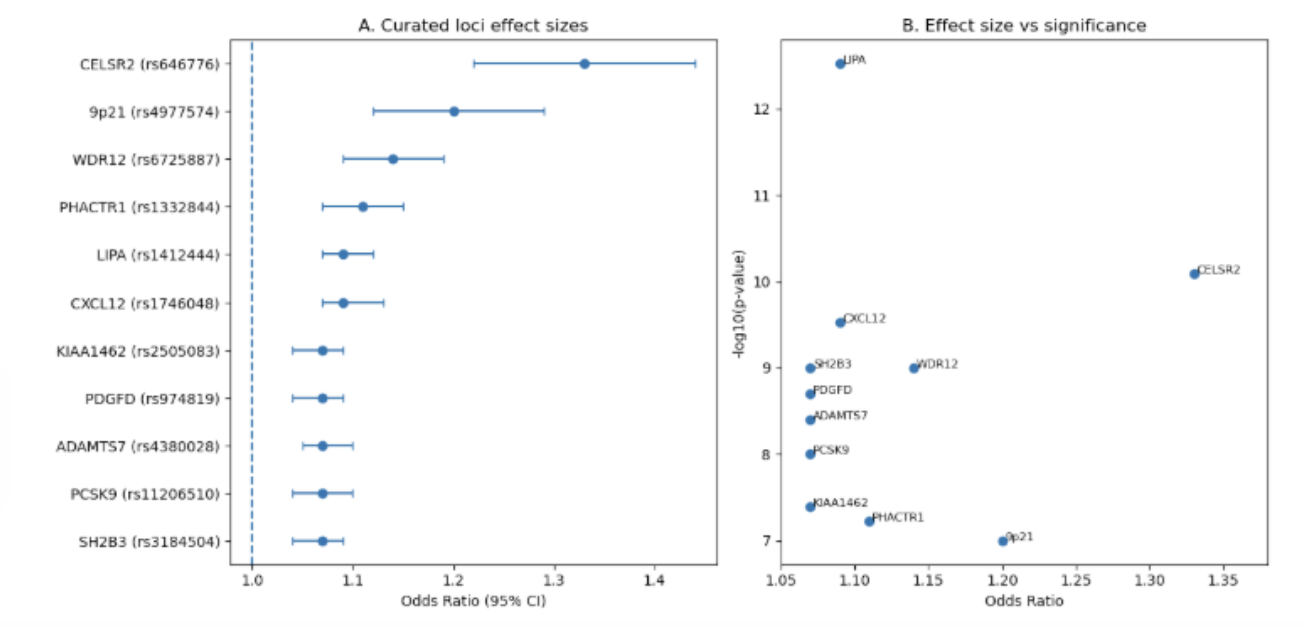
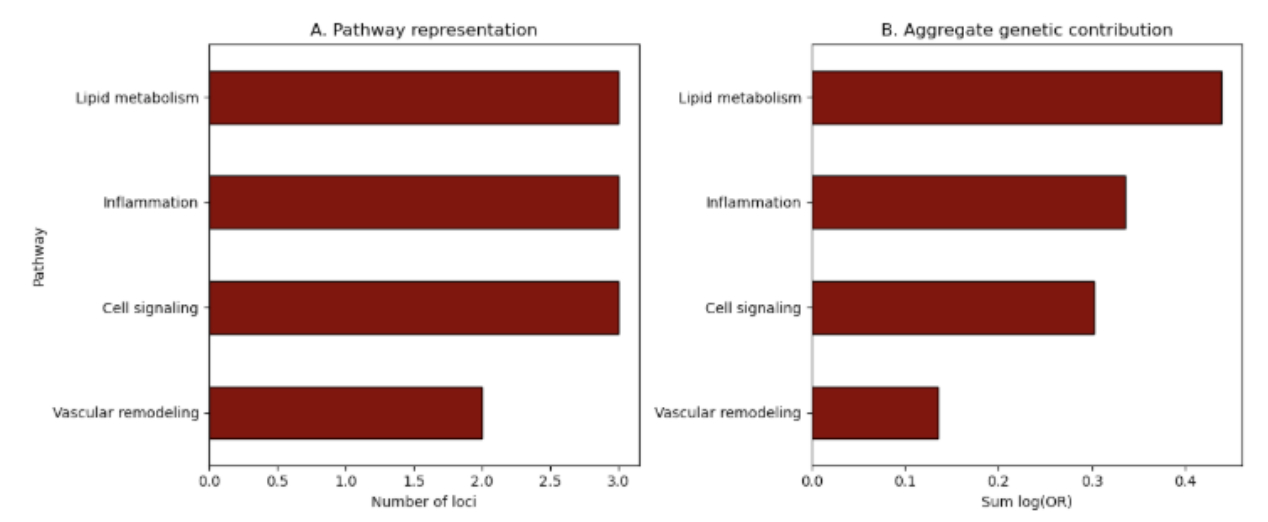
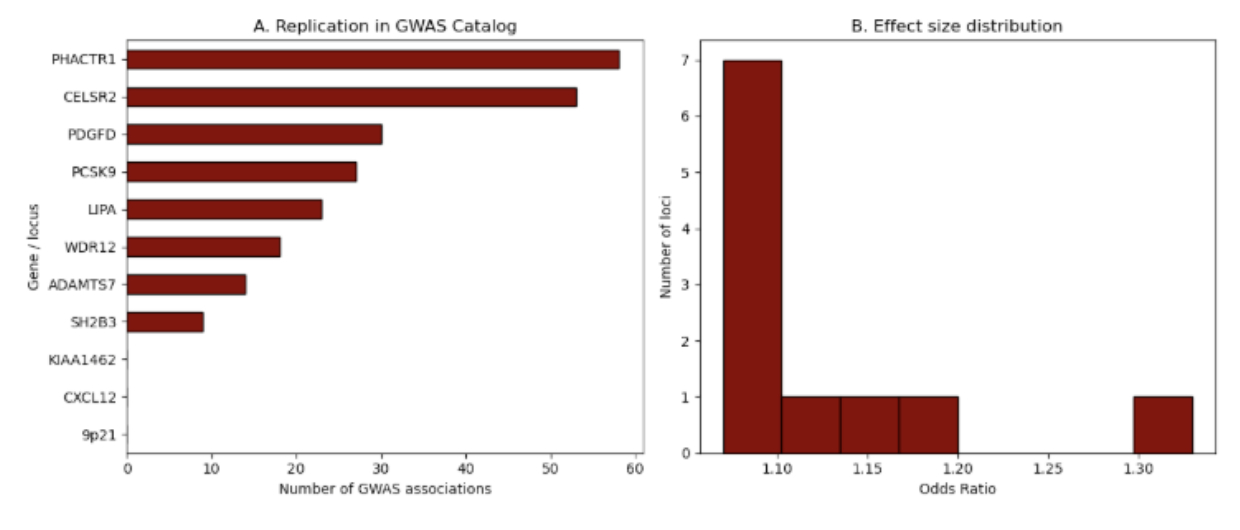
Abstract Body: South Asian populations experience a disproportionately high burden of Coronary Artery Disease (CAD), but identification and interpretation of the genetic loci associated with CAD in this population remains limited. The objective of this project was to analyze a curated set of 11 genome-wide significant CAD-associated loci reported in studies including South Asian populations, characterizing their effect sizes, biological pathways, and replication across global Genome-Wide Association Studies (GWAS). To evaluate replication of the curated loci across independent studies, an additional dataset was obtained from the NHGRI-EBI GWAS Catalog. Analysis of the loci, which showed a median odds ratio (OR) of ~1.09 and an OR range of 1.07–1.33, is consistent with a polygenic genetic architecture, where numerous variants contribute small increments of risk to the overall pathological phenotype. When mapped to biological pathways (Lipid metabolism, Inflammation, Cell signaling, Vascular remodeling), genetic signals converged on known CAD mechanisms. Cumulative genetic contribution analysis suggested that lipid metabolism contributed the largest approximate signal (~36%), consistent with its established central role in CAD pathogenesis. Replication analysis across the GWAS Catalog found that many of these curated loci, including PHACTR1 (~58 associations) and CELSR2 (~53 associations), appear frequently across independent studies. Overall, these results suggest that CAD risk in the South Asian population follows a polygenic pattern and that the identified CAD loci substantially overlap with well-established global CAD risk loci. Further research testing polygenic risk scores derived from this data is warranted. This approach centers South Asian CAD loci in the broader context of cardiovascular genetics, providing clearer biological interpretation of individual and population risk.
  • Patel, Suraj  ( Stony Brook Medicine , Kendall Park , New Jersey , United States )
  • Kaur, Jasmeen  ( Stony Brook Medicine , Kendall Park , New Jersey , United States )
  • Parthasarathy, Praveen  ( Stony Brook Medicine , Kendall Park , New Jersey , United States )
  • Rahman, Tahmid  ( Stony Brook University Hospital , Stony Brook , New York , United States )
  • Author Disclosures:
Meeting Info:

Basic Cardiovascular Sciences 2026

2026

Boston, Massachusetts

Session Info:

Poster Session 1

Monday, 07/13/2026 , 04:30PM - 07:00PM

Poster Session and Reception

More abstracts on this topic:
Blood protein mediators of association between smoking and abdominal aortic aneurysm: exploration integrating human proteomic and genomic data

Yuan Shuai, Khodursky Samuel, Geng Jiawei, Sharma Pranav, Spin Joshua, Tsao Philip, Levin Michael, Damrauer Scott

Causal Association of Left Atrial Emptying Fraction With Ischemic Stroke: A Mendelian Randomization Analysis

Nguyen Kevin, Cole John, Perry James, Gaynor Brady, Bai Zilong, Wang Fei, Xu Huichun, Leifer Dana

More abstracts from these authors:
A Conserved HMOX1-Associated Macrophage Axis Dominates Inflammatory Variation Across Human Peripheral Arteries

Patel Suraj, Pulickal Christo, Zhang David, Yarmohammadi Hirad, Madhavan Mahesh

You have to be authorized to contact abstract author. Please, Login
Not Available