
Logo

American Heart Association

  12
  0


Final ID: Wed108

Clinical Outcomes of Elective vs Urgent Leadless Pacemaker Implantation: Evidence from National Inpatient Samples.

Abstract Body: Background:
The implantation of leadless pacemakers has been growing in recent years. There have been no randomized controlled trials evaluating the impact of planned, urgent, or emergent implantation of leadless pacemakers on outcomes.
Objective:
To compare in-hospital mortality and procedural outcomes between elective and non-elective leadless pacemaker implantations.
Methods:
We conducted a retrospective analysis of the National Inpatient Sample Database from 2016 to 2019. We identified patients who had undergone implantation of leadless pacemakers using the ICD, 10thEdition PCS codes. The primary outcome studied was in-hospital mortality. Our secondary outcomes included length of stay, total hospitalization cost, and post-procedural complications. We used a multivariable logistic regression model to compare outcomes, adjusted for demographics and comorbidities.
Results:
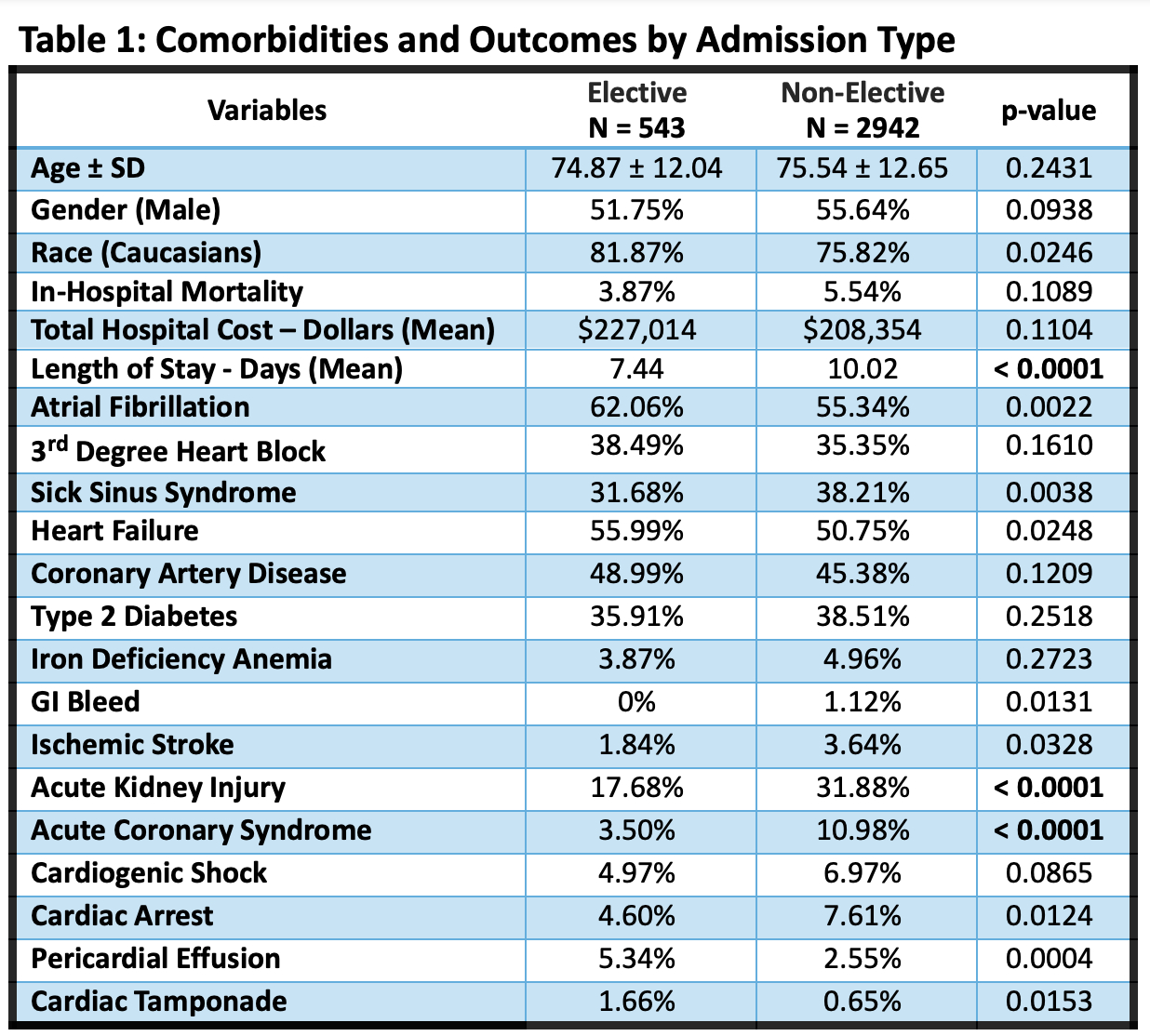
We identified 3,488 patients with leadless pacemaker implantation. The mean age was 75.44 ± 12.55 years; most patients were male (55.1%) and Caucasian (76.8%). Leadless pacemakers were implanted by admission type, which were 84.4% non-elective and 15.6% elective. Table 1 shows the comorbidities and outcomes by admission type. The overall in-hospital mortality was 5.3% and was highest among patients undergoing leadless pacemaker implantation as non-elective (5.54% vs 3.87%) but was not statistically significant (p = 0.109). The odds ratio for in-hospital mortality was highest for cardiac arrest (OR 6.67, 95% CI 4.37-10.17, p< 0.0001). Leadless pacemaker implantation for elective admission had an odds ratio of 1.14 (95% CI 0.67-1.94, p = 0.6199).
Conclusions:
Our study indicates that leadless pacemakers have a higher in-hospital mortality rate when implanted under non-elective admissions, but these results were not statistically significant. One explanation is that patients being implanted with non elective leadless pacemakers may have a higher burden of comorbid conditions responsible for the higher in-hospital mortality rate. Further prospective studies arewarranted to identify patient- and procedural-level predictors of adverse outcomes.
  • Ahmed, Sana  ( Northeast Georgia Medical Center , Cumming , Georgia , United States )
  • Mahmood, Riaz  ( Northeast Georgia Medical Center , Cumming , Georgia , United States )
  • Egolum, Ugochukwu  ( Georgia Heart Institute , Gainesville , Georgia , United States )
  • Author Disclosures:
Meeting Info:

Basic Cardiovascular Sciences 2026

2026

Boston, Massachusetts

Session Info:

Poster Session 3

Wednesday, 07/15/2026 , 04:30PM - 07:00PM

Poster Session and Reception

More abstracts on this topic:
Brash Syndrome Requiring Permanent Pacemaker: A Case Report

Bhatt Nilay, Mrad Yves Najm, Gupta Shivam, Dickey Curtis

Causes of 30-Day Readmissions Following Permanent Pacemaker Implantation in Dialysis-Dependent End-Stage Renal Disease Patients: Analysis of the National Readmission Database 2020

Jha Vivek, Teaima Taha, Gajjar Rohan, Aryal Badri, Quevedo Ramirez Andres, Karki Sadichhya, Jha Supriya

More abstracts from these authors:
You have to be authorized to contact abstract author. Please, Login
Not Available