Risk of Ventricular Arrhythmia Development due to Hypoglycemia in Diabetic Patients
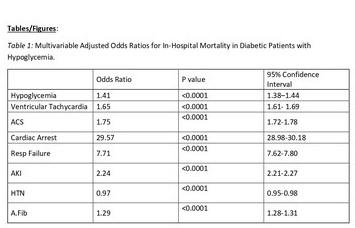
Abstract Body: Introduction: Hypoglycemia, a known complication of diabetic medications, has been linked to increased cardiovascular risk. Ventricular arrhythmias, particularly ventricular tachycardia (VT) and ventricular fibrillation (VF), are major contributors to sudden cardiac death. Hypothesis: This study evaluates the association between hypoglycemia and ventricular arrhythmias and related complications in hospitalized diabetic patients using the National Inpatient Sample (NIS) database. Methods: A retrospective cohort study was conducted using the NIS database (2016–2019). Adult patients with diabetes (ICD-10-CM: E10, E11) and hypoglycemia (ICD-10-CM: E16.2, E10.649, E11.649, E16.A1–A3) were identified. Primary outcomes included incidence of VT and VF; secondary outcomes included atrial fibrillation, acute coronary syndrome (ACS), respiratory failure, and in-hospital mortality. Multivariable logistic regression adjusted for demographics, comorbidities, and disease severity. Results: Of 6,465,478 hospitalized adults with diabetes, 0.05% (306,329) had hypoglycemia. Mean age was 65.7 ± 14.7 years; 50.5% were male, 63.3% Caucasian. In-hospital mortality among hypoglycemic patients was 4.28%. VT occurred more frequently in hypoglycemic vs. non-hypoglycemic patients (2.30% vs. 1.85%, p < 0.0001), as did VF (0.33% vs. 0.31%, p = 0.019) and atrial fibrillation (21.61% vs. 21.30%, p < 0.001). Hypoglycemia was independently associated with higher odds of VT (OR 1.08, 95% CI: 1.05–1.10, p < 0.0001), and also increased risk of in-hospital mortality, ACS, cardiac arrest, respiratory failure, and acute kidney injury. Conclusions: In this large national cohort, hypoglycemia in diabetic patients was associated with increased risk of ventricular and atrial arrhythmias, mortality, and other complications. These findings suggest hypoglycemia may be an independent marker of cardiovascular vulnerability. Enhanced monitoring and glycemic control may reduce adverse outcomes in this high-risk population. Further studies are needed to explore causal mechanisms.
Ahmed, Sana
(
Northeast Georgia Medical Center
, Gainesville , Georgia , United States )
Mahmood, Riaz
(
Northeast Georgia Medical Center
, Gainesville , Georgia , United States )
Salih, Rayan
(
Northeast Georgie Medical Center
, Flowery branch , Georgia , United States )
Patel, Sharvil
(
Northeast Georgia Medical Center
, Gainesville , Georgia , United States )
Egolum, Ugochukwu
(
Georgia Heart Institute
, Gainesville , Georgia , United States )
Author Disclosures:
Sana Ahmed:DO NOT have relevant financial relationships
| Riaz Mahmood:No Answer
| Rayan Salih:DO NOT have relevant financial relationships
| Sharvil Patel:No Answer
| Ugochukwu Egolum:No Answer