Impact of Hypertension on Adverse Outcomes in Hypertrophic Obstructive Cardiomyopathy: A National Inpatient Analysis
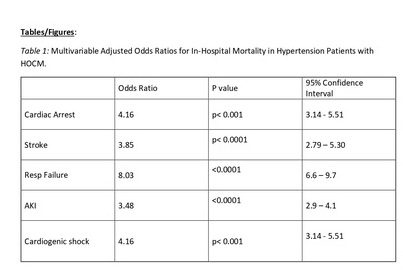
Abstract Body: Background: Hypertrophic obstructive cardiomyopathy (HOCM), a subtype of the most common genetic heart disease, poses challenges in hypertensive patients, as many antihypertensives are contraindicated. This study evaluates the association between essential hypertension and clinical outcomes in hospitalized HOCM patients using the National Inpatient Sample (NIS). Methods: A retrospective cohort study was conducted using the NIS database (2016–2019). Adults with HOCM (ICD-10-CM I42.1) and essential hypertension (I10) were identified. Primary outcomes included cardiac arrest and cardiogenic shock. Secondary outcomes were respiratory failure, stroke, acute kidney injury (AKI), in-hospital mortality, CAD, PAD, atrial fibrillation, COPD, type 2 diabetes, obesity, and obstructive sleep apnea. Multivariable logistic regression assessed the association between HOCM and outcomes, adjusting for demographics, comorbidities, and disease severity. Results: Among 19,634 hospitalized HOCM patients, 36% (7,071) had essential hypertension. Mean age was 66.2 ± 15.1 years; 60.8% were female and 71.7% White. HOCM was less frequent among hypertensive patients (36% vs. 64%). In-hospital mortality for hypertensive HOCM patients was 3.37%; however, hypertension was not a significant predictor of mortality (OR 0.85, 95% CI: 0.68–1.06, p = 0.169). Despite this, logistic regression showed hypertensive HOCM patients had significantly increased odds of cardiac arrest (OR 9.91, 95% CI: 7.21–13.62, p < 0.0001), respiratory failure (OR 8.03, 95% CI: 6.6–9.7, p < 0.0001), AKI (OR 3.48, 95% CI: 2.9–4.1, p < 0.0001), stroke (OR 3.85, 95% CI: 2.79–5.30, p < 0.0001), and cardiogenic shock (OR 4.16, 95% CI: 3.14–5.51, p < 0.001). No significant differences were found in CAD, PAD, atrial fibrillation, COPD, diabetes, obesity, or OSA between groups. Conclusions: In this national cohort, hypertensive HOCM patients had higher risks of cardiac arrest, respiratory failure, AKI, stroke, and cardiogenic shock. Although not an independent predictor of mortality, hypertension may increase the risk of cardiogenic shock and cardiac arrest. These findings highlight the need for enhanced monitoring and individualized blood pressure management. Further studies are needed to explore underlying mechanisms and causal pathways.
Ahmed, Sana
(
Northeast Georgia Medical Center
, Cumming , Georgia , United States )
Mahmood, Riaz
(
Northeast Georgia Medical Center
, Cumming , Georgia , United States )
Salah, Rayan
(
Northeast Georgia Medical Center
, Cumming , Georgia , United States )
Egolum, Ugochukwu
(
Georgia Heart Institute
, Gainesville , Georgia , United States )
Author Disclosures:
Sana Ahmed:DO NOT have relevant financial relationships
| Riaz Mahmood:No Answer
| rayan salah:No Answer
| Ugochukwu Egolum:No Answer