
Logo

American Heart Association

  21
  0


Final ID: Wed134

R-propranolol Alleviates Cardiac Arrhythmias in Sickle Cell Mice by Normalizing Ca2+ Handling

Abstract Body: Introduction: Patients with sickle cell anemia (SCA) have cardiomyopathy leading to sudden cardiac death and ventricular arrhythmias. We previously reported that transgenic SCA mouse hearts exhibit systemic inflammation and interleukin-18 (IL-18) mediated inflammasome signaling, causing prolongation of action potential duration (APD) and ventricular tachyarrhythmias (VT). R-propranolol (R-P), an enantiomer of β-blocker L-propranolol, may prevent VT in SCA mice through a β-independent pathway via activation of the sterol regulatory binding protein (SREBP1). Ca2+ handling is a potential target of R-P to reduce cardiac arrhythmias via SREBP1 activation.

Goal: To establish the mechanisms behind the R-P induced reduction of ventricular arrhythmias in SCA mouse hearts.

Methods: Prior to recording, mice were treated with R-P (3 or 12.5 mg/kg, IP, 14 days). We optically mapped Langendorff perfused hearts from homozygous Townes SCA mice or non-sickling controls (CTR) at baseline and after perfusion of 5 ng/ml IL- 18 (60 min). Isolated ventricular myocytes from SCA mouse hearts were used for patch clamp and Ca2+ imaging.

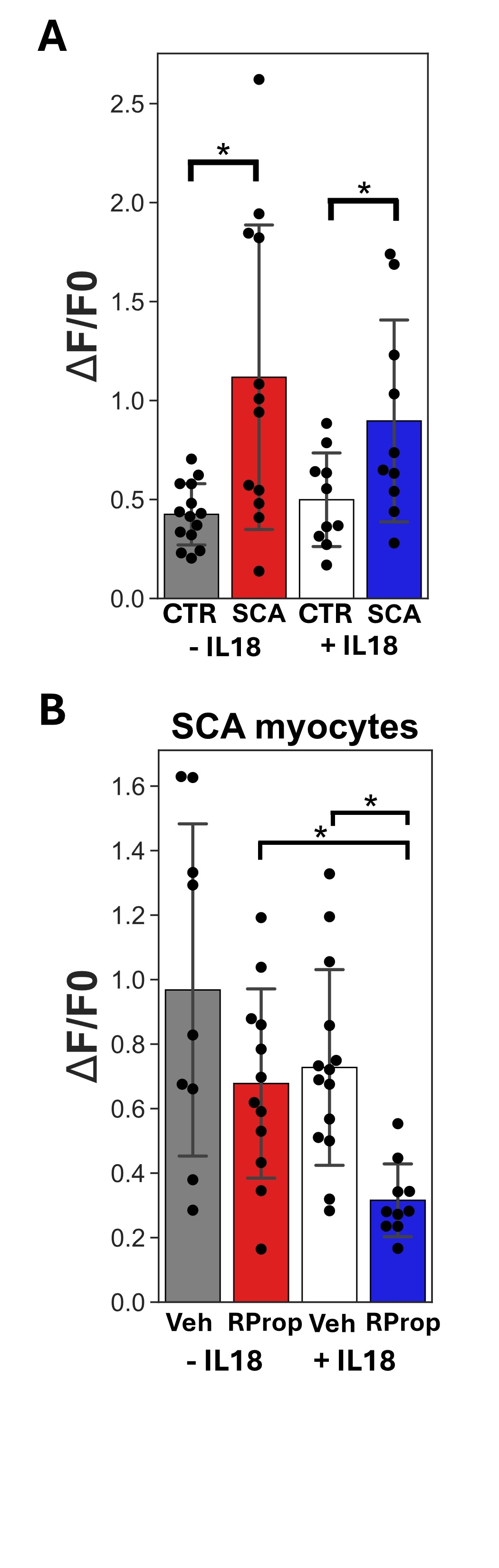
Results: Untreated SCA mouse ventricular cardiomyocytes showed a leftward shift in Cav1.2 channel current activation curves (V1/2 max = -28 ± 2 mV, SCA vs. -19 ± 1 mV, CTR), which is known to induce early after depolarizations and premature ventricular contractions (PVCs). IL-18 perfusion (60 min) induced PVCs in 2 of 8 (25%) R-P treated SCA mouse hearts relative to vehicle treated SCA mouse hearts (4 of 4). Western blot analysis revealed a significant reduction of Cav1.2 channel protein levels in vehicle treated SCA mouse LV and R-P increased SCA mouse LV Cav1.2 protein levels relative to vehicle. Ca2+ transient amplitudes were increased in SCA mouse ventricular cardiomyocytes (Figure 1A) and reduced to control levels with R-P (Figure 1B).

Conclusion: R-P normalization of aberrant Ca2+ handling, which may explain the antiarrhythmic potential of R-P in SCA mice, supports a role for R-P as a potential therapeutic for SCA patients.
  • Bronk, Peter  ( Cardiovascular Research Center, Rhode Island Hospital and Alpert Medical School of Brown University , Providence , Rhode Island , United States )
  • Kim, Tae Yun  ( Korea University , Seoul , Korea (the Republic of) )
  • Lu, Yichun  ( Cardiovascular Research Center, Rhode Island Hospital and Alpert Medical School of Brown University , Providence , Rhode Island , United States )
  • Jia, Yangfan  ( Indiana University , Indianapolis , Indiana , United States )
  • Naidu, Samisubbu  ( Indiana University , Indianapolis , Indiana , United States )
  • Maun, Avinash  ( Indiana University , Indianapolis , Indiana , United States )
  • Michel, Sage  ( Providence VA , Providence , Rhode Island , United States )
  • Desai, Ankit  ( Indiana University , Indianapolis , Indiana , United States )
  • Zhang, Peng  ( Providence VA and Alpert Medical School of Brown University , Providence , Rhode Island , United States )
  • Choi, Bum-rak  ( Cardiovascular Research Center, Rhode Island Hospital and Alpert Medical School of Brown University , Providence , Rhode Island , United States )
  • Author Disclosures:
Meeting Info:

Basic Cardiovascular Sciences 2026

2026

Boston, Massachusetts

Session Info:

Poster Session 3

Wednesday, 07/15/2026 , 04:30PM - 07:00PM

Poster Session and Reception

More abstracts on this topic:
More abstracts from these authors:
R-propranolol Attenuates Interleukin-18 Mediated Sickle Cell Cardiomyopathy: A Novel Adrenergic-independent Mechanism Involving Lipid Synthesis.

Jia Yangfan, Bronk Peter, Chu Aiai, Kim Tae Yun, Lu Yichun, Javaheri Ali, Tang Haiyang, Choi Bum-rak, Desai Ankit

Pharmacological enhancement of SK channels increases repolarization reserve in congenital and acquired long QT type 2 syndrome

Bronk Peter, Koren Gideon, Coulombe Kareen, Choi Bum-rak, Kim Tae Yun, Daley Mark, Soepriatna Arvin, Lu Yichun, Turan Nilufer, Qu Zhilin, Terentyeva Radmila, Terentyev Dmitry

You have to be authorized to contact abstract author. Please, Login
Not Available