
Logo

American Heart Association

  9
  0


Final ID: Mon037

Vasohibin Inhibition Preserves Human Living Myocardial Slices Contractility Under Chronic High Afterload

Abstract Body: Background: Increased microtubule detyrosination by the tubulin carboxypeptidase Vasohibin (VASH) impairs cardiac mechanics in heart failure by increasing cytoplasmic viscosity. However, the role of VASH inhibition in maintaining Living Myocardial Slice (LMS) contractility under sustained mechanical stress remains poorly defined. We hypothesized that VASH inhibition to suppress the detyrosinated microtubules mitigates this "microtubule brake," preserving contractile performance under chronic high afterload.
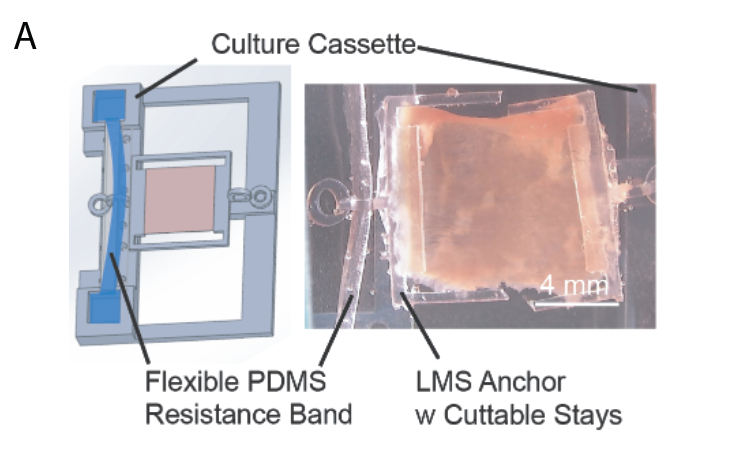
Methods: Human LMS (7mm*7mm*300µm) were sectioned from normal human myocardium glued to a 3D printed anchor and cultured for 5 days in a 3D-printed platform (Fig 1) allowing precise preload and afterload control. LMS were paced at 0.25 Hz and subjected to three conditions: 1) Normal Afterload (10 mN/mm), 2) High Afterload (HA, 36 mN/mm), and 3) HA + VASH Inhibitor (HA+VASH-i) for the total duration of the culture. Contractility and force-length work loops were generated using the IonOptix system, followed by histological and molecular analysis of α-tubulin detyrosination and cell area.
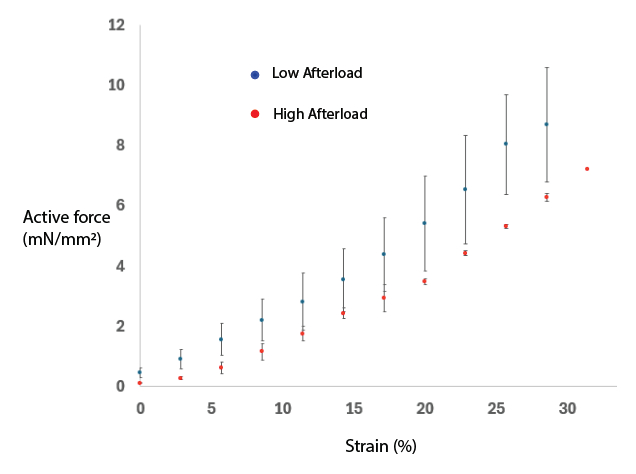
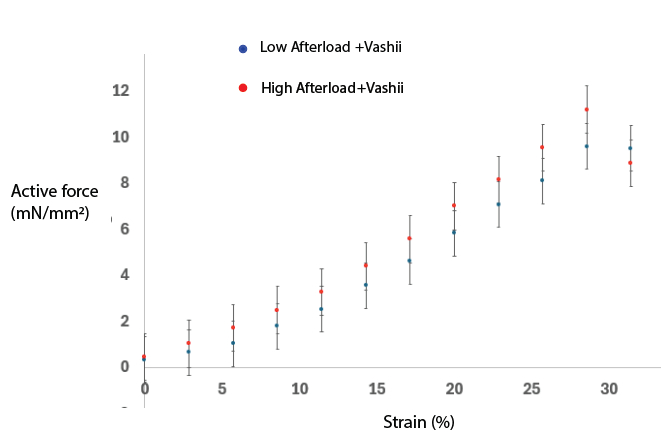
Results: Exposure to 5 days of HA significantly reduced active force generation (Fig.2) and increased cell area by 17% compared to low afterload (P < 0.05). VASH inhibition prevented this accumulation and preserved contractility; HA+VASH-i slices maintained significantly higher active force generation than the HA group (Fig.3). Kinetic analysis revealed that VASH inhibition prevented the prolongation of the relaxation constant observed under HA. Despite 5 days of chronic load, the HA+VASH-i group exhibited preserved contractile forces, suggesting that mitigating microtubule-mediated drag maintains efficient cross-bridge cycling and mechanical performance even under pathological resistance.
Conclusion: Suppressing detyrosinated microtubules via VASH inhibition effectively preserves LMS contractility and kinetics during chronic high afterload. These findings identify the VASH-mediated "microtubule brake" as a viable therapeutic target to sustain cardiac function during persistent hypertensive or valvular stress.
  • Bouhrira, Nesrine  ( University of Pennsylvania , Philadelphia , Pennsylvania , United States )
  • Webb, Megan  ( University of Pennsylvania , Philadelphia , Pennsylvania , United States )
  • Pizarro, Sebastian  ( University of Pennsylvania , Philadelphia , Pennsylvania , United States )
  • Bedi, Kenneth  ( UNIV PENNSYLVANIA SCH OF MEDICINE , Philadelphia , Pennsylvania , United States )
  • Rosa, Francisco  ( University of Pennsylvania , Philadelphia , Pennsylvania , United States )
  • Margulies, Kenneth  ( UNIV PENNSYLVANIA SCH OF MEDICINE , Philadelphia , Pennsylvania , United States )
  • Author Disclosures:
Meeting Info:

Basic Cardiovascular Sciences 2026

2026

Boston, Massachusetts

Session Info:

Poster Session 1

Monday, 07/13/2026 , 04:30PM - 07:00PM

Poster Session and Reception

More abstracts on this topic:
Flow-Regulated Pathogenesis of Hypoplastic Left Heart Syndrome in a 3D Bioprinted Human Heart Tube

Jin Linqi, Neelakantan Sunder, Fineman Sarah, Nandwani Roshni, Avazmohammadi Reza, Bauser-heaton Holly, Serpooshan Vahid

Abnormal Calcium Regulation Leads to Pathological Cardiac Hypertrophy During Pregnancy in the GSNOR-Deficient Mouse Model of Preeclampsia

Dulce Raul, Balkan Wayne, Hare Joshua, Kulandavelu Shathiyah

More abstracts from these authors:
The Complex Role of ROR2 in Fibroblast Activation and Tissue Mechanics

Hartman Hali, Rajagopal Hari, Senf Victor, Yuan Shirley, Bouhrira Nesrine, Lee Benjamin, Margulies Kenneth, Edwards Jonathan

Stretch-Induced Remodeling of Human Living Cardiomyocyte Slices

Webb Megan, Pizarro Sebastian, Rosa Francisco, Bedi Kenneth, Bouhrira Nesrine, Margulies Kenneth

You have to be authorized to contact abstract author. Please, Login
Not Available