The Complex Role of ROR2 in Fibroblast Activation and Tissue Mechanics
Abstract Body: Background: There are no proven therapies for right ventricular failure (RVF) and limited mechanistic studies to identify novel candidate targets. We found in human and mouse RVF robust, severity-dependent re-expression of the normally developmentally restricted ROR2. ROR2 has pleiotropic effects across similar cells, and the impact of ROR2 on cardiac fibroblasts has not been well studied.
Methods: We used adenovirus to overexpress (ROR2OE) or knockdown (ROR2KD) ROR2 in primary ventricular fibroblasts from neonatal rats (NRVFs) and adult human heart (HuFBs) cell line. Cells were grown on tissue culture plates or magnetorheological elastomer to mimic clinically relevant myocardial stiffness. We assessed wound healing and injury provoked proliferation by scratch assay. We used CellProfiler to assess cell junctions. Engineered HuFB tissues (ETs) were cast in a collagen matrigel.
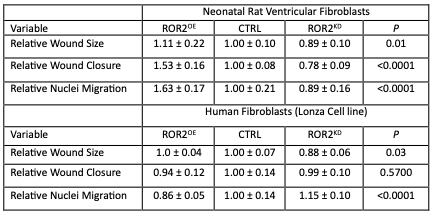
Results: In NRVFs, ROR2OE increased and ROR2KD decreased scratch-induced wound area, and ROR2promoted cell migration and wound healing (Table). ROR2KDsignificantly decreased NRVF proliferation by EdU labeling, Ki67, and PH3 expression, and decreased TGFβ induced COL1A1 without affecting αSMA. In HuFBs, ROR2KD also dampened scratch-induced wound size, but unlike in NRVFs ROR2KD promoted cell migration. In NRVFs and HuFBs, CellProfiler revealed that ROR2-responsive cell migration was associated with weakened cell junctions marked by reduced peripheral phalloidin (~1.2X) and increased granularity (~3X). In ETs, ROR2KD increased compaction and stretch induced stiffness (6.3 ± 0.2 vs. 7.0± 0.4 mm2 and 1.59 ± 0.07 vs 1.146 ± 0.04 mN/mm 2, p<0.01, both).
Discussion: ROR2 has significant and opposing effects on NRVFs and HuFBs, impinging on migration, wound healing, collagen production, proliferation, and tissue compaction/stiffness. Future clinical translatability to RVF will require further work to unravel the disparate ROR2 effects on NRVFs and HuFBs (e.g. age vs species).
Hartman, Hali
( Childrens Hospital of Philadelphia
, Philadelphia
, Pennsylvania
, United States
)
Rajagopal, Hari
( Childrens Hospital of Philadelphia
, Philadelphia
, Pennsylvania
, United States
)
Senf, Victor
( University of Pennsylvania
, Philadelphia
, Pennsylvania
, United States
)
Yuan, Shirley
( University of Pennsylvania
, Philadelphia
, Pennsylvania
, United States
)
Bouhrira, Nesrine
( University of Pennsylvania
, Philadelphia
, Pennsylvania
, United States
)
Lee, Benjamin
( University of Pennsylvania
, Haddonfield
, New Jersey
, United States
)
Margulies, Kenneth
( UNIV PENNSYLVANIA SCH OF MEDICINE
, Philadelphia
, Pennsylvania
, United States
)
Edwards, Jonathan
( Childrens Hospital of Philadelphia
, Philadelphia
, Pennsylvania
, United States
)
Author Disclosures:
Hali Hartman:DO NOT have relevant financial relationships
| Hari Rajagopal:No Answer
| Victor Senf:No Answer
| Shirley Yuan:DO NOT have relevant financial relationships
| NESRINE BOUHRIRA:No Answer
| Benjamin Lee:DO NOT have relevant financial relationships
| Kenneth Margulies:No Answer
| Jonathan Edwards:DO NOT have relevant financial relationships