Role of ERBB4 in fibroblasts and myeloid cells during neonatal cardiac regeneration
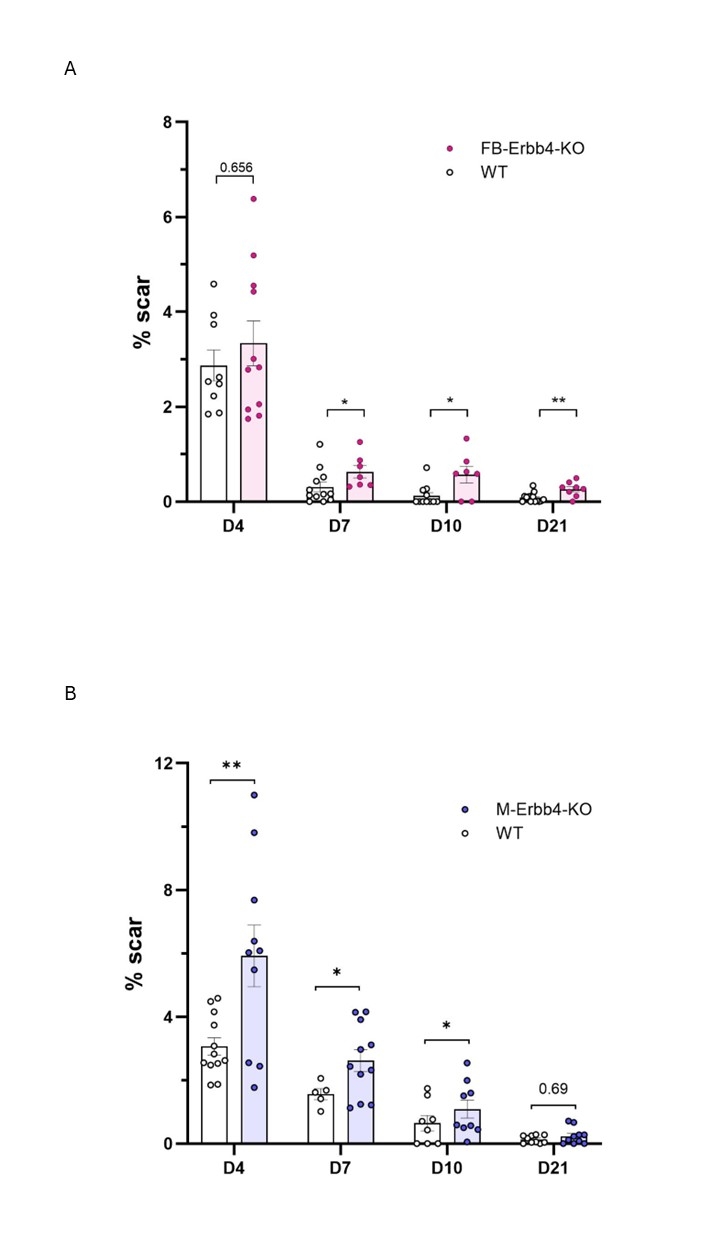
Abstract Body: BACKGROUND: Scarless regeneration of the injured neonatal mammalian heart is poorly understood. Neuregulin-1 (NRG1) is indispensable by stimulating cardiomyocyte proliferation through ERBB4 tyrosine kinase receptors. The role of ERBB4 signaling in fibroblasts and inflammatory cells remains unclear. HYPOTHESIS: We hypothesized that neonatal cardiac regeneration after myocardial infarction (MI) is impaired by cell-specific ERBB4 deletion in fibroblasts or myeloid cells. METHODS: Wild type (WT), fibroblast-specific hemizygous (FB-Erbb4-KO) and myeloid-specific homozygous (M-Erbb4-KO) mice underwent MI by LAD ligation at postnatal day 1 (total n=180). Animals were euthanized at 4, 7, 10, or 21 days post-MI. Infarct scar size was quantified by Masson’s Trichrome staining. Cardiac tissue was processed for transcriptome analysis, including qPCR and bulk RNA sequencing. RESULTS: In FB-Erbb4-KO mice, infarct scar size at day 4 was comparable to WT and significantly decreased 6-fold by day 7 in both WT and KO mice. At day 10, however, scar size was larger in KO mice (4.5-fold;p=0.050). At day 21, regeneration was nearly complete in both WT and KO mice, although the remaining scar in KO mice was slightly but significantly larger (p=0.010). Myocardial TNFα and Col1a1 mRNA levels were higher in KO mice at 10 days after MI. In M-Erbb4-KO mice, infarct scar size at day 4 was 2-fold larger in KO mice (p=0.006), and remained larger at day 7 (p=0.049) and day 10 (p=0.023). At day 21, regeneration was nearly complete in both WT and KO mice, with no significant difference between the remaining scars. Myocardial IL-6, Col1a1 and TNFα mRNA expression was downregulated in KO mice at day 4. At day 10, MMP2 and MMP9 mRNA was upregulated in KO mice. RNA sequencing at day 10 confirmed activated immune and inflammatory pathways in the KO mice. CONCLUSION: Fibroblast-specific ERBB4 deletion slightly impaired scarless regeneration, resulting in a small residual scar at 21 days. Conversely, myeloid ERBB4 deletion increased early scar formation and activated inflammatory pathways, but did not impair complete scar resolution at 21 days. Thus, NRG-1/ERBB4 signaling affects fibroblasts and myeloid cells during neonatal cardiac regeneration, but ERBB4 deletion in these cells does not profoundly impair cardiac regeneration at 21 days.
Van Den Bogaert, Siel
(
University of Antwerp
, Wilrijk , Belgium )
Eens, Sander
(
University of Antwerp
, Wilrijk , Belgium )
Civati, Celine
(
University of Antwerp
, Antwerp , Belgium )
Goovaerts, Bo
(
University of Antwerp
, Antwerp , Belgium )
Cools, Julie
(
University of Antwerp
, Wilrijk , Belgium )
Segers, Vincent
(
University Hospital Antwerp
, Edegem , Belgium )
De Keulenaer, Gilles
(
University of Antwerp
, Wilrijk , Belgium )