
Logo

American Heart Association

  13
  0


Final ID: Tue163

A Src Family Kinase Inhibitor Reprograms Fibroblast and Cardiomyocyte Responses to Attenuate Heart Failure

Abstract Body: Introduction: Cardiac fibrosis is a central determinant of adverse outcomes in heart failure, yet therapies that directly target fibrogenic remodeling remain limited. We previously identified the Src family kinase (SFK) inhibitor PD as a candidate anti-fibrotic compound through a phenotypic screening approach; however, its therapeutic efficacy and mechanism in heart failure remain unknown. We hypothesized that PD exerts therapeutic benefit in pressure overload-induced heart failure.
Methods: Mice with transverse aortic constriction (TAC) were treated with PD or vehicle. We performed multimodal analyses, including single-nucleus RNA sequencing (snRNA-seq) of heart tissue. Complementary in vitro studies were conducted in primary mouse and human cardiac fibroblasts, and human pluripotent stem cell-derived cardiomyocytes (hPSC-CMs) under oxidative stress.
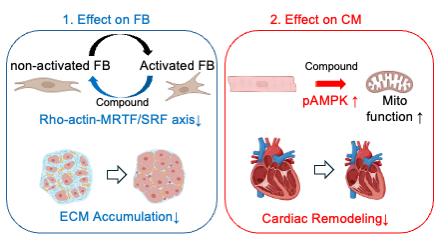
Results: PD attenuated cardiac remodeling and fibrosis after TAC. snRNA-seq indicated a transcriptional reprogramming of cardiac fibroblasts from activated states toward a quiescent-like phenotype. Mechanistically, PD reduced actin polymerization and suppressed nuclear accumulation of myocardin related transcription factor A (MRTF-A) and serum response factor (SRF)-associated regulatory programs, supporting inhibition of SFK-linked mechanotransduction pathways that sustain fibroblast activation. Consistently, PD promoted deactivation-associated responses in cardiac fibroblasts derived from patients with advanced heart failure. Concomitantly, cardiomyocyte snRNA-seq showed enrichment of mitochondrial metabolism-related gene programs with PD treatment. In hPSC-CMs under oxidative stress, PD increased AMPKα Thr172 phosphorylation and enhanced maximal mitochondrial respiratory capacity.
Conclusion: We demonstrate that PD attenuates cardiac remodeling and fibrosis through dual mechanisms: restraining fibroblast activation and enhancing mitochondrial metabolism in cardiomyocytes (Image 1). These findings nominate PD as a potential therapeutic candidate for heart failure.
  • Nishijo, Daigo  ( the University of Tokyo , Bunkyo-ku , Tokyo , Japan )
  • Ko, Toshiyuki  ( the University of Tokyo , Bunkyo-ku , Tokyo , Japan )
  • Ito, Masamichi  ( the University of Tokyo , Bunkyo-ku , Tokyo , Japan )
  • Nomura, Seitaro  ( The University of Tokyo , Tokyo , Japan )
  • Takeda, Norihiko  ( The University of Tokyo , Tokyo , Japan )
  • Komuro, Issei  ( the University of Tokyo , Bunkyo-ku , Tokyo , Japan )
  • Author Disclosures:
Meeting Info:

Basic Cardiovascular Sciences 2026

2026

Boston, Massachusetts

Session Info:

Poster Session 2

Tuesday, 07/14/2026 , 04:30PM - 07:00PM

Poster Session and Reception

More abstracts on this topic:
A Case of Steroid-Refractory Immune-checkpoint-inhibitor Induced Myocarditis Responsive to Mycophenolate and Anti-thymocyte globulin

Dabdoub Jorge, Wilson Michael, Gottbrecht Matthew, Salazar Ryan, Shih Jeffrey

9-Year Longitudinal Assessment of the 12-lead Electrocardiogram of Volunteer Firefighters

Bae Alexander, Dzikowicz Dillon, Lai Chi-ju, Brunner Wendy, Krupa Nicole, Carey Mary, Tam Wai Cheong, Yu Yichen

More abstracts from these authors:
Predictive Factors for Early Recovery from Mechanical Circulatory Support in Patients with Fulminant Myocarditis

Ueda Tomomi, Amiya Eisuke, Hatano Masaru, Ishida Junichi, Takeda Norifumi, Akazawa Hiroshi, Komuro Issei, Takeda Norihiko

CRISPR screening identifies critical factors regulating DNA damage response in human cardiomyocytes under oxidative stress

Kubota Masayuki, Ito Masamichi, Nomura Seitaro, Takeda Norihiko, Komuro Issei

You have to be authorized to contact abstract author. Please, Login
Not Available