Logo

American Heart Association

  21
  0


Final ID: Mon176

Dynamic Calcium-Pressure Coupling of in vivo Heart

Abstract Body: Background
Heart failure (HF) exhibits impaired cardiac mechanics and dysregulated intracellular calcium handling. Calcium–force coupling is primarily studied in ex vivo preparations, leaving its in vivo relationship incompletely understood. Elucidating calcium–pressure coupling of in vivo hearts can lead to new insights and treatments for HF.

Hypothesis
Physiological changes alter cardiac calcium-pressure coupling that is not apparent in ex vivo measurements.

Methods
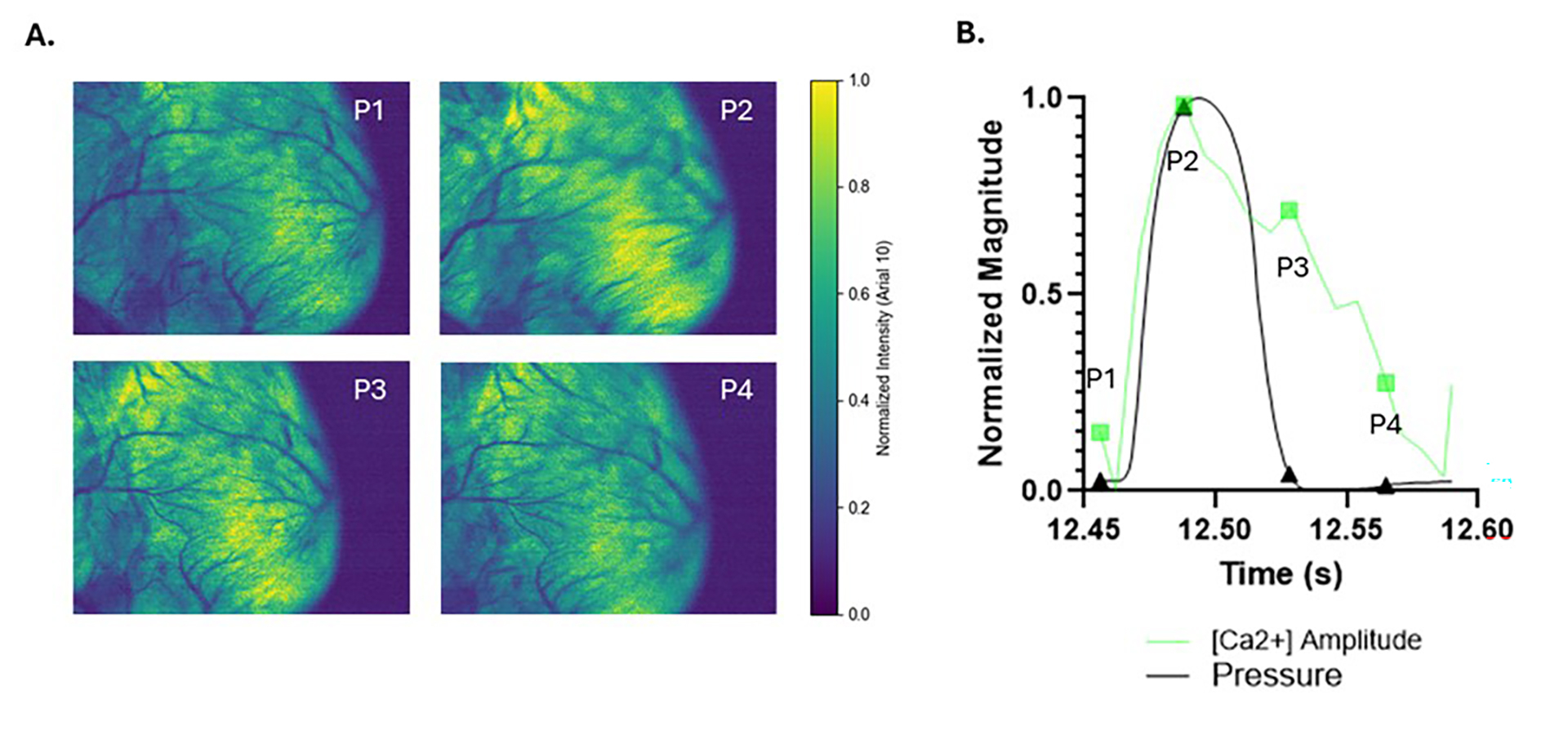
We utilized a transgenic mouse model expressing the cardiomyocyte-specific calcium-sensitive fluorescent indicator GCaMP8 under the control of alpha-myosin heavy chain promoter (C57BL6). We then developed a system that performs 488nm excitation and 510nm emission imaging to capture intracellular calcium [Ca2+] GCaMP8 fluorescence, simultaneously measured intracardiac pressure and volume with admittance catheterization, and used dobutamine to stimulate β1 adrenergic receptors.

Results
By echocardiography, GCaMP8 hearts exhibited depressed systolic function (GCaMP8 n=8 vs. WT n=10; LVEF% 34 ± 11 vs. 54 ± 8, p=0.001) and normal diastolic function (E/e’ 22.9 ± 3.2 vs. 21.9 ± 3.7, p=0.546). Simultaneous [Ca2+] imaging and intra-cardiac pressure measurements on 5 mice showed 50% [Ca2+] rise preceded pressure rise under basal conditions by 6.4±3% of period. Surprisingly, pressure decay preceded 50% [Ca2+] decay by 25.1±6.1% of period. Dobutamine induced pressure pulse-width shortening of 11.2±3.9% (p=0.005 vs. basal condition). [Ca2+] pulse duration, 50% rise, and 50% fall did not change significantly. Data showed increasing [Ca2+] triggered contraction but relaxation occurred before [Ca2+] decay in modifiable manner. These findings indicate that calcium elevation initiates contraction, while relaxation may occur prior to calcium decline in modifiable manner.

Conclusion
Simultaneous intracardiac pressure and calcium imaging in vivo reveals a previously underappreciated dissociation between calcium decay and mechanical relaxation. These results suggest that myosin cross-bridge detachment during diastole may be governed by load- or mechanics-dependent mechanisms beyond simple reductions in intracellular calcium, providing new insight into cardiac relaxation physiology and potential therapeutic targets in HF.
  • Hale, Joshua  ( University of Arizona , Tucson , Arizona , United States )
  • Sadayappan, Sakthivel  ( University of Arizona , Tucson , Arizona , United States )
  • Tong, Carl  ( University of Arizona , Tucson , Arizona , United States )
  • Author Disclosures:
Meeting Info:

Basic Cardiovascular Sciences 2026

2026

Boston, Massachusetts

Session Info:

Poster Session 1

Monday, 07/13/2026 , 04:30PM - 07:00PM

Poster Session and Reception

More abstracts on this topic:
Modeling Cooperative Cross-Bridge Dynamics in Beating Heart

Stahr Nicholas, Hale Joshua, Sadayappan Sakthivel, Tong Carl

Biomarkers of myocardial injury in community-based patients with suspected heart failure

Docherty Kieran, Taylor-sweet Daniel, Fagura Malbinder, Ammer Tatjana, Masson Serge, Mcmurray John, Campbell Ross, Petrie Mark, Mckinley Gemma, Mcconnachie Alex, Brooksbank Katriona, Lowe David, Macklin Leanne, Mccoubrey Aimee, Osmanska Joanna

More abstracts from these authors:
Modeling Cooperative Cross-Bridge Dynamics in Beating Heart

Stahr Nicholas, Hale Joshua, Sadayappan Sakthivel, Tong Carl

Emerging Models and Therapeutic Strategies of HCM

Sadayappan Sakthivel

You have to be authorized to contact abstract author. Please, Login
Not Available