Inflammatory Profiles in Takotsubo Cardiomyopathy: A TriNetX Retrospective Analysis
Abstract Body: Background: The incidence of Takotsubo cardiomyopathy (TTC) has risen due to increased clinical awareness, improved diagnostics, and the broader use of coronary angiography in patients presenting with acute coronary syndrome (ACS)-like symptoms. Despite the risk of life-threatening cardiogenic shock, ventricular arrhythmias, and ventricular thrombus formation, the pathophysiology of TTC remains poorly understood.
Methods: We conducted a retrospective cohort study using the TriNetX Global Collaborative Network. We identified adults (≥18 years) with an incident diagnosis of TTC and compared them with a group consisting of adults with an incident diagnosis of ACS. Propensity score matching (1:1) was performed using a greedy nearest-neighbor algorithm with a caliper of 0.1 pooled standard deviations. The primary outcomes were inflammatory and immune laboratory values measured within ±7 days of the index cardiac event, including leukocyte and differential counts (neutrophils, lymphocytes, monocytes, eosinophils, basophils), platelets, C-reactive protein, erythrocyte sedimentation rate, ferritin, lactate dehydrogenase, and D-dimer. Secondary biomarkers included troponin, brain natriuretic peptide, and cortisol.
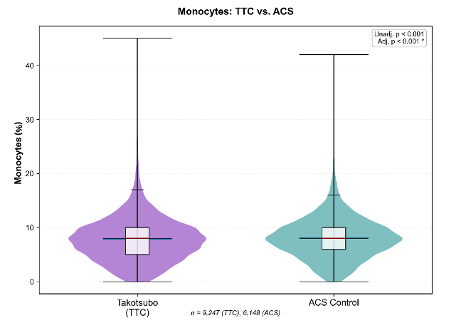
Results: After propensity score matching, 47,246 Takotsubo patients were matched 1:1 with 47,246 ACS controls, yielding a final analytic cohort of 94,492 individuals. Across inflammatory cell counts, monocytes emerged as the only marker demonstrating a difference between groups. Monocyte values were modest but significantly lower in TTC than in ACS (TTC mean 7.82 ± 4.45 vs ACS 8.10 ± 4.10) (Image 1).
Conclusion: In this large, propensity-matched TriNetX analysis, TTC and ACS demonstrated broadly similar routine inflammatory profiles, with only modest differences in monocyte values. These findings support a hypothesis-generating framework suggesting that TTC does not exhibit a globally distinct inflammatory signature compared with ACS in real-world clinical practice. Even though our results support the pathophysiology of TTC and ACS as being more similar than previously assumed, monocyte attenuation could serve as a supportive diagnostic signal.
Samayamanthula, Sai
(
University of Virginia School of Medicine
, Charlottesville , Virginia , United States )
Bouras, Andrew
(
Nova Southeastern Medical University
, Fort Lauderdale , Florida , United States )
Sporn, Kyle
(
SUNY Upstate Medical University
, Syracuse , New York , United States )
Kumar, Rahul
(
University of Massachusetts T.H. Chan School of Medicine
, Worcester , Massachusetts , United States )
Carpenito-kronenfeld, Michael
(
University of Massachusetts T.H. Chan School of Medicine
, Worcester , Massachusetts , United States )
Lee, Ryung
(
University at Buffalo
, Buffalo , New York , United States )
Naim, Onassis
(
Memorial Health System
, Fort Lauderdale , Florida , United States )
Benavidez, Pamela
(
Fairfield Medical Center
, Lancaster , Ohio , United States )