Blood Pressure Trends Across Human Spaceflight Missions
Abstract Body: Introduction: With a future mission to Mars and a return to the Moon, mankind is breaking barriers in spaceflight exploration. However, understanding of hemodynamic changes during spaceflight remains limited, largely due to small sample sizes. This poses risks for orthostatic intolerance and cardiovascular deconditioning. We aimed to characterize blood pressure changes during real and simulated spaceflight.
Hypothesis: Blood pressure varies by flight phase, mission type, BMI, and sex.
Methods: We conducted a retrospective, observational study using data from the NASA Longitudinal Study of Astronaut Health database and peer-reviewed publications reporting blood pressures during spaceflight. We extracted systolic blood pressure (SBP), diastolic (DBP) and mean arterial pressure (MAP), along with mission-related variables of interest. Inclusion criteria encompassed studies or astronaut records in reporting at least one of the three blood pressure measurements during real or simulated spaceflight. Independent t-tests and ANOVA with Games-Howell Post-Hoc (GHPH) analysis were performed for between group comparisons using summary statistics.
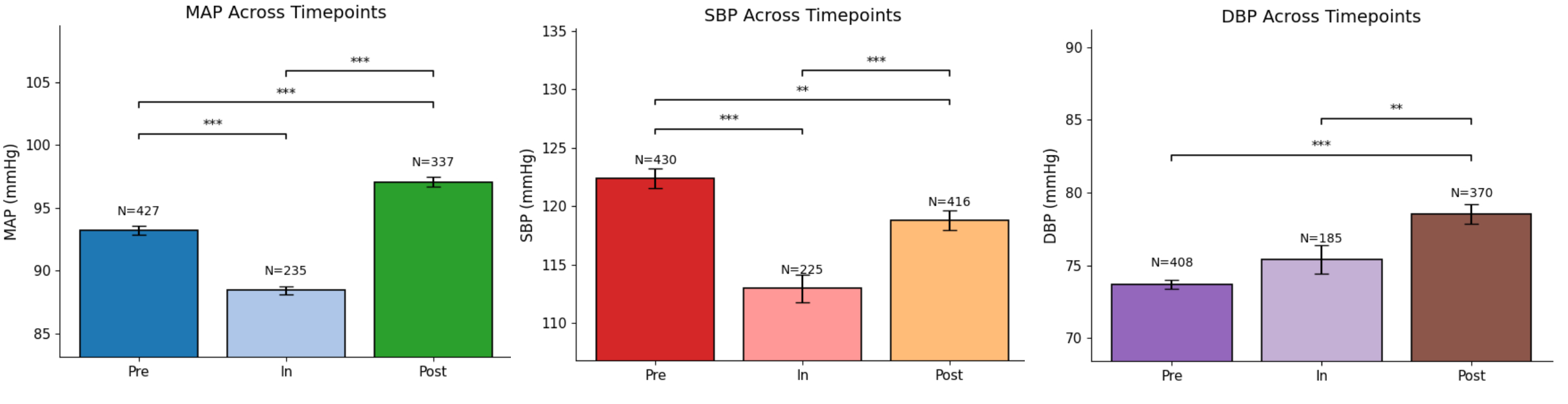
Results: We analyzed 963 subjects (803 males, 131 females, 29 unreported) with a mean age of 42.98 ± 10.65 years and BMI of 24.55 ± 1.49. Significant differences were observed in MAP, SBP, and DBP across flight phases (pre-flight, in-flight, and post-flight) using Welch’s ANOVA (p < 0.05), with all but one pairwise comparison remaining significant via GHPH (p < 0.01). Subgroup analysis revealed significant in-flight SBP (p < 0.01) and DBP (p < 0.01) differences by mission type, as well as post-flight SBP differences (p < 0.01). Notable pairwise findings included ISS vs. Soyuz (p = 0.022), STS vs. Soyuz (p = 0.0046), and ISS vs. HDT (p = 0.023). Sex significantly influenced in-flight SBP (p < 0.001) and post-flight MAP (p = 0.004). BMI was a significant determinant of blood pressure across all flight phases.
Conclusion: The significant differences observed across mission types and subgroups indicate that the analyzed variables (BMI, sex, mission type) may influence blood pressure regulation in the spaceflight environment. Given the importance of blood pressure in regulating central venous pressure, stroke volume, and cerebrovascular flow, future studies should collect blood pressure measurements and health variables that occur during spaceflight so that possible therapeutic avenues to improve astronaut health can be elucidated.
Lee, Ryung
(
University at Buffalo
, Buffalo , New York , United States )
Podger, Blake
(
University at Buffalo
, Buffalo , New York , United States )
Cavalieri, Christian
(
University at Buffalo
, Buffalo , New York , United States )
Lee, Andrew
(
Baylor College of Medicine
, Houston , Texas , United States )
Tarver, Bill
(
NASA
, Houston , Texas , United States )
Author Disclosures:
Ryung Lee:DO NOT have relevant financial relationships
| Blake Podger:DO NOT have relevant financial relationships
| Christian Cavalieri:No Answer
| Andrew Lee:No Answer
| Bill Tarver:No Answer