Logo

American Heart Association

  21
  0


Final ID: Tue075

A Continuum of Atrial Peristalsis Initiates the Bicuspid to Quadricuspid Valve Transition

Abstract Body: Background: Congenital bicuspid valve leaflets create aberrant biomechanical microenvironments that accelerate valvular calcification in humans. How hemodynamic shear forces coordinate the spatial and temporal patterning of valvular cusp development remains poorly understood. The zebrafish atrioventricular (AV) valve transitions from two- to four-cusp at 14 days post-fertilization (dpf), serving as a simplified model for flow-mediated patterning of valvular leaflets.

Hypothesis: Chamber-specific (ventricular vs. atrial) shear stress mediates the formation of distinct pairs of the AV leaflets.

Method: We used transgenic reporter lines, laser microdissection-assisted RNA seq, and Stereo-seq validation to elucidate the mechanism of 2- to 4- cusp transistion. We then test our hypothesis using in vivo light-sheet imaging, computational modeling, and mutants of chamber-specific myosin heavy chains (wea - myh6 and haf - myh7).

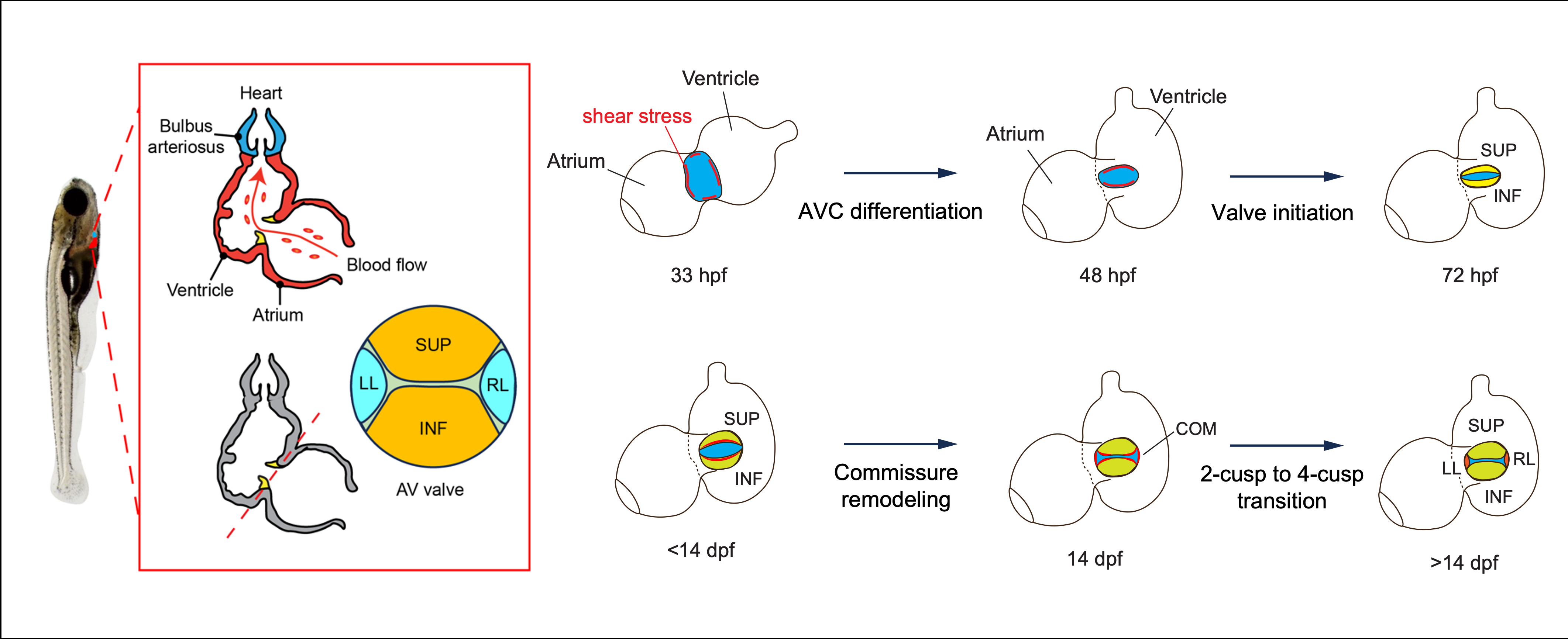
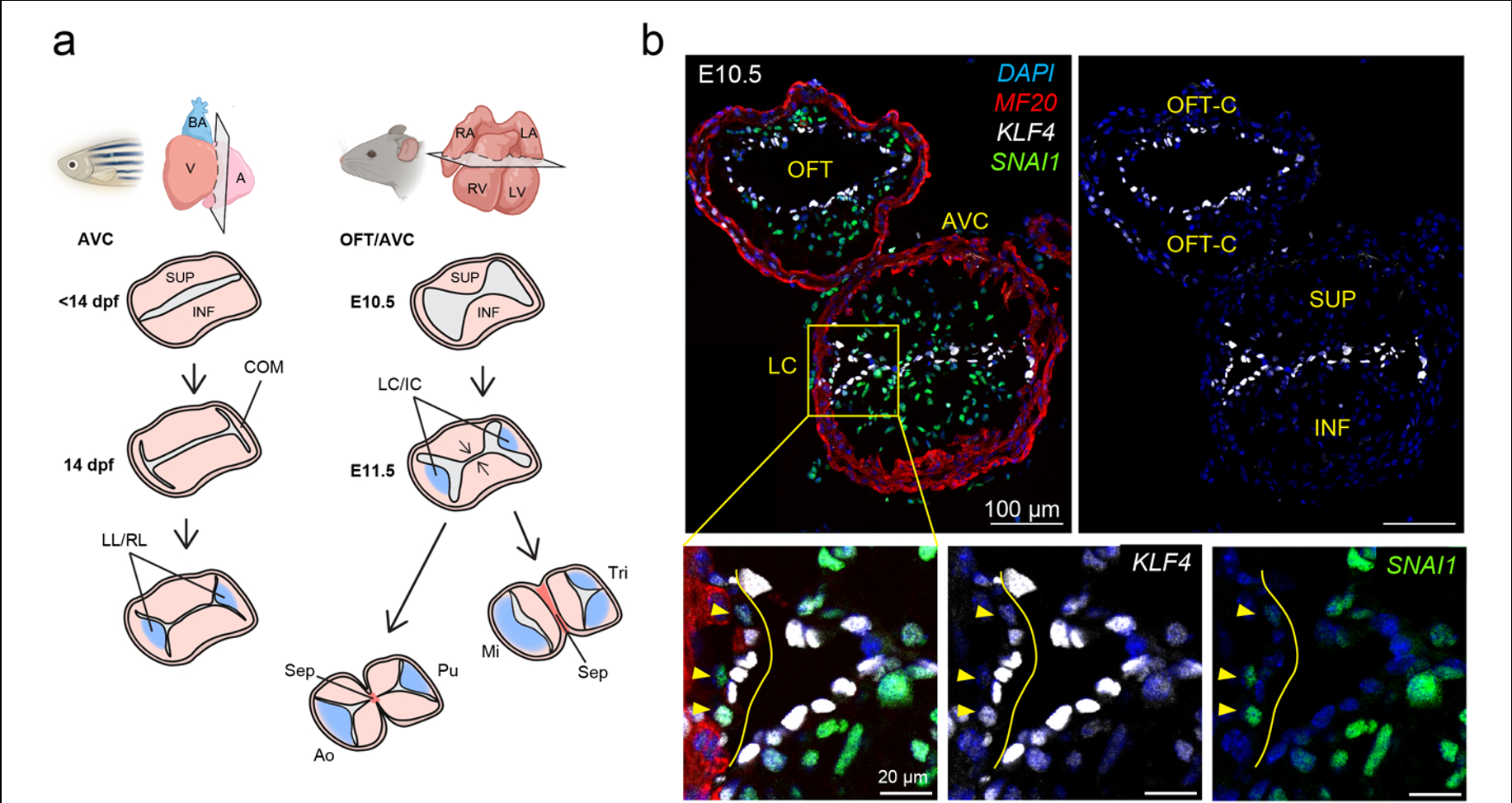
Results: Zebrafish AV valve 2- to 4-cusp transistion occurs through commissural remodeling, differential cell proliferation, and chondrogenic matrix secretion. Orthogonal valvular axes are present at 25 hpf (hours), preceding endocardial cushion formation. AV canal remodeling aligns shear stress with the valvular axes prior to leaflet formation at 48 hpf and 14 dpf (Figure 1). At 28 hpf, the ventricle develops functional syncytium, while the atrial contraction remains peristaltic. Mutants with non-contracting ventricle (haf) and atrium (wea) reveal that atrial peristalsis is necessary for the Klf2a-Snai1b signaling in Notch-negative and ccm1-positive endocardial cells to initiate the 2- to 4-cusp transition. Meanwhile, ventricular contraction is required for initiating the first pair of AV leaflets. As a coronary, we demonstrate that KLF4/SNAI1 expression at the commissure is conserved in the mammalian AV 2- to 4-cushion transition (Figure 2).
  • Wang, Jing  ( UCLA , Los Angeles , California , United States )
  • Brown, Aaron L.  ( Stanford University , Stanford , California , United States )
  • Zhao, Peng  ( UCLA , Los Angeles , California , United States )
  • Zheng, Charlie  ( UCLA , Los Angeles , California , United States )
  • Chen, Jaunian  ( UCLA , Los Angeles , California , United States )
  • Zhou, Bin  ( University of Chicago , Chicago , Illinois , United States )
  • Liu, Jiandong  ( University of North Carolina at Chapel Hill , Chapel Hill , North Carolina , United States )
  • Yokota, Tomohiro  ( UCLA , Los Angeles , California , United States )
  • Kaiser, Alexander  ( Stanford University , Stanford , California , United States )
  • Park, Seul Ki  ( UCLA , Los Angeles , California , United States )
  • Marsden, Alison  ( Stanford University , Stanford , California , United States )
  • Hsiai, Tzung  ( UCLA , Los Angeles , California , United States )
  • Author Disclosures:
Meeting Info:

Basic Cardiovascular Sciences 2026

2026

Boston, Massachusetts

Session Info:

Poster Session 2

Tuesday, 07/14/2026 , 04:30PM - 07:00PM

Poster Session and Reception

More abstracts on this topic:
A Novel Technique in Managing Equipment Entrapment: A Complicated Case of Aortic Valvuloplasty Balloon Rupture and Detachment

Abdelsalam Mahmoud, Ezaldin Shady, Abu-halimah Shadi, Han Richard

A functional survey of postnatal heart maturation with in vivo Perturb-seq in spatial and temporal resolution

Wang Haofei, Liu Jiandong, Dong Yanhan, Shi Huitong, Colon Marazzano, Liu Xingyan, Farber Gregory, Qian Yunzhe, Anthony Nicholas, Qian Li

More abstracts from these authors:
Photoaged Microplastics Impair Endothelial Mechanotransduction to Compromise Vascular Barriers and Systemic Calcium Signaling

Park Seul Ki, Cho Jae Min, Zhu Enbo, Wang Jing, Romero Aaron, Campen Matthew, Zhao Peng, Castillo Eliseo, Hsiai Tzung

Habitual Exercise Modulates Neuro-Immune Interaction to Mitigate Aortic Stiffness

Cho Jae Min, Chapleau Mark, Shen Ying, Hsiai Tzung, Vu Khoa, Zhu Enbo, Park Seul Ki, Li Charlie, Zhao Peng, Yang Lilly, Lu Rong, Xiang Yang

You have to be authorized to contact abstract author. Please, Login
Not Available