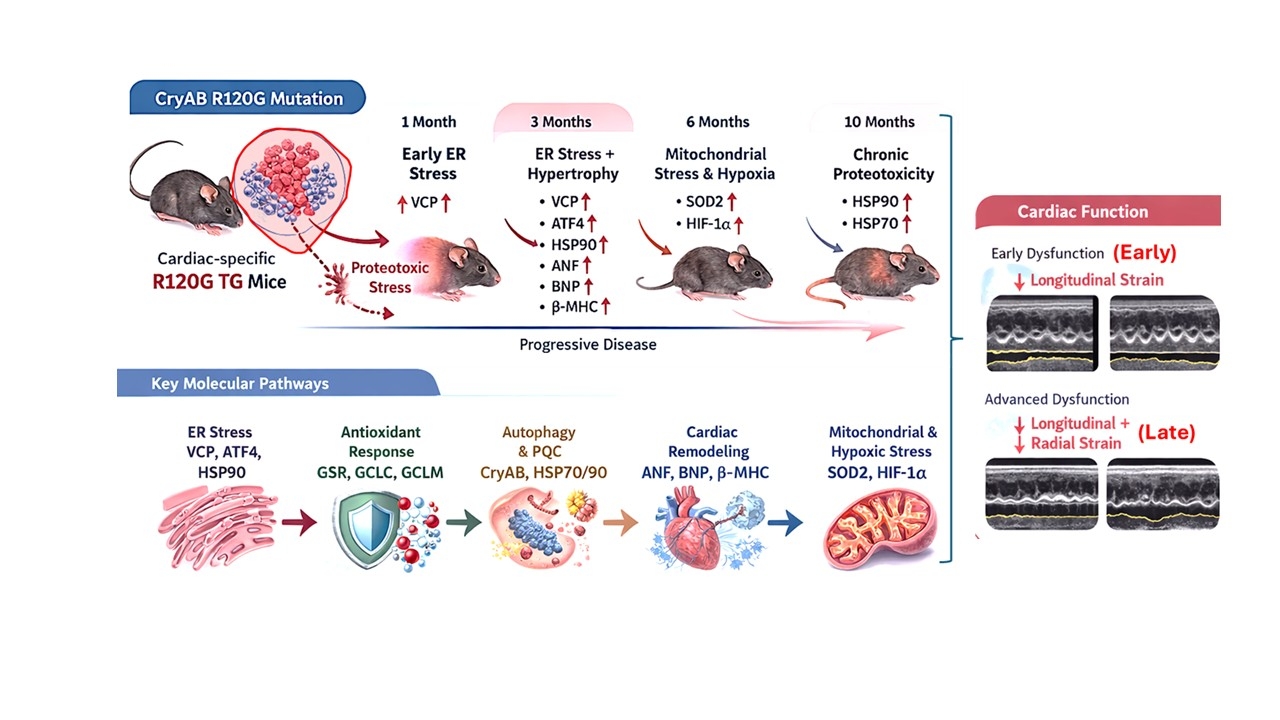
Early ER Stress and Antioxidant Responses Drive Progressive Proteotoxic Cardiomyopathy in CryAB R120G Mice
Abstract Body: Background: The human αB-crystallin (CryAB) R120G mutation, an autosomal dominant variant, induces progressive cardiac remodeling, and cardiomyopathy leading to heart failure. Here, we defined the temporal molecular mechanisms underlying mutant CryAB-mediated cardiac pathology to better understand time-dependent responses that may inform early diagnosis and therapeutic targeting in proteotoxic cardiomyopathies. Methods: Cardiac-specific hR120G CryAB transgenic (TG) mice and non-transgenic (NTG) littermates were used to examine temporal molecular changes. Gene expressions related to antioxidant defense, ER stress, cardiac remodeling, autophagy, and conduction pathways was analyzed by SYBR-based qPCR in cardiac tissues collected at 1, 3, 6, and 10 months. Cardiac function was assessed by longitudinal echocardiography. Results: Compared with NTG controls, TG mice exhibited progressive age-dependent molecular alterations consistent with proteotoxic cardiomyopathy. At 1 month, TG hearts showed early ER stress response marked by VCP. By 3 months, ER stress, redox stress, and hypertrophic remodeling markers (ANF, BNP, β-MHC) were significantly elevated. Increased VCP, ATF4, HSP90, and CryAB indicated activation of protein quality control pathways, while elevated GSR, GCLC, and GCLM reflected enhanced antioxidant responses. At 6 months, these stress responses remained elevated, accompanied by increased SOD2 and HIF-1α, suggesting mitochondrial stress and hypoxia signaling. By 10 months, TG hearts showed increased chaperone expression (HSP90, HSP70), indicating sustained challenge to the PQC machinery and proteotoxic stress. Longitudinal echocardiography demonstrated progressive systolic and diastolic dysfunction in R120G mice. Strain analysis revealed early impairment of longitudinal strain, with radial strain declining later during disease progression, indicating that longitudinal mechanics serve as an early marker of contractile dysfunction in proteotoxic cardiomyopathy. Conclusion: Progressive accumulation of mutant CryAB R120G drives sustained proteotoxic stress and maladaptive cardiac remodeling. Early ER stress activation may represent a potential window for therapeutic intervention.
Bestharapalya Nanjegowda, Sneha
(
UAB
, Tuscaloosa , Alabama , United States )
Mason, Melissa
(
UAB
, Tuscaloosa , Alabama , United States )
Sunny, Sini
(
University of Alabama at Birmingham
, Hoover , Alabama , United States )
Sayed, Aniqa
(
UAB
, Tuscaloosa , Alabama , United States )
Wende, Adam
(
UAB
, Tuscaloosa , Alabama , United States )
Pogwizd, Steven
(
UAB
, Tuscaloosa , Alabama , United States )
Benjamin, Ivor
(
MCW
, Mequon, , Wisconsin , United States )
Namakkal-soorappan, Rajasekaran
(
Univ. Alabama at Birmingham
, Birmingham , Alabama , United States )