Differential changes in Atrial vs. Ventricular excitation-contraction coupling in transgenic mice expressing an autosomal dominant mutation in the human αB-crystallin gene (hR120GCryAB)
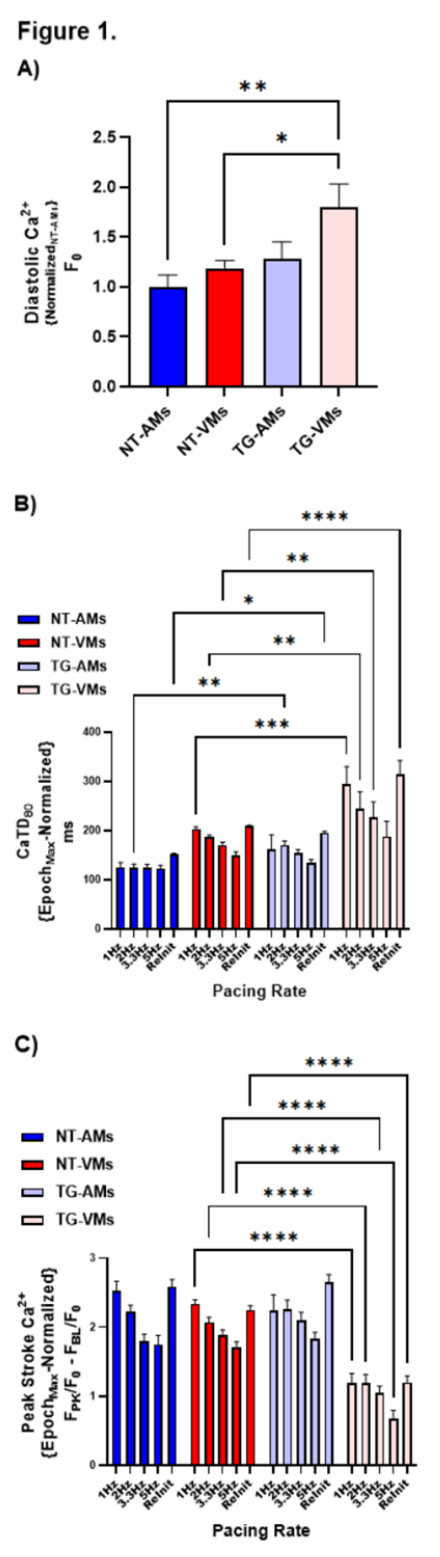
Abstract Body (Do not enter title and authors here): Background: Transgenic mice expressing the human R120G mutant αB-crystallin (hR120GCryAB)—an autosomal dominant mutation—develop progressive cardiomyopathy, with atrial remodeling preceding ventricular pathology. We hypothesize that late-stage disease in hR120GCryAB transgenic mice involves distinct excitation–contraction coupling abnormalities in atrial versus ventricular myocytes, which we characterized in this study. Methods: Action potentials (APs) and calcium transients (CaTs) were measured in ‘working’ (non-nodal) atrial and ventricular myocytes (AMs and VMs) isolated from 8–9-month-old non-transgenic (NT) and hR120GCryAB transgenic (TG) mice. Preliminary Results: Both TG atrial myocytes (TG-AMs) and ventricular myocytes (TG-VMs) showed a trend toward higher diastolic Ca and prolonged action potentials (APs) and calcium transients (CaTs), though this was less pronounced in AMs. Specifically, diastolic Ca (F0) levels were 1.3 ± 0.2 in TG-AMs versus 1.0 ± 0.1 in NT-AMs, and 1.8 ± 0.2 in TG-VMs versus 1.2 ± 0.1 in NT-VMs. AP duration at 90% repolarization (APD90) at 3 Hz pacing was 82 ms in TG-AMs compared to 66 ± 9 ms in NT-AMs, and 77 ± 13 ms in TG-VMs compared to 59 ± 8 ms in NT-VMs. CaT durations at 80% recovery CaTD80 at 3 Hz pacing was 154 ± 7 ms in TG-AMs versus 124 ± 7 ms in NT-AMs, and 227 ± 31 ms in TG-VMs versus 171 ± 6 ms in NT-VMs (Figure 1A,B). Overall, NT and TG atrial myocytes showed minimal differences, while ventricular myocytes exhibited significant abnormalities, including CaTs that were not only slow but also quite diminished (Figure 1C) typical of disease progression – i.e., heart failure. At 3 months, these mice demonstrate sustained CaMKII activation, reduced HCN channel expression, impaired autophagy, and abnormal electrical function. Notably, severe ventricular remodeling, a key feature of this model, typically emerges later, around 7–8 months of age. Conclusions: These findings indicate that in late-stage hR120GCryAB pathology, atrial myocytes better maintain excitation–contraction coupling than ventricular myocytes, suggesting they are less prone to decompensation. While enhanced CaMKII activity may contribute, other factors are likely involved. Ongoing studies are examining key ECC proteins – L-type Ca channels, RyR2, Na-Ca exchanger, SERCA2A, and phospholamban – all CaMKII substrates.
Aistrup, Gary
(
Masonic Medical Research Institute
, Utica , New York , United States )
Goodrow, Robert
(
Masonic Medical Research Institute
, Utica , New York , United States )
Xu, Bing
(
Masonic Medical Research Institute
, Utica , New York , United States )
Sunny, Sini
(
University of Alabama at Birmingham
, Hoover , Alabama , United States )
Benjamin, Ivor
(
MCW
, Mequon, , Wisconsin , United States )
Kontaridis, Maria
(
Masonic Medical Research Institute
, Utica , New York , United States )
Namakkal-soorappan, Rajasekaran
(
Univ. Alabama at Birmingham
, Birmingham , Alabama , United States )
Author Disclosures:
Gary Aistrup:DO NOT have relevant financial relationships
| Robert Goodrow:No Answer
| Bing Xu:No Answer
| Sini Sunny:DO NOT have relevant financial relationships
| Ivor Benjamin:No Answer
| Maria Kontaridis:DO have relevant financial relationships
;
Employee:Masonic Medical Research Institute:Active (exists now)
; Research Funding (PI or named investigator):Lupus and Allied Diseases:Active (exists now)
; Research Funding (PI or named investigator):AHA:Active (exists now)
; Research Funding (PI or named investigator):DOD:Active (exists now)
; Research Funding (PI or named investigator):NIH:Active (exists now)
; Executive Role:Masonic Medical Research Institute:Active (exists now)
; Consultant:BioMarin:Past (completed)
; Researcher:Onconova:Active (exists now)
; Employee:Beth Israel Deaconess Medical Center:Active (exists now)
| Rajasekaran Namakkal-Soorappan:DO NOT have relevant financial relationships