
Logo

American Heart Association

  14
  0


Final ID: Tue157

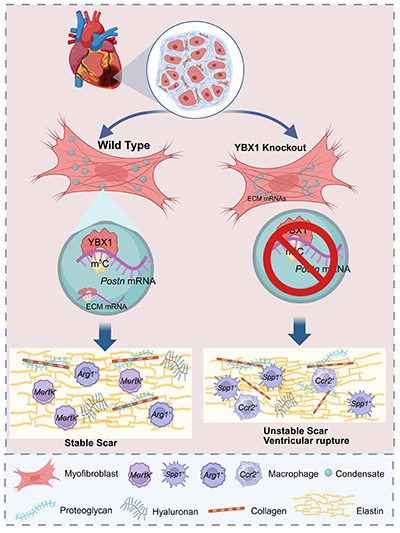
YBX1 Condensates Mediated Post-transcriptional RNA Programs Essential for Early Cardiac Repair

Abstract Body: Background: Fibrosis is a hallmark of cardiac remodeling and a major contributor to heart failure. While excessive extracellular matrix (ECM) accumulation drives chronic fibrosis, early ECM deposition is indispensable for stabilizing the injured heart after myocardial infarction. Despite its clinical importance, the post-transcriptional program that enables myofibroblasts to mount this rapid reparative response remains poorly defined. Understanding these mechanisms is critical for developing strategies that preserve early repair while mitigating long-term fibrosis.
Methods: We generated fibroblast- and myofibroblast-specific Ybx1 knockout mice subjected to myocardial infarction to assess cardiac function and ECM architecture. Single-cell RNA sequencing, eCLIP-seq, and m5C MeRIP-seq were integrated to define the YBX1-dependent RNA program. Imaging approaches, including RNAscope and live-cell assays, were employed to visualize YBX1 condensates and target mRNAs.
Results: YBX1 was strongly induced in injury-responsive myofibroblasts. Conditional deletion of Ybx1 in fibroblasts or myofibroblasts impaired ECM architecture and exacerbated cardiac dysfunction after myocardial infarction. Consistently, single-cell RNA sequencing of hearts with myofibroblast-specific Ybx1 ablation revealed marked suppression of the ECM-related gene expression and enhanced inflammatory response with a shift toward pro-inflammatory macrophage states. Mechanistically, eCLIP-seq and m5C MeRIP-seq demonstrate that YBX1 binds and stabilizes m5C-modified ECM transcripts, notably Postn, through 3’ UTR interactions. These RNA-binding events converge within the phase-separated YBX1 condensates in activated myofibroblasts, which compartmentalize target RNAs to enable spatiotemporal control of ECM production during the acute reparative phase.
Conclusions: Our study identifies YBX1 condensates as a critical regulator of RNA stability and ECM production during early cardiac repair. This work establishes a mechanistic link between phase separation and tissue remodeling, providing a conceptual framework for therapeutic strategies to modulate RNA fate in fibrotic disease.
  • Dong, Yanhan  ( UNC at Chaple Hill , Chapel Hill , North Carolina , United States )
  • Wang, Haofei  ( UNC , Chapel Hill , North Carolina , United States )
  • Yapundich, Nicholas  ( UNC-Chapel Hill , Hickory , North Carolina , United States )
  • Song, Yiran  ( UNC at Chapel Hill , Chapel Hill , North Carolina , United States )
  • Chawla, Divya  ( UNC at Chaple Hill , Chapel Hill , North Carolina , United States )
  • Wang, Qiaozi  ( Fudan University , Shanghai , China )
  • Qian, Li  ( UNIVERSITY NORTH CAROLINA , Chapel Hill , North Carolina , United States )
  • Liu, Jiandong  ( UNC at Chaple Hill , Chapel Hill , North Carolina , United States )
  • Author Disclosures:
Meeting Info:

Basic Cardiovascular Sciences 2026

2026

Boston, Massachusetts

Session Info:

Poster Session 2

Tuesday, 07/14/2026 , 04:30PM - 07:00PM

Poster Session and Reception

More abstracts on this topic:
Δ9-THC Drives Fibrotic Activation in Vascular Cells and Coronary Dysfunction In Vivo

Jimenez-tellez Nerea, Vacante Francesca, Tsarouchas Themistoklis, Juguilon Cody, Casas-ortiz Alberto, Chandy Mark, Wei Tzu-tang, Wu Joseph

A 50% or Greater Reduction in LDL-Cholesterol Is Associated with Improved Long-Term Outcomes and Lower Health Care Utilization After Myocardial Infarction - a SWEDEHEART study

Reitan Christian, Watanabe Alexandre, Bash Lori, Galvain Thibaut, Arnet Urs, Jernberg Tomas

More abstracts from these authors:
You have to be authorized to contact abstract author. Please, Login
Not Available