
Logo

American Heart Association

  77
  0


Final ID: Or203

Charting Postnatal Heart Development Using In Vivo Single-Cell Functional Genomics

Abstract Body: Background:
The transition at birth, marked by increased circulatory demands and rapid growth, necessitates extensive remodeling of the heart’s structure, function, and metabolism. Despite substantial advancements, the regulatory mechanisms driving these changes remain poorly understood because the study of postnatal cardiac development has predominantly relied on single-cell RNA-seq that cannot fully capture the intricate cell neighborhood regulating the postnatal maturation.
Method:
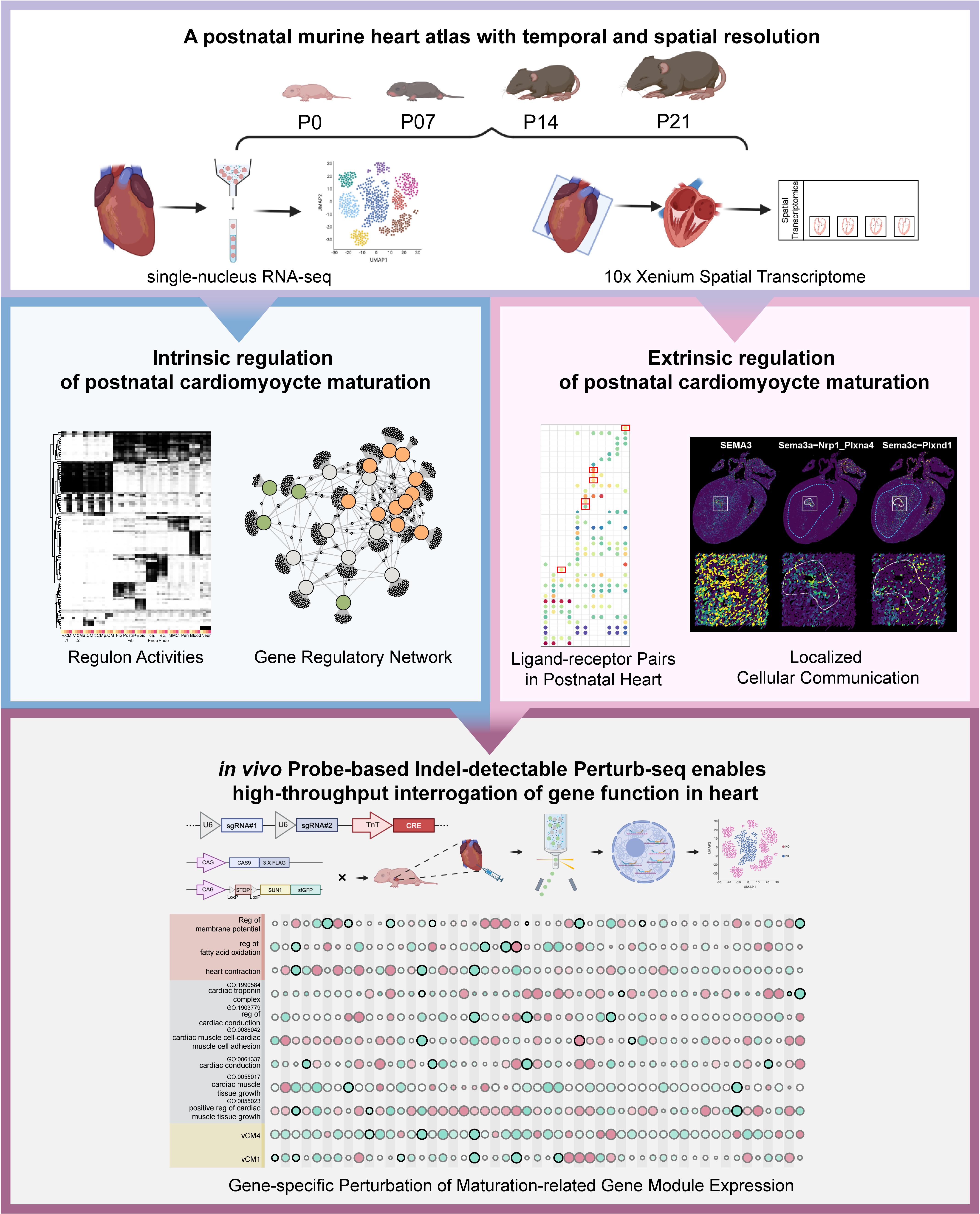
To test this hypothesis, we performed parallel imaging-based single-cell spatial transcriptomics and single-nucleus RNA sequencing on mouse hearts at postnatal Day 0, 7, 14, and 21 (n = 2 per time point). This strategy enabled us to capture the shift from hyperplastic growth to hypertrophic maturation. Moreover, we developed an in vivo Probe-based Indel-detectable Perturb-seq (PIP-seq) platform that utilizes probe hybridization to simultaneously detect sgRNA and transcriptomic profiles from fixed single nuclei. This integrated approach allowed us to assess perturbation states alongside their transcriptional consequences directly within the native tissue environment.
Results:
Here, we constructed a temporal and spatial atlas of postnatal hearts by integrating temporal single-nucleus transcriptomic profiling with image-based spatial transcriptomics. The integrative spatial analyses of postnatal heart atlas revealed the coordinated effort of the cardiac cells in shaping the postnatal heart, including how capillary endothelial cells interact with cardiomyocyte through Ptprm to drive the cell cycle exit through Meis1 in the postnatal heart.
Our analysis of the localized intrinsic and extrinsic regulatory mechanisms underlying postnatal cardiomyocyte maturation identified 53 candidate regulators of cardiomyocyte maturation, with 21 candidates validated by PIP-seq for their significant impact on maturation-specific transcriptional programs. Furthermore, targeted knockout of two candidates, Rreb1 and Ncl, led to reduced cardiomyocyte size and impaired heart function, directly linking transcriptional alterations to phenotypic outcomes.
Conclusion:
In conclusion, our study demonstrates that cell–cell communication and localized regulatory networks are pivotal in postnatal cardiac maturation. The novel PIP-seq platform extends our ability to comprehensively explore gene function and regulatory networks in vivo, offering new insights into the mechanisms governing heart maturation.
  • Wang, Haofei  ( UNC , Chapel Hill , North Carolina , United States )
  • Dong, Yanhan  ( UNC at Chaple Hill , Chapel Hill , North Carolina , United States )
  • Song, Yiran  ( The University of North Carolina at Chapel Hill , Chapel Hill , North Carolina , United States )
  • Yapundich, Nicholas  ( UNC-Chapel Hill , Hickory , North Carolina , United States )
  • Qian, Li  ( UNIVERSITY NORTH CAROLINA , Chapel Hill , North Carolina , United States )
  • Liu, Jiandong  ( UNC CHAPEL HILL , Chapel Hill , North Carolina , United States )
  • Author Disclosures:
    Haofei Wang: DO NOT have relevant financial relationships | Yanhan Dong: DO NOT have relevant financial relationships | Yiran Song: DO NOT have relevant financial relationships | Nicholas Yapundich: No Answer | Li Qian: DO NOT have relevant financial relationships | Jiandong Liu: DO NOT have relevant financial relationships
Meeting Info:

Basic Cardiovascular Sciences 2025

2025

Baltimore, Maryland

Session Info:

Cardiovascular Development, Gene Regulation and Congenital Heart Disease

Thursday, 07/24/2025 , 01:30PM - 02:45PM

General Session

More abstracts on this topic:
Clonal Fate Mapping of Sinoatrial Node Progenitors

Kethana Khushi, Black Brian, Galang Giselle, Chouhan Gagandeep, Mandla Ravi, Sinha Tanvi, Devine Walter, Mohan Rajiv, Soe Amanda, Vedantham Vasanth

Engineering and Development of Optimal CRISPR Based Genome Modification Molecules for Safe and Effective LDL-C Lowering

Duncan-lewis Christopher, Colin Isabel, Corbo Lana, Deiter Fred, Demaree Benjamin, Denny Sarah, Fernandes Jason, Gardner Matthew, Hadaczek Piotr, Hochman Myles, Hsu Bernadette, Harms Matthew, Karanth Santhosh, Karmarkar Maitreyee, Keller Steven, Kozy Heather, Krupa Oleh, Leeman Dena, Li Yuexuan, Mirotsou Maria, Mok Amanda, Mrak Anna, Adil Maroof, Narsineni Lokesh, Ripley-phipps Sterling, Reimer Kirsten, Szulwach Keith, Shroff Shilpa, Tran Vanessa, Tung Kuei-ling, Wright Addison, Oakes Benjamin, Khakoo Aarif, Alcantra-lee Raniel, Bardai Farah, Oresic Bender Kristina, Bale Shyam Sundhar, Charles Emeric, Chen Kai-yuan

More abstracts from these authors:
A functional survey of postnatal heart maturation with in vivo Perturb-seq in spatial and temporal resolution

Wang Haofei, Liu Jiandong, Dong Yanhan, Shi Huitong, Colon Marazzano, Liu Xingyan, Farber Gregory, Qian Yunzhe, Anthony Nicholas, Qian Li

Unraveling the Role of the Senescence-Associated Secretory Phenotype in Cardiac Aging Through Meta-Analysis and Experimental Validation

Song Yiran, Wang Haofei, Liu Jiandong, Qian Li

You have to be authorized to contact abstract author. Please, Login
Not Available